
Greece
SeaHake mod 4, PLUTO GIGAS and the frogmen’s vehicles: the Hellenic Navy’s underwater war
The SeaHake mod 4 heavy torpedo, the PLUTO GIGAS mine-hunting ROV and the divers’ propulsion vehicles passed in the October 28 parade. Attack, defence and special operations beneath the Aegean.

The weapons of underwater warfare are rarely seen: they work below the surface, where a submarine fires a torpedo from tens of kilometres away, a robot searches for mines at 600 metres and a frogman approaches the target without leaving a trace. At the military parade of October 28, 2026 in Thessaloniki the Navy brought them into daylight in turn: the black SeaHake mod 4 heavy torpedo with the yellow head, the orange remotely operated mine-hunting vehicle PLUTO GIGAS and, on the beds of two pickup trucks, the diver propulsion vehicles of the Underwater Demolition Teams. Three very different assets that together describe the underwater war of the Aegean: attack, defence and special operations.
SeaHake mod 4: the torpedo that was half a century late
Germany’s TKMS/Atlas Elektronik SeaHake mod 4 is a heavy torpedo of 533 millimetres, for use against both surface ships and submarines. Based on what NEMESIS HD has presented, it is about 6.2 metres long, weighs about 1,500 kilograms, exceeds 50 knots, and its range is over 50 kilometres, depending on the mission profile. After launch it remains tethered to the submarine by an optical fibre: the operator sees what the torpedo’s sonar “hears” and can correct its course, turn it onto another target or cancel the attack.
TKMS’s official description explains where its value lies. Propulsion is electric, with a modular battery system and a very low-noise motor, while glass-fibre-reinforced plastic propellers reduce noise further. The digital sonar in the head has a conformal array that covers a wide angle, separates multiple targets, classifies them and recognises decoys and jamming. Put simply, the target finds it hard to hear it coming and is hard-pressed to fool it with countermeasures.
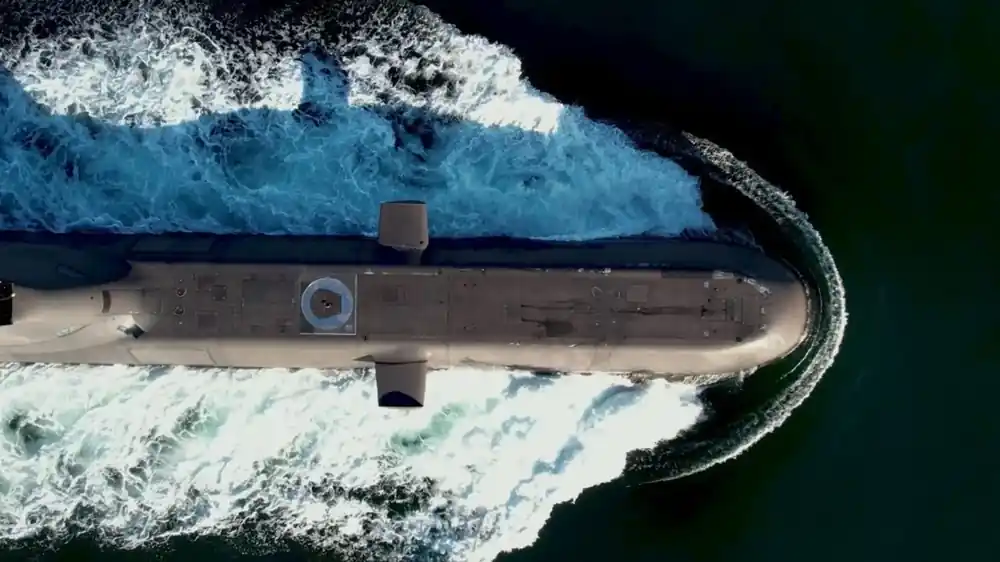
For the Greek submarines this torpedo is not just another weapon. The four Type 214 boats of the “Papanikolis” class, with air-independent propulsion and a very low acoustic signature, operated for years with torpedoes designed for the Type 209 class, in service for almost five decades. The programme covers 44 SeaHake mod 4 torpedoes and passed through Parliament in 2022, but deliveries were delayed. On December 11, 2025, Nikos Dendias boarded the “Pipinos” and watched a SeaHake mod 4 fired at a surface target in the “PERISCOPE” exercise, a sign that the torpedoes are now in numbers that allow operational use. Its presence at the parade, ten months later, confirms it publicly. The same torpedo is the logical weapon of any future Greek submarine, whichever is chosen, from the German designs to the Korean KSS-III.
PLUTO GIGAS: the robot that goes where the diver cannot
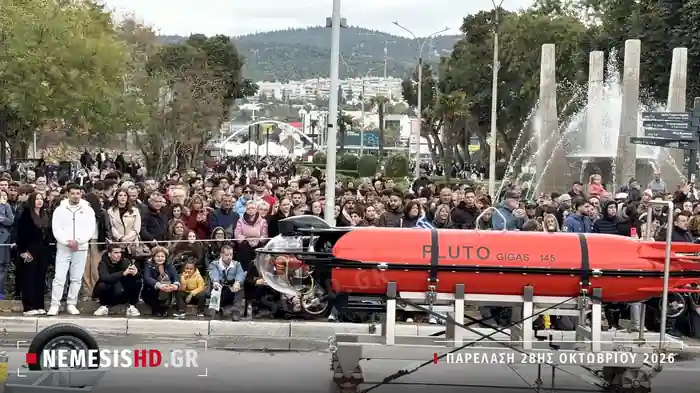
Italy’s Gaymarine PLUTO GIGAS is a remotely operated underwater vehicle (ROV) for the identification and destruction of mines, the equipment with which a minehunter “touches” a suspect contact without sending a person. According to the manufacturer’s data, it weighs 600 kilograms, is 3.27 metres long, reaches a depth of 600 metres at 7.5 knots, carries 100 kilograms of payload and works in currents of up to 5 knots and in zero visibility. Eight thrusters hold it steady in the current, the imaging sonar sees from half a metre to 400 metres, and its thin fibre-optic cable lets it move away from the ship. It can also carry out pre-programmed autonomous missions, with the operator taking control whenever necessary.
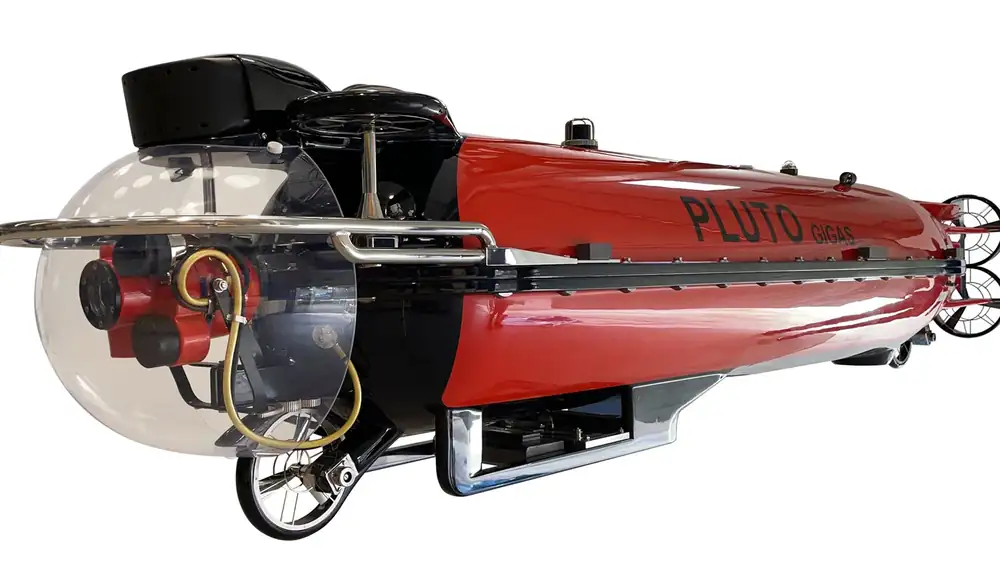
The GIGAS was also presented at the inauguration of the “Pyrpolitis” at Skaramangas in October 2026, next to the smaller PLUTO PLUS (320 kilograms, 300 metres) and the PLUTINO. Gaymarine is a supplier to the Italian Navy, and the link is no accident: Nikos Dendias has asked Italy to hand over two used minehunters. Mine warfare matters more and more to the Greek fleet: a few mines in an Aegean strait or at a harbour entrance can immobilise the fleet and coastal shipping, and undersea cables and pipelines are now a target. Every robot that identifies a mine is one less diver risking their life.
The frogmen’s vehicles
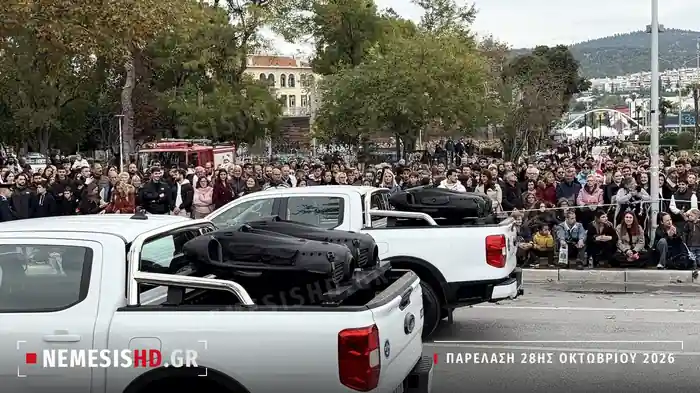
The black vehicles on the beds of the two pickup trucks are diver propulsion vehicles, used by the frogmen of the Underwater Demolition Teams. The diver holds on to the vehicle and its electric propeller pulls him underwater at much higher speed and over a much longer distance than he could swim, reaching the target less tired and with more weapons or equipment. It is the simplest link in a chain that begins at long range: the semi-submersible craft VICTA being acquired by the special forces brings the team close to the coast, and the propulsion vehicles cover the last stretch below the surface.
The Thessaloniki parade showed, if only for a few minutes, a Navy that does not think only in frigates. The SeaHake finally gives the submarines the weapon that suits them, the PLUTO GIGAS clears the way for the fleet and the Underwater Demolition Teams’ vehicles carry the frogmen where the adversary does not expect them. They are assets built not to be seen, and that is precisely the point.