Military & Defense
U.S. Coast Guard cutter Munro ends 112-day Arctic patrol after tracking three Chinese research ships
The national security cutter returned to Alameda on October 9 after 23,000 nautical miles, a watch on three Chinese-flagged research ships and drills with the Royal Canadian Navy.

The U.S. Coast Guard cutter Munro (WMSL 755) is back at its homeport in Alameda, California, after a 112-day patrol of the Bering Sea and the Arctic Ocean in which the crew tracked three Chinese-flagged research vessels and trained with the Royal Canadian Navy. The cutter returned to Coast Guard Island on October 9, and the service published its account of the deployment on October 21.
According to the U.S. Coast Guard Pacific Area account of the patrol, Munro sailed more than 23,000 nautical miles under the service’s Arctic District. Its stated tasks were to control and defend the northernmost maritime approaches of the United States, enforce fisheries regulations and work with joint and international partners in a region the service describes as increasingly contested.
Chinese research ships and Canadian training
During the deployment the cutter ran what the Coast Guard calls Operation Frontier Sentinel, monitoring three Chinese-flagged research vessels operating in and around the U.S. Arctic maritime domain. The service says Munro’s crew checked that the foreign ships complied with international maritime law while asserting U.S. sovereignty. The account does not name the vessels or say what research they were carrying out.
Munro also held combined exercises with the Royal Canadian Navy, which the Coast Guard says improved bilateral law-enforcement cooperation, joint maneuvering and shared awareness of the polar waters. Capt. Adam J. Disque, the cutter’s commanding officer, said the crew was proud to sustain a U.S. presence in the region and to strengthen its partnership with Canadian counterparts.
Operation Tundra Merlin
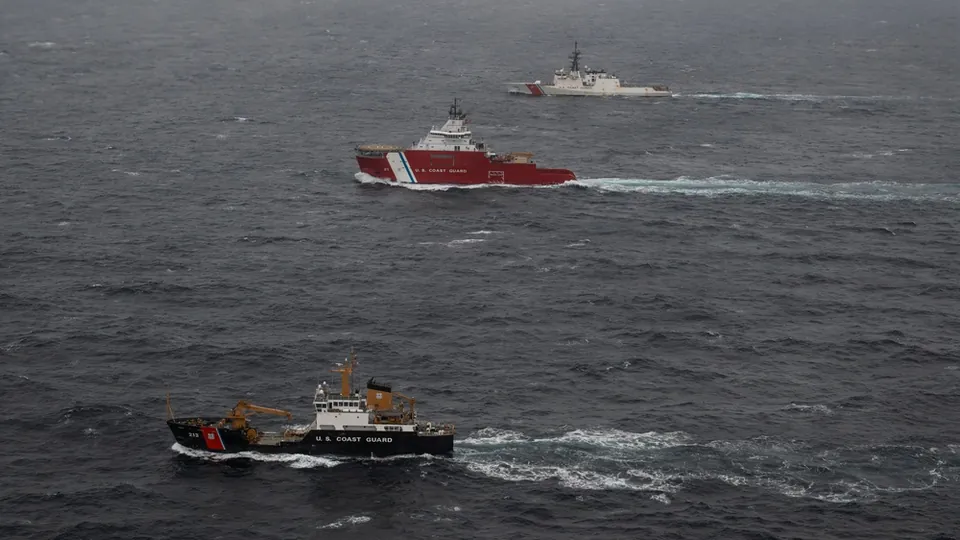
The cutter also took part in Operation Tundra Merlin, which the Coast Guard says brought it together with U.S. Department of War and Canadian Armed Forces units to test a multi-domain homeland defence architecture, integrate command-and-control networks and validate joint response readiness in northern maritime corridors. On July 21, Munro sailed in formation in the high Arctic with the icebreaker Storis (WAGB 21) and the buoy tender Fir (WLB 213), a grouping the service said showed three different cutter classes working together.
Alongside the security work, Munro’s boarding teams inspected commercial fishing vessels in the Bering Sea. The Coast Guard describes the cutter as the front-line guardian of Alaska’s commercial fishery, which it values at $6 billion.
Background
Commissioned in 2017, Munro is one of four 418-foot Legend-class national security cutters homeported in Alameda. It is named for Signalman 1st Class Douglas A. Munro, the only Coast Guardsman to receive the Medal of Honor, for rescuing nearly 500 Marines under fire at Point Cruz, Guadalcanal, on September 27, 1942.
The Arctic has drawn growing attention from allied governments this autumn. Geopolitiki has reported on the EU unveils new Arctic strategy: cable hub, icebreaker pooling and satellite upgrades, and on how the US Army activates 11th Airborne Division Sustainment Brigade (Arctic) in Alaska.