Drones
Part of the Crimean Bridge collapses: Zelensky calls it an “unprecedented operation” with Neptune and Flamingo missiles
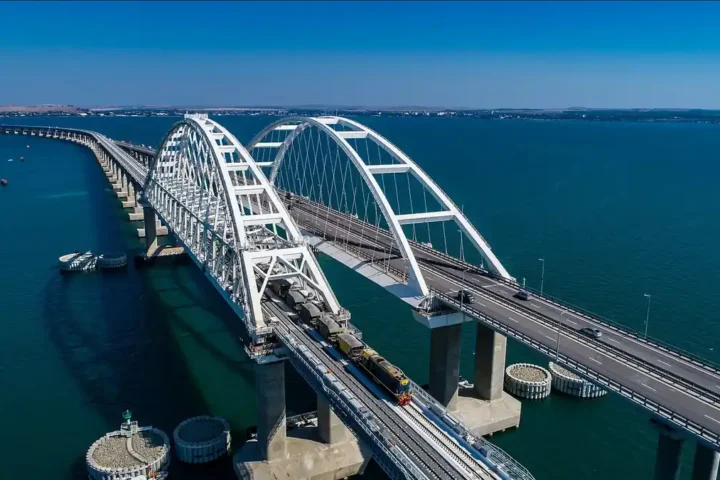
A section of the Crimean Bridge collapsed after the Ukrainian strike overnight on November 17. Kyiv claimed responsibility, with Zelensky describing a seven-stage operation by the SBU and the General Staff.

A section of the Crimean Bridge, across the Kerch Strait, collapsed into the sea after the Ukrainian strike overnight from Monday, November 16 to Tuesday, November 17, and Kyiv officially took responsibility. Ukrainian President Volodymyr Zelensky spoke of an “unprecedented operation in response to the Russian strikes on our infrastructure”, in a Telegram post on Tuesday morning. Ukraine’s Security Service (SBU) announced that one of the metal arches and the road section beneath it were completely destroyed, and that the railway span of the bridge was also damaged. The Russian side had initially spoken of a new attack and a suspension of traffic (our report).
A seven-stage operation, Zelensky says
Zelensky described the strike as the seventh stage of an operation that lasted several weeks and was designed by the SBU together with the General Staff. Ukrainian forces, he said, gradually destroyed air defence systems, radars, electronic warfare assets and other targets along the route to the final objective. In the final stage “Palianytsia” drones hit the road section, while R-360 Neptune missiles and Ruta and FP-5 drones hit the rail section. With the FP-5 Flamingo cruise missile, he added, a guided strike was carried out and the communications link worked flawlessly “until the last seconds”. The Ukrainian president said Moscow had rejected every de-escalation proposal and strikes Ukrainian infrastructure daily, including bridges. “The war will always return to where it started,” he wrote.
The SBU says the operation lasted about a month and had seven stages, the first being the systematic neutralisation of Russian air defences. The agency’s “Alpha” special forces hit the road section with Palianytsia missile-drones and it fell into the water, while other branches of Ukraine’s armed forces took part in the final stage. It is, according to the SBU, its fourth strike on the bridge, after the truck bomb in October 2022, the Sea Baby naval drones in July 2023 and the underwater explosion at the piers in June 2025. The General Staff wrote that the arch and the span of the road section collapsed and that “no vehicle” can cross. The rail line still stands, but with damage to the arch. The General Staff recalled that in the autumn the bridges at Chonhar and Henichesk were brought down.
Ukraine’s Defence Minister Yevhen Khmara called the strike a response to Russian strikes on Ukrainian bridges (“we answered in kind”) and stressed that it was carried out “exclusively with Ukrainian weapons”. His ministry said the central arch and spans of the road section collapsed, while the rail section sustained “critical damage”, destroying the short supply route from Russian territory.
A terrorism case in Russia, a Kremlin pledge to rebuild
In Russia, the Investigative Committee opened a criminal case for a terrorist act (Article 205 of the Russian Criminal Code), saying that the drone attacks on November 16 and 17 damaged the structure. Kremlin spokesman Dmitry Peskov said Deputy Prime Minister Marat Khusnullin briefed Vladimir Putin after a government commission meeting and that a restoration plan with a timetable will be drawn up. “There is no doubt the bridge will be restored and will be even better than before,” he said. Sergei Aksyonov, the Moscow-installed head of Crimea, announced that the rail link between Crimea and Taman had been restored and that passengers without vehicles can use the ferry across the Kerch Strait.
The strike comes a day after the first attack on the bridge since June 2025, in the early hours of Monday, November 16 (our report). The same night Russian ballistic missiles hit the Northern and Southern bridges in Kyiv over the Dnipro (our report).