
Greece
Exclusive: LORA – talks advance on co-production of the ballistic missile in Greece, with a 500+ km range in the background
Talks on Israel Aerospace Industries’ LORA ballistic missile are advancing, and Greek interest is very high. The focus of recent contacts is now on co-producing it in Greece, according to information obtained by NEMESIS HD.

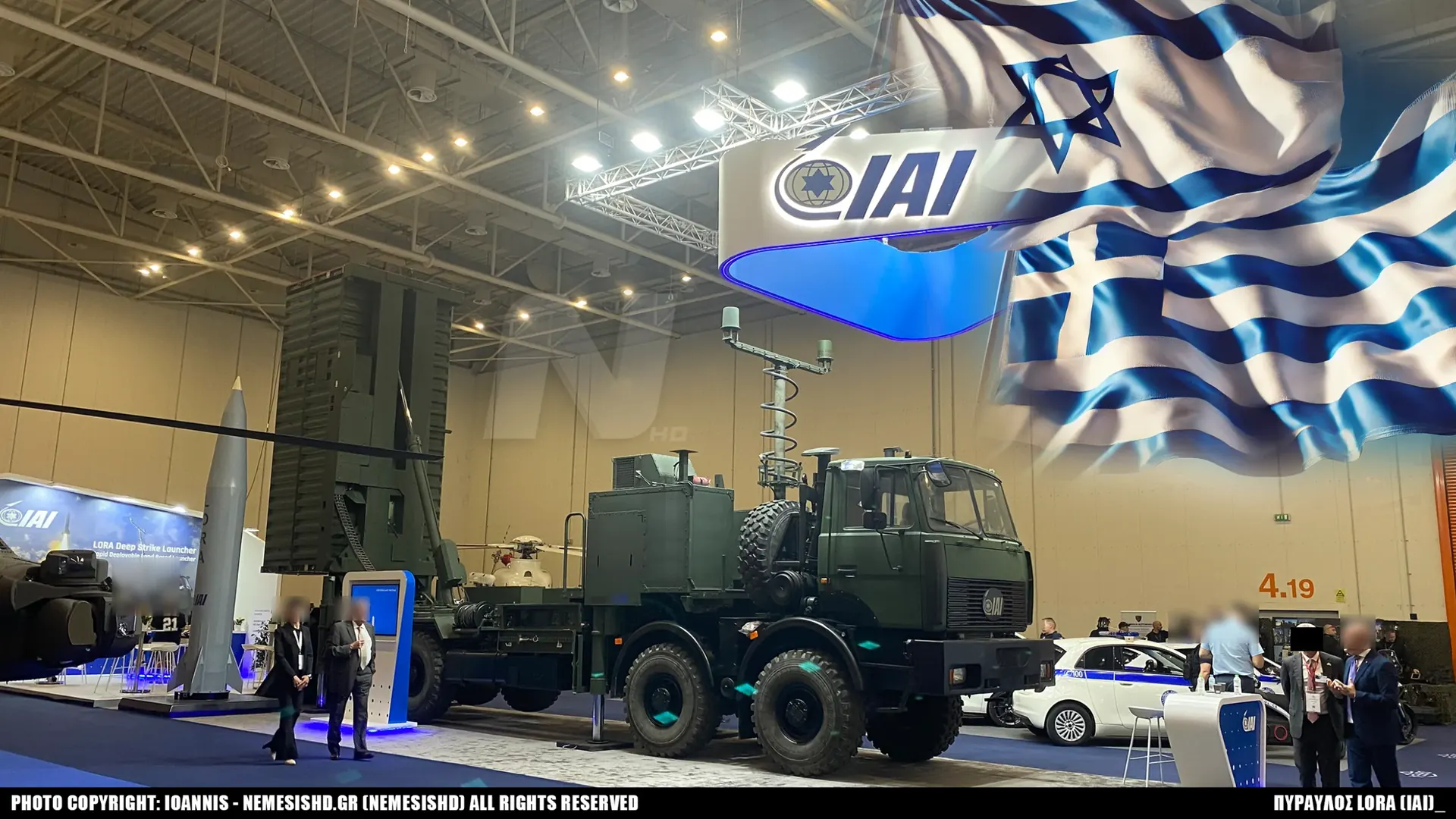
Talks on the Israeli ballistic missile LORA of Israel Aerospace Industries (IAI) are advancing, and the interest of the Greek side in the system is very high. According to exclusive information obtained by NEMESIS HD, the weight of recent contacts is now shifting to its co-production in Greece, a goal that sits at the centre of planning by the Ministry of National Defence and at the general-staff level.
The development comes at a moment when the picture of the missile itself is changing. After the German Navy’s test of the Naval LORA, the latest official references put its potential range at 500 kilometres and above, while for the existing version IAI had told NEMESIS HD that it reached up to 430.
The key points
- Talks on LORA are advancing and Greek interest is very high.
- The focus of the contacts is now on co-producing it in Greece, a central goal for the Ministry of National Defence and the general staffs.
- The new range exceeds 500 kilometres, up from 430 for the existing version.
- The missile is kept in a hermetically sealed canister, with no preventive maintenance, and can be launched from land and naval platforms.
- The conclusion of negotiations and the final price are awaited before a purchase can go ahead.
Where the issue started
NEMESIS HD has followed the subject closely for years. In its report on the approval of the PULS rocket launchers in the Greek Parliament it pointed out that LORA lay in the background. A few days later it presented a technical analysis of the missile, based on talks with IAI officials who revealed some of its hidden advantages.
In January, with the Israeli defence minister in Athens, LORA was a pivotal point of the discussions. Israel appeared willing to discuss everything, even co-production, provided Greece was interested in a sufficient number of missiles, and all the systems proposed included at least 25% domestic participation. In September it was added that, according to well-informed sources, LORA would most likely be the next choice for strengthening the deep-strike capability of the Army and in particular the Artillery.
The new range: from 430 to 500+ kilometres
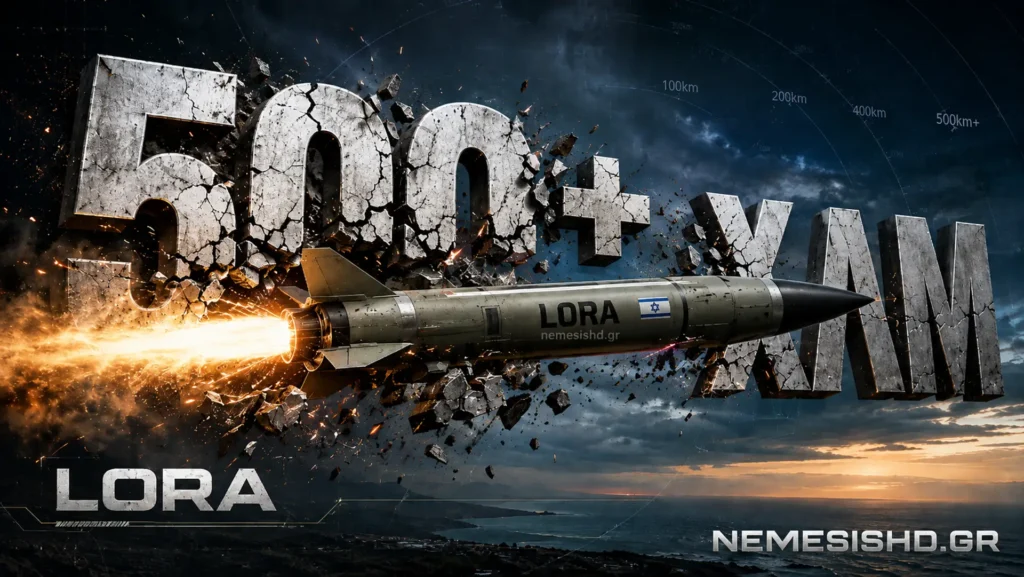
IAI announced on September 2, 2026 that the German Navy had successfully completed a double operational firing test of the Naval LORA, within the Operational Experimentation (OPEX) programme. The system was installed on an operational German warship, with the necessary launcher and command-and-control unit. In both firings the missiles followed their programmed trajectory and hit their targets with the required accuracy, according to the company’s announcement.
The chief of the German Navy, Vice Admiral Jan Christian Kaack, spoke of a historic moment for the fleet and noted that the system’s potential range exceeds anything the German Navy has had until now. Germany has no operational ballistic missile of a similar class, and its long-range strike capability rests mainly on the air-launched Taurus.
The difference between 430 and 500+ kilometres is a serious sign that either a newer, longer-range configuration has been developed or that the figures given earlier were deliberately conservative. For Greece the new reach has practical significance: it would give the Artillery a class of power that does not exist today as an organic land capability.
LORA’s technical characteristics
LORA (Long Range Artillery) is a solid-fuel ballistic missile designed for precision strikes at operational and strategic depth. Its main characteristics are:
- length: about 5.2 metres,
- diameter: 624 millimetres,
- launch weight: about 1,600 kilograms,
- range: 90 to 500+ kilometres,
- accuracy: about 10 metres CEP,
- guidance: INS/GNSS with a TV terminal seeker (according to an unofficial briefing),
- engine: solid propellant,
- angle of attack: 60 to 90 degrees,
- warhead: up to about 600 kilograms, depending on the configuration,
- land configuration: four missiles in sealed canisters on a vehicle of about 16 tonnes.
The missile is designed for targets such as command centres, air bases, air-defence batteries, missile systems, infrastructure facilities and fortified positions. Its high speed and shaped ballistic trajectory significantly reduce the reaction time of the opponent’s air defence.

The sealed canister and the “wooden round”
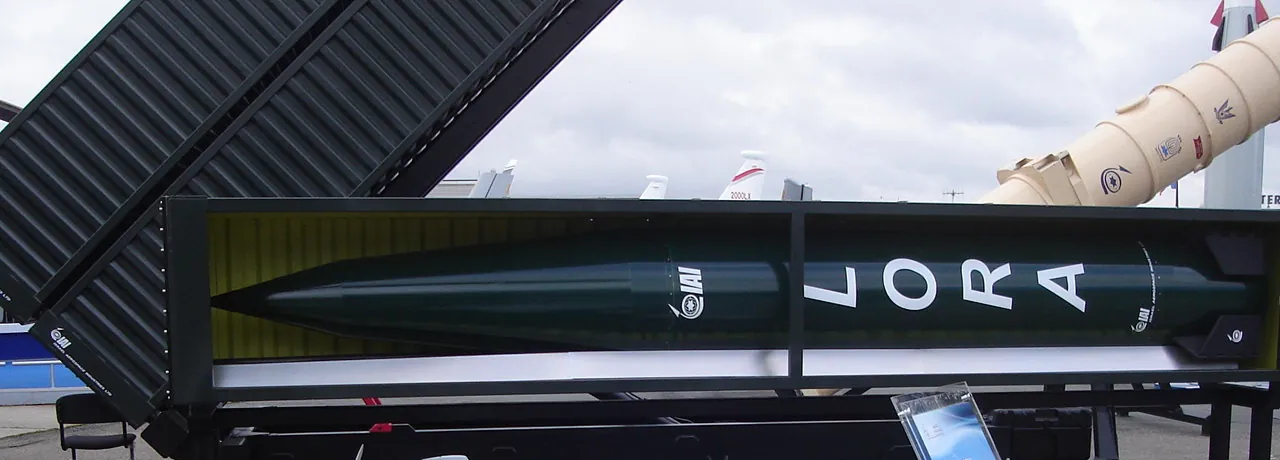
What impressed NEMESIS HD most was an IAI representative’s explanation of the hermetically sealed transport-and-launch canisters (TPK) that house each missile. On LORA the TPK works as a self-contained micro-environment of stabilised temperature, pressure and humidity, limiting chemical and mechanical stress on the missile. The canister is kept under constant pressure with high-purity dry nitrogen, which displaces oxygen, water vapour and microparticles that could cause oxidation, hydrolytic corrosion or micro-delamination in the electronics and control circuits.
Removing water vapour, even at trace levels, is critical for solid propellants: modern composite propellants need low humidity so that micro-cracks do not form which, during burning, could cause a sudden pressure spike and catastrophic failure. Based on the discussion, the units can remain operational for periods exceeding the official seven-year limit.
In practice the missile is stored like a cartridge, a true “wooden round”: it needs no inspection, opening or resealing, and no maintenance is foreseen for several years. This allows a country to hold stocks over time without the high life-cycle cost of other systems, which require periodic inspection, disassembly and replacement of components.
Electric actuators, no hydraulics
A point often underestimated is that LORA has no hydraulic circuits. The servomechanisms, the control-surface actuators and the control systems all work electrically. There are therefore no leaks, pumps or thermal fatigue of hydraulic fluid, and the response of the control surfaces stays stable over time. Combined with advanced processors, the missile follows its programmed shaped trajectory accurately even after a decade of storage.
Guidance and the terminal phase
The combination of INS/GNSS guidance with a TV seeker allows LORA to move from a classic ballistic profile to a semi-guided attack profile. The flight computer recognises the aiming point and makes small course corrections. The terminal phase thus resembles a precision glide weapon with a vertical attack more than a classic short-range ballistic missile.
For fortified positions, bridges, command centres and underground facilities, this means the missile can hit the critical weak point, reducing the number of rounds needed for the same effect. The shaped trajectory, with the ability to adjust the apogee or the terminal dive profile, makes the interception point harder to predict, especially when launches come from several directions and altitudes.
A LORA battalion: 48 missiles in two minutes
According to the company, a battalion-level LORA unit has 48 missiles ready to fire and can carry out a mass launch (salvo) in under two minutes. Resupply takes 60 minutes, coverage is 360°, and the transition time is 10 minutes to fire and 3 minutes to depart. A salvo of this kind could saturate even modern air-defence systems with AESA radars and anti-ballistic capabilities.
Launch from ships
LORA has been tested in a naval configuration since 2017, from an Israeli ship, with TPK canister-launchers. The German Navy’s test in September confirmed the capability on an operational ship. Because the missile remains inactive but permanently ready inside the canister, no technical preparation is needed, and the system can be activated within minutes from a command-and-control console.
Integration on low-signature platforms, such as auxiliary vessels, would give Greece a power-projection capability beyond its coasts, at a safe distance from anti-access/area-denial (A2/AD) systems.
Why co-production is the central issue
The goal of the country, at the level of the Ministry and the general staffs, is for Greece to stop being a mere buyer of defence systems and become a co-producer of defence technologies. For a missile like LORA, co-production could mean domestic production of subsystems, transfer of know-how and participation of the Greek defence industry in a system of strategic importance.
The framework already exists: as NEMESIS HD wrote in January, the systems proposed to Greece include at least 25% domestic participation, with possibilities for further co-production and technology transfer. According to the information, discussions are now concentrated on this point.
What LORA means for Greek deterrence
Greece has long relied on three pillars: air superiority, naval flexibility and dispersal of power across the island complex. A high-precision ballistic strike system would add a fourth, independent axis: the ability to deliver an immediate, very deep strike from land or naval platforms, without preparation or a long deployment of forces. In an environment where anti-aircraft umbrellas are strengthening rapidly, a weapon that hits targets without exposing aircraft is of great value.
The possibility of placing the canisters on merchant-type ships, already demonstrated in tests, also creates strategic uncertainty for an opponent, who does not know which platform carries operational missiles.
Questions and answers on LORA
Is LORA a strategic ballistic missile?
LORA is classed among tactical precision ballistic missiles. It is not a long-range strategic missile, but offers theatre-level strike capability, with a range of up to 430 kilometres in the existing version and over 500 in the newer one.
What are the advantages of the sealed TPK canisters?
They create a stable micro-environment of low humidity and controlled pressure that protects the solid propellants and the electronics. The missile thus stays fully ready for years without preventive maintenance.
Can LORA be launched from ships?
Yes. It has been tested in a naval configuration from a ship, with TPK canister-launchers, and most recently from a German warship. This allows deployment on low-signature platforms.
How hard is it for modern air-defence systems to intercept?
The shaped trajectory, high speed and mass launch make interception difficult. Even systems with AESA radars face serious challenges in saturation scenarios.
Can it be used for a surprise strike?
Yes. The missile is stored fully ready inside the TPK and needs no preparation, allowing launch from land or naval platforms with minimal warning time for the opponent.