Asia-Pacific
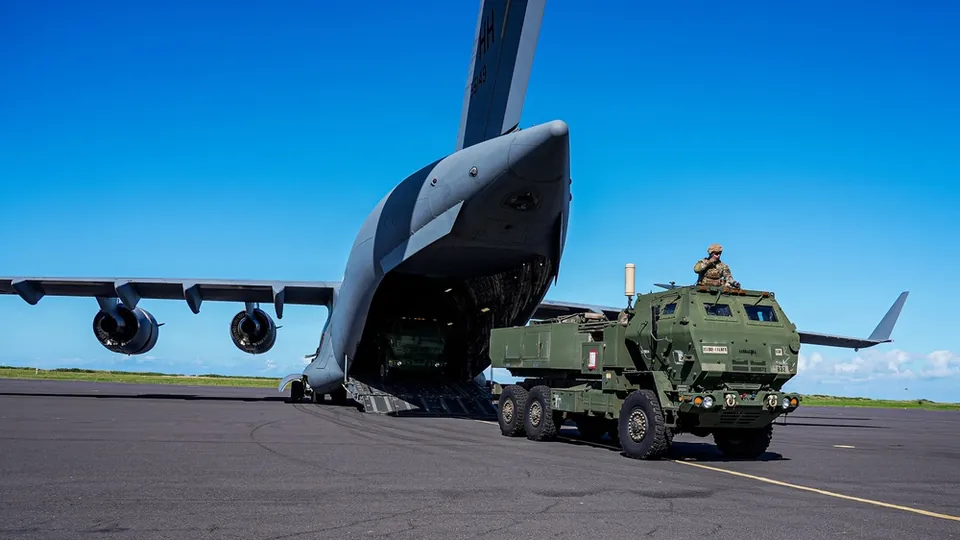
U.S. Army flies HIMARS onto Kauai by C-17 for a rapid-infiltration dry-fire in the JPMRC 27-01 exercise
U.S. Army HIMARS crews of the 25th Infantry Division were flown to Kauai by U.S. Air Force C-17s and set up for a dry-fire mission during JPMRC 27-01, ahead of deployments to the Philippines.

The U.S. Army’s 25th Infantry Division has used a C-17 transport aircraft to fly HIMARS rocket launchers onto the island of Kauai, Hawaii, set them up for a dry-fire mission and prepare them to load back on board. The drill, called a HIMARS Rapid Infiltration (HIRAIN), took place on 10 November as part of Joint Pacific Multinational Readiness Center (JPMRC) Rotation 27-01, according to a release from the division.
Geopolitiki reported earlier on another phase of the same rotation: JPMRC 27-01: U.S. Army moves from the Hawaii drop zone to a long-range maritime air assault.
What the crews did
The launchers belong to the 2nd Battalion, 11th Field Artillery Regiment, part of the 25th Division Artillery Brigade. The U.S. Air Force’s 15th Wing provided the airlift. According to the release, the systems were flown in, driven off the aircraft on the airfield and moved straight into a firing posture.
The division describes the concept as one built around speed and survivability. A launcher is brought to an austere location, fires, and is loaded back onto an aircraft so that it does not remain a fixed target for an adversary’s counter-battery fire. In this case the fire mission was a dry-fire, meaning no rockets were launched.
The release says commanders used encrypted networks, decision aids and new command-and-control software to process sensor data, confirm targets and tie the fire mission into the wider scheme of manoeuvre, while the main ground fight was taking place hundreds of miles away on the islands of Hawaii and Oahu.
What commanders said
First Lt. Cameron Richardson, a platoon leader in Bravo Battery, 2-11 Field Artillery, said that for his unit a strike “means being quick” and being accurate, and that crews need to be “hitting the right thing at the right time”. He added that the work depends on close communication between Army crews and U.S. Air Force loadmasters so the heavy launchers are safely secured.
Col. Kyle Clinton, the 15th Wing commander, said the unit’s C-17 aircraft are “uniquely capable” of repositioning equipment in austere or contested environments, and that missions of this kind show the teamwork and interoperability of the services and their partners. Col. Bryan Fanning, who commands the 25th Division Artillery Brigade, said training in Hawaii prepares forces to fight “anywhere in the Pacific” through short-notice deployments into contested terrain.
Context: the exercise and what follows
JPMRC is described by the Army as U.S. Army Pacific’s regional combat training centre, operating across the Hawaiian Islands, Alaska and other locations in the Indo-Pacific, with training in jungle, archipelagic and arctic conditions. According to the caption released with the story, Rotation 27-01 brings together U.S. forces with military personnel from the Republic of Korea, Singapore, France, New Zealand, Japan and the Maldives.
The division says the Kauai drill is a stepping stone toward the deployments of its light infantry to the Philippines for Operation Pathways, scheduled for the spring and summer. The release frames the training as preparation to operate alongside regional allies “in times of crisis or conflict”.
The account comes from the U.S. military’s own public affairs channel, and the assessments of capability in it are the division’s own. No performance data, such as range or timings, was published.
Source: DVIDS, 25th Infantry Division.