Middle East & North Africa
Iran’s Revolutionary Guards show the new underground “missile city” – Abdollahi: “The surprises will come one after another”
Three days after announcing it, the IRGC showed Iranian state media footage of a new underground “missile city” of its Aerospace Force; armed forces chief Ali Abdollahi sent a message to Washington and Israel.

Three days after announcing it, the Revolutionary Guards (IRGC) showed on Tuesday, November 10 the new underground “missile city” of their Aerospace Force. Iranian state media released video from inside the complex, showing a launcher, missiles and military vehicles lined up in tunnels. The location of the facility was not disclosed.
The tour was led by Major General Ali Abdollahi, chief of the General Staff of the Iranian Armed Forces and commander of the Khatam al-Anbiya Central Headquarters, and Brigadier General Seyed Majid Mousavi, commander of the Guards’ Aerospace Force. The IRGC-affiliated agency Tasnim presented the facility as one more part of the Aerospace Force’s missile infrastructure, built so that missile units remain operational and ready to respond to threats.
The presentation had been announced on Saturday, November 7 by the Guards’ spokesman, Brigadier General Hossein Mohebbi, at the same press conference at which he said that the 2,000-kilometre limit on the range of Iranian missiles had been “lifted”. Mohebbi had said then that missile and drone production lines were moved underground so that production could continue even under bombardment.
“The surprises will come one after another”
Abdollahi used the ceremony to send a message to Washington and Israel. He claimed that the country’s advanced missile capabilities will surprise its adversaries in a next war and that the United States has never spent so much ammunition in such a short time as in the recent clashes, without achieving its goal. He attributed that failure to the determination of Iranian fighters, stressing that the enemy’s military capabilities and equipment do not determine the decisions of the Iranian Armed Forces. Responding to Israeli Prime Minister Benjamin Netanyahu’s phrase “either we must destroy Iran or Iran will destroy us”, he said the statement is not new and that Tehran will destroy Israel. He also warned that if the enemy moves against Iran again, the response will go beyond the limits of the region.
Mousavi followed the same line. He said the Aerospace Force is ready to face any threat, inside and outside the region, and that, if necessary, all the capabilities of adversaries “in the region and beyond” will come under fire. He added that new weapons and systems will enter the force structure after each phase of development, and spoke of constant combat readiness, as, he said, in both previous wars.
What the 2,000 kilometres cover
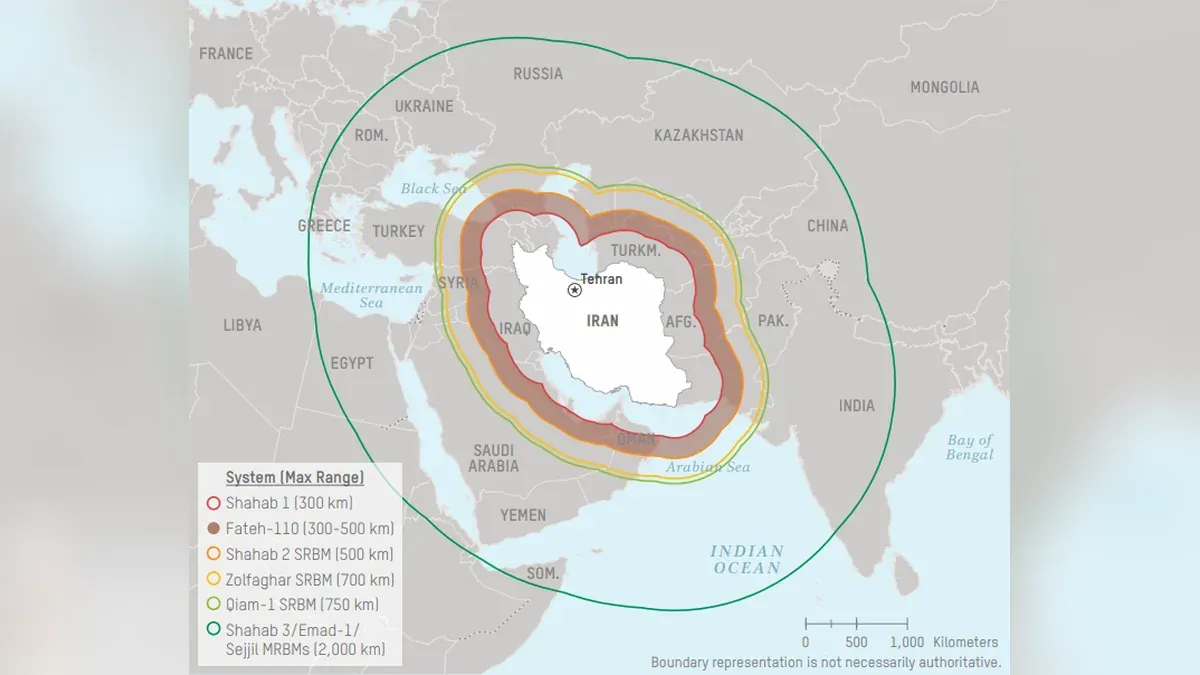
Iran has been building so-called “missile cities”, that is underground depots and launch positions, for years to protect its arsenal from air attack. Before the war that began on February 28, estimates of Iran’s ballistic missile stockpile ranged from 2,500 to 6,000, the largest in the Middle East. Within 2,000 kilometres lie the Arabian Peninsula, the Levant, most of Egypt and parts of south-eastern Europe, Greece among them, while the Khorramshahr version with a lighter warhead is estimated to reach about 3,000 kilometres. Iran does not possess intercontinental ballistic missiles.
The new show of force comes as Trump speaks of a “positive momentum” toward ending hostilities but at the same time threatens strikes on bridges and the electricity grid, a few days after the American strikes on Qeshm island, and as the Guards insist that their missile programme not only survived the war but continues to produce.