
Air Force
KC-390: Greece and Portugal sign the agreement for three aircraft for the Hellenic Air Force, and Embraer says up to six
Greece and Portugal signed in Athens on November 2 the government-to-government agreement for three Embraer KC-390 Millennium aircraft for the Hellenic Air Force. Embraer says Greece is acquiring up to six.

The government-to-government agreement between Greece and Portugal for three Embraer KC-390 transport aircraft was signed on Monday, November 2, 2026, in Athens, in the presence of Defence Minister Nikos Dendias and his Portuguese counterpart, Nuno Melo. With the signing, the Hellenic Air Force takes the decisive step towards acquiring its first KC-390 Millennium aircraft.
Embraer confirmed the deal in an announcement whose headline says Greece is acquiring up to six KC-390 Millennium multirole aircraft. The intergovernmental contract signed in Athens, and the Portuguese government decision that preceded it, concern three aircraft.
The schedule provides for the first aircraft to be delivered in 2027 and the other two in 2029 and 2031. The Greek KC-390s will be delivered in the configuration developed with Portuguese participation for NATO requirements. Initial training of Greek pilots and technicians will take place at Beja Air Base in Portugal, and the programme includes technical support for the Air Force’s transition to the new aircraft.
The signing took place during the Portuguese minister’s official visit to Athens, where Mr Dendias received him in the morning at the Ministry of National Defence. Talks between the two delegations focused on cooperation, the exchange of know-how and the development of joint technology projects, with emphasis on advanced defence technology, support for the defence industry and innovation, and regional and international security issues were also discussed. Joint statements by the two ministers followed.
How the government-to-government deal works
Greece is not buying the aircraft directly from Embraer. Under Resolution 207/2026 of Portugal’s Council of Ministers, published on October 22 in the Diário da República, Portugal buys the three KC-390s through its own programme and transfers them to Greece under the government-to-government contract signed in Athens. The cost falls entirely on the Greek side: the resolution states that the expenditure is financed solely from the revenue of the contract with the Hellenic Republic.
The resolution provides for two budget lines. The three aircraft, together with a logistics support package for their entry into service, cost 532.9 million euros and will be bought under a contract with the consortium of Embraer S.A. and Embraer Portugal. A further 57.1 million euros is managed by the Portuguese Air Force for the electronic warfare suite, training, logistics support, the technical support teams that will be based in Greece and programme management. Under the Portuguese decision, the total comes to 589.98 million euros before VAT, with payments spread from 2026 to 2031 and the largest amounts for the aircraft paid in 2029 and 2030. We covered the details of the decision in our report on Portugal’s approval.
Air-to-air refuelling: the KC-390 as a flying tanker
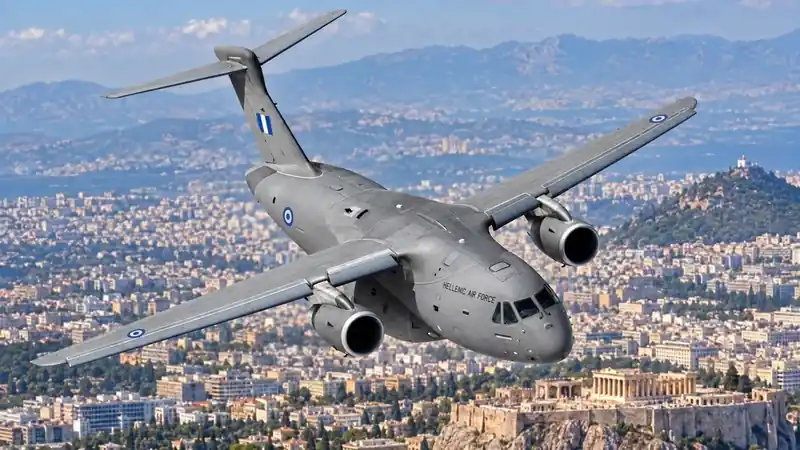
The biggest change the KC-390 brings concerns air-to-air refuelling. The Hellenic Air Force has not had its own flying tanker until now and relied on allied aircraft for long-range missions. The KC-390 can carry two Cobham 912E refuelling pods under its wings, with a flexible hose and drogue (probe and drogue), and according to Embraer it transfers up to 400 gallons of fuel a minute. This system serves aircraft with a refuelling probe, such as the Rafale and the Mirage 2000-5, but not, in its current form, the F-16s and the future F-35s, which refuel with a rigid boom. The refuelling kits are expected to be the subject of a separate contract.
Jet speed, 26 tonnes of cargo and self-protection
Unlike the propeller-driven C-130s that have served in the Air Force for decades, the KC-390 is powered by two IAE V2500 engines and, according to Embraer, cruises at Mach 0.80 (about 870 kilometres an hour) at altitudes up to 36,000 feet. It carries up to 26 tonnes of palletised cargo, 80 soldiers or 64 paratroopers, an armoured vehicle or a helicopter the size of a Black Hawk, and can perform airdrops, medical evacuations and aerial firefighting.
The Greek aircraft are expected to have the Portuguese configuration, with an electronic warfare suite from Israel’s Elbit Systems. The company announced a contract with Portugal’s defence ministry in 2019 for a complete suite including radar and laser warning receivers, an infrared missile warning system, countermeasure dispensers, directional infrared countermeasures (DIRCM) and an active electronic countermeasures pod. The Portuguese government says the KC-390 has already been bought by ten other countries, five of them NATO members.
From Lisbon and the Hellenic Aerospace Industry to the signing
The signing completes a path that began with the letter of intent of June 16, 2025 for cooperation with Portugal on military airlift, and continued on May 7, 2026, when Mr Dendias, on a visit to Lisbon, confirmed with Mr Melo Greece’s interest in the aircraft. Two weeks later, on May 22, the Hellenic Aerospace Industry and Embraer signed a memorandum of understanding on the support and maintenance of the aircraft in Greece. The procurement was approved by the Government Council for National Security (KYSEA) in July, followed by the Portuguese government’s approval in October.
Earlier this week we reported on the Portuguese minister’s arrival in Athens for the final signatures.