Europe
Royal Navy has five anti-submarine frigates instead of eight: Commons Defence Committee sees “glaring gaps” against Russia in the High North
The House of Commons Defence Committee says the Royal Navy lacks the ships and submarines to meet the demands of the High North, with only five towed-array frigates against a requirement for eight.

The Royal Navy does not today have enough ships and submarines to meet the demands of the High North, where Russia is seeking military advantage. That is the conclusion of the House of Commons Defence Committee’s report, published on Thursday, October 22, which speaks of “glaring gaps” in British capabilities in the Arctic and the North Atlantic.
“The UK must be willing to confront a hard truth: it does not currently have all the capabilities to operate successfully in the High North,” said the committee chair, Labour MP Tan Dhesi. According to him, Russian submarine and sabotage forces in the region pose a direct danger to the North Atlantic and to Britain, “including the nuclear deterrent”.
Five frigates against a requirement for eight
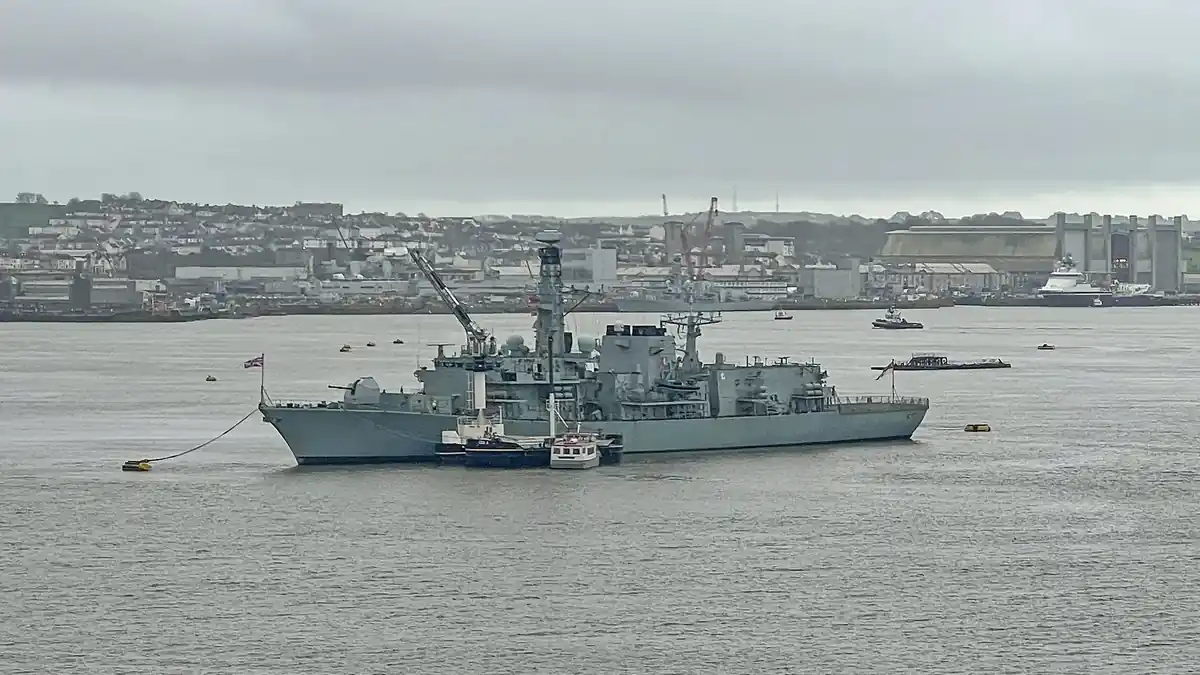
The core of the report is anti-submarine warfare. The Navy has a requirement for eight frigates fitted with the Sonar 2087 towed array, but today has only five, all of the ageing Type 23 class. “Compared to its own military requirements, the Ministry of Defence has a serious gap in anti-submarine warfare,” the report says, adding that the reduction to five ships raises questions about whether the transition from the Type 23 to the new Type 26 was handled properly. The committee asks that no further towed-array Type 23 frigate be retired before being replaced, one for one, by a new Type 26.
At the heart of the gap is the Type 26 timetable. The committee calls it “extremely sluggish”, with up to ten years from the laying of the first ship’s keel to its expected delivery, and attributes to this the fact that the old Type 23s cannot stay in service until their successors arrive. Eight Type 26s will take on the anti-submarine role and five general-purpose Type 31s will complement the frigates. Meanwhile the fleet is shrinking: since 2010 the requirement has been 19 frigates and destroyers, that is 13 and six respectively, but 11 ships are in service, five Type 23s and six Type 45 destroyers, 58% of the target. The frigates HMS Richmond and HMS Iron Duke were retired in mid-2026, although Iron Duke had undergone a five-year refit costing £103 million less than three years earlier. Had they stayed, the Navy would today have seven towed-array frigates.
Submarines and the Arctic ice
The committee also points to the low availability of destroyers, frigates and attack submarines. The inquiry heard of “shockingly low” availability of Astute-class submarines, like HMS Agamemnon, while Britain has lost the ability to operate with submarines under Arctic ice. In a conflict, Russia could thus hide its nuclear submarines there unopposed. “If we don’t fund defence properly, if we don’t close these gaps, we will regret it in the long term,” Dhesi told LBC. MPs ask that the capability be restored as soon as possible and that the government set out how fleet availability will improve before 2030.
In peacetime, the committee warns, the inability to deter in the High North leaves undersea data cables and energy pipelines around British waters exposed. In war, the risk extends to the population, military bases, the nuclear deterrent and the Atlantic routes along which US reinforcements would reach Europe. The report asks Britain and its European allies to consider how they would fight in the region without American help, and warns that new uncrewed systems must first prove they can endure Arctic conditions. It also asks whether the Joint Expeditionary Force (JEF), the British-led coalition with Northern European countries, should turn more toward the High North than the Baltic, and whether the British Army should strengthen its presence in Estonia.
Speaking to Forces News, Dhesi recalled that when the crisis with Iran broke out, Britain had to take HMS Dragon out of maintenance to send a ship to the Mediterranean. “If the government means what it says, that Russia could attack NATO as early as 2030, then the work to fix these vulnerabilities cannot start early enough,” he noted in the committee’s statement.
The Ministry of Defence replied that it takes a “clear-eyed” view of the Russian threat. It recalled that the frigate HMS St Albans monitors Russian submarine activity in the North Atlantic, that Britain leads allied activity in the High North through the JEF, and that it is investing £1.5 billion in the Atlantic Bastion programme for a new-generation “hybrid navy”, as well as £330 million to protect undersea infrastructure.