Technology
NASA completes the solar array on NEO Surveyor’s sunshade, the asteroid-hunting telescope, with up to 2 kW of power
NASA said on October 26 that the solar cells have been integrated into the sunshade of the NEO Surveyor space telescope, which will search for hazardous asteroids. Launch is planned no earlier than September 2027.

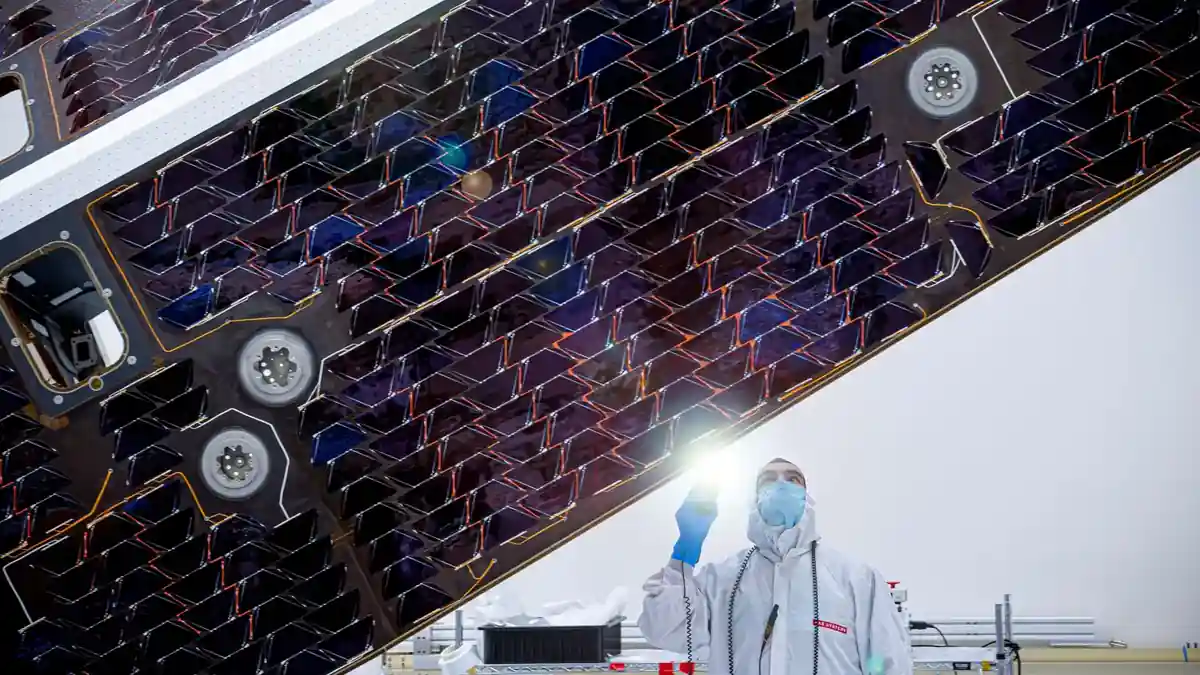
The largest part of the NEO Surveyor space telescope, which will search for hazardous asteroids, is now nearing its final form. NASA announced on Monday, October 26 that integration of the solar arrays onto the spacecraft’s sunshade is complete, a structure that will keep the telescope shaded and cool while also supplying all of its electrical power. The details come from NASA’s official report on the sunshade.
The shield is 6 metres (20 feet) tall and 2.4 metres (8 feet) wide at its base. It consists of two flat panels forming a 23.5-degree angle, both covered with 864 interconnected photovoltaic cells. The array can generate up to 2 kilowatts, enough power to charge the batteries that run all of the spacecraft’s systems.
The design has a purpose. NEO Surveyor is the first spacecraft built specifically to detect asteroids and comets that could pose a hazard to Earth. It searches in the infrared, that is, in the thermal radiation bodies emit when heated by the Sun.
Looking toward the Sun
One more advantage concerns the direction of the search. Objects lying toward the Sun are harder for ground-based optical telescopes to detect. The sunshade keeps sunlight out of the telescope’s 50-centimetre (20-inch) aperture and allows these regions of the sky to be scanned. From the position and motion of each body, the data will help NASA understand how many potentially hazardous objects exist near Earth and what their nature is.
The telescope has two infrared detector arrays, tuned to two infrared bands. Each array produces a 16-megapixel mosaic. Imaging the same part of the sky in both bands lets the mission team calculate the temperature of an asteroid or comet and, from that, estimate its size, a key element in assessing any potential threat.
A manufacturing chain across several US states
The project represents a manufacturing chain across several US states. The shield’s structure was built by Applied Aerospace in Stockton, California, and the solar cells were installed in January by SolAero Technologies in Albuquerque, New Mexico. In March came environmental tests of the shield and array at a commercial thermal-vacuum facility in El Segundo, California. In May the assembly was delivered ahead of schedule to BAE Systems Space & Mission Systems in Boulder, Colorado.
There, the low-accuracy Sun sensors, which help determine the spacecraft’s orientation, as well as temperature sensors, have been integrated since. The team also completed functional and performance tests of the solar array. In late July a technician inspected the shield in a clean room, on an assembly ring, as shown in the published photographs.
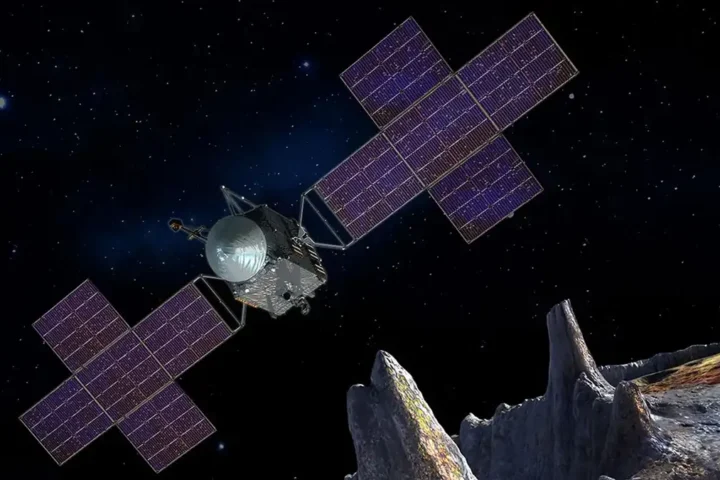
Launch is planned no earlier than September 2027. Another NASA mission to a small body is the Psyche spacecraft, which Geopolitiki covered recently as it heads toward the metallic asteroid.