Military & Defense
SBU: Russian missile ship Naro-Fominsk hit – Estonia reports explosion on a Russian warship in the Gulf of Finland
Ukraine’s Security Service says it hit the Russian Baltic Fleet small missile ship Naro-Fominsk on the night of November 11, as drones struck the port of Ust-Luga. Estonia’s defence minister reported an explosion on a Russian warship in the Gulf of Finland.

Ukraine’s Security Service (SBU) announced that it hit the Russian Baltic Fleet small missile ship Naro-Fominsk. According to the SBU, the attack took place on the night to Wednesday, November 11, at the same time as Ukrainian drones were striking the port of Ust-Luga, in the Leningrad region. Independent indication that something happened at sea came from Estonia: the country’s defence minister, Martin Herem, spoke of an explosion on a Russian warship in the Gulf of Finland.
What the SBU announced
The Ukrainian service describes a single night operation in two parts. In the first, drones of the “Alpha” Special Operations Centre targeted port facilities: tanks at the Novatek-Ust-Luga terminal, where the SBU reports a leak of oil products, tanks and a large fire at the Ust-Luga Oil terminal, as well as a fire at the Faktor company’s terminal and at the Luzhskaya railway station.
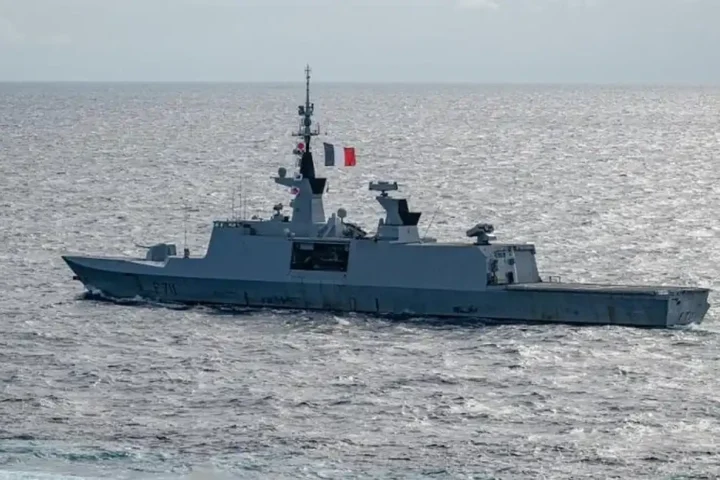
The second part was the ship. The Naro-Fominsk belongs to the Buyan-M class (Project 21631), was launched in 2022 and, according to the SBU, carries Kalibr cruise missiles and Onyx anti-ship missiles. The SBU says the ship was “hit”, without specifying exactly where it was or how serious the damage is. The service is also examining information on the possible destruction of Russian attack helicopters, without giving details.
Estonia and Finland: an explosion near Gogland
Mr Herem told Estonian public broadcaster ERR that the explosion on the Russian warship occurred at around 05:30 local time. “We know that smoke came from the ship afterward. The vessel itself headed back toward Saint Petersburg”, he said. The Estonian minister made clear, however, that Tallinn cannot say whether the explosion was caused by a Ukrainian attack or by an accident.
On the Finnish side, a senior official told public broadcaster Yle that Finland detected an attack near the Russian island of Gogland (Suursaari in Finnish). The island lies in the eastern part of the gulf, about 40 kilometres south of Finland and 55 kilometres north of Estonia. The Finnish Defence Forces had already imposed temporary restrictions on navigation and airspace in the eastern Gulf of Finland from the early hours, as a precaution after the attack on Ust-Luga.
The Ukrainian OSINT channel Exilenova+ places the strike near Gogland, about 180 kilometres from Saint Petersburg, and speaks of possible dead and wounded among the crew. This information has not been officially confirmed. Neither the identity of the ship the Estonians saw nor the cause of the explosion has been independently cross-checked, and Moscow has not commented.
Why it matters
If confirmed, it would be the first time Ukraine has struck a Russian warship at sea in the Baltic, almost 1,000 kilometres from its borders. Until now Ukrainian actions in the Baltic involved ships in shipyards or bases. In 2024 Ukrainian military intelligence claimed two acts of sabotage at the Baltiysk base in Kaliningrad, where the Serpukhov, also of the Buyan-M class, and the minesweeper Alexander Obukhov were damaged. In March 2026 the patrol icebreaker Purga, which was under construction in Vyborg, was hit.
Buyan-M ships are small, displacing about 950 tonnes, but they carry eight vertical launch cells for Kalibr missiles. Russia has used them from the Caspian and the Black Sea for strikes on Ukraine and Syria. Their presence in the Gulf of Finland, next to two NATO states, explains why Tallinn and Helsinki followed the night operation closely.
Ukraine is striking ever deeper into Russian territory, as in the attack on Omsk, 2,500 kilometres from the border. Meanwhile the Baltic countries live in a state of heightened alert, with nights of alerts in Lithuania and Latvia.