Opinion Air Force
Opinion: the moment of decision that could decide the Aegean, from the cockpit of an F-16
A reader’s opinion on what real air combat means, what a simulator can and cannot offer, and why over the Aegean the most important component of an F-16 is still between the seat and the stick.

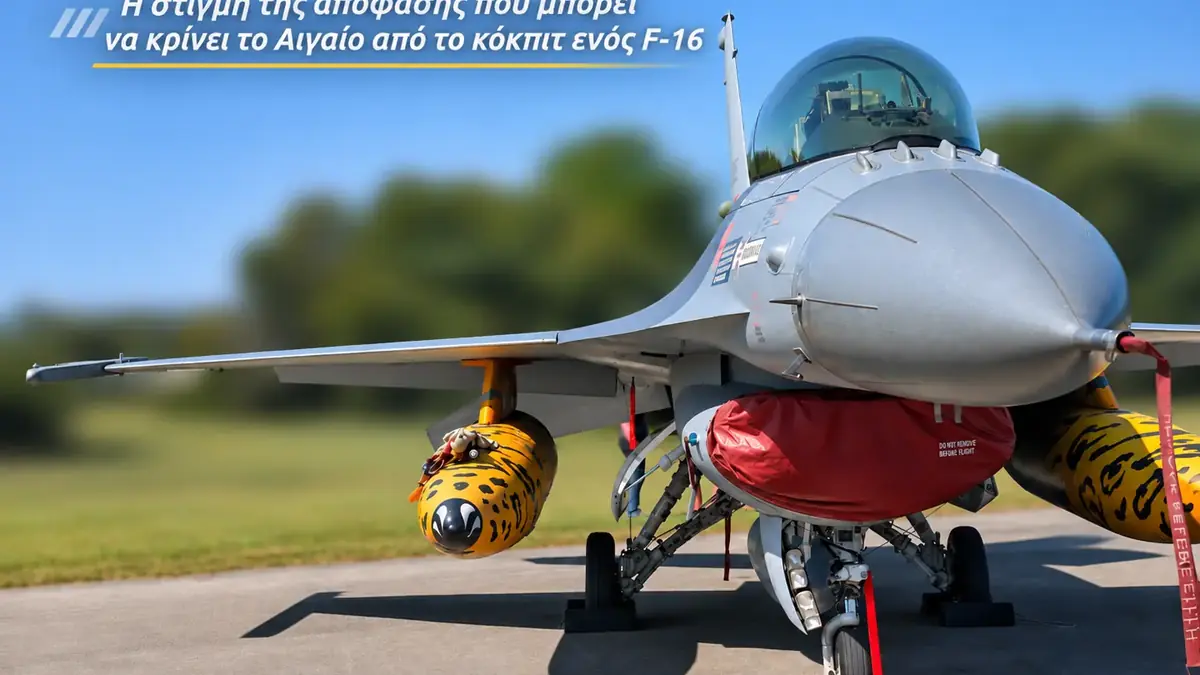
A friend once told me, in a conversation about geopolitics, that the easiest thing in the world is shooting down aircraft from your chair. You switch on the sim, pick an F-16, load AMRAAMs and two Sidewinders, fill the tank and start handing out kills. If something goes wrong, it is not the end of the world. You hit restart and try again. If you are also up against an opponent who flies as if he had just got his licence from a driving school, you might finish the mission and believe you are ready for the next Red Flag. The problem is that in real life things are somewhat different. Having spent quite a few hours outside that chair, I will try to explain in simple words what real air combat means, what a simulator can offer you, and why, when we speak of the Aegean, the most important component of an F-16 is still between the seat and the stick.
It starts long before the visual
Suppose you are in an F-16C taking off for an interception mission. No war has started, no missiles have been fired, and there is no reason to think that every aircraft you meet must be shot down. But you have a mission, specific instructions, rules of engagement and a constantly changing picture of the situation. On the ground there are people watching the airspace and passing you information, while you must fly the aircraft, monitor your systems and assess what is happening around you. On paper it sounds simple. In practice, even a routine interception can become a very demanding mission, because you do not always know what the other pilot is thinking or about to do. And especially in the Aegean, where Turkish air activity has over the years created countless dangerous situations, you cannot afford to treat anything lightly. Nor, of course, to assume that whoever sits in a Turkish F-16 is automatically a formidable airman because an Ankara promotional video presented him that way.
The first thing to understand is that air combat does not begin when you see the opponent with your own eyes. In many cases it begins much earlier, with the information you receive, with the processing of the tactical picture and with the decisions you take before any visual contact. The radar has different air-to-air modes and allows targets to be detected and tracked. But the indications on your screens have no prophetic powers. They do not tell you what the other is thinking, whether he has noticed you or whether he is about to perform a dangerous manoeuvre. Moreover, a radar track is not in itself identification of a hostile aircraft. You need correct identification, correlation of information and an understanding of the operational environment. What we call situational awareness is far more important than simply having a screen full of symbols.
What the simulator cannot give you
This is where the misunderstandings about simulators begin. A good user of DCS, for example, may know quite a lot about how the radar modes work, weapons management, how a missile behaves and the basic principles of beyond-visual-range (BVR) combat. Such knowledge is not useless at all, and it would be foolish to underestimate it; in our free time most of us are or were busy with exactly this when we are away from the real skies and the tough F-16 “stick.” But it is one thing to know how a system works in a controlled environment and another to use it when the data are incomplete, the radios are busy, the fuel is running down and a wrong decision can cost your life. In the sim you know you are taking part in an air combat. In reality you may set out on an ordinary interception and find yourself facing a situation nobody expected.
Many people also think a real air combat is decided by who turns faster or who gets behind the other. That is the classic picture of the dogfight, which still has operational importance but does not by itself describe modern air confrontation. Today sensors, data links, medium- and long-range weapons and cooperation with the command-and-control system have changed the environment considerably. An AIM-120 AMRAAM has an active radar seeker for the terminal phase of the engagement, but that does not mean every launch guarantees a kill. Real effectiveness depends on the kinematic situation, the quality of the data, the engagement conditions and the reactions of the target. There is no magic button that makes the opponent vanish.
As for the famous aircraft performance, even more care is needed. The F-16 is an extremely agile fighter with a fly-by-wire flight control system and can perform manoeuvres at high accelerations. The celebrated 9 G limit, however, is not something the screen simply displays and that is that. Under such conditions the body is subjected to enormous strain. Maintaining blood supply to the brain, avoiding loss of vision and dealing with G-LOC require proper physical preparation, training and the use of the right techniques. The pilot must at the same time keep control of the aircraft, awareness of the tactical situation and the ability to make decisions. In the sim you can pull the stick all the way, watch 9 G on the screen and go on drinking your coffee.
The human factor in the Aegean
Returning to the Aegean, there is one more issue that is often avoided in public discussion: the quality of the people inside the aircraft. A fighter’s performance does not automatically turn into operational superiority. You can buy an excellent aircraft, equip it with modern missiles and add an expensive AESA radar, but you cannot buy from the factory the experience, judgment and composure of the pilot. These take time, real flight hours, quality training and continuous evaluation. The departure of experienced flying personnel from an air force is not easily made up by taking delivery of new aircraft. The Turkish Air Force faced serious turbulence in its human resources after 2016, when many officers and pilots were removed in the purges that followed the coup attempt. That is a historical fact. The exact operational footprint of those losses today, however, cannot be determined from public information alone. And it would be a mistake to assume from the outset that all the pilots opposite are inadequate. Underestimating an opponent is one of the quickest ways to hand him an advantage he did not have.
That does not mean we should be impressed by every Turkish video of fighters passing in front of the camera to epic music. Air capability is not certified by likes, nor does the success of a mission depend on how impressive the editing was. I have often seen ordinary manoeuvres presented as if they were the discovery of new laws of aerodynamics. That someone can take off, fly in formation and return to base does not automatically make him a top air-combat pilot. The essential question is how an air force functions when it must carry out many complex missions, coordinate different units, face electronic jamming, manage losses and sustain an operational tempo over a long period. That is where its real quality shows, not in photographs of pilots in front of their aircraft.
The seconds before the decision
Now imagine the interception developing into an extremely dangerous situation. The Greek pilot watches the moves of the fighter opposite, receives instructions and tries to understand whether its behaviour is some form of provocation or whether there is a real sign of hostile intent. The most important thing is not to rush to conclusions. An aircraft that changes course is not necessarily attacking. A dangerous approach, on the other hand, can create a serious risk of collision even without any intention to use weapons. That calls for a combination of experience, composure and correct perception. You do not need to prove anything to the other pilot. You are not taking part in a contest of impressions. Your job is to carry out the national mission, protect your aircraft and keep the ability to react should the situation worsen.
That brings us to the moment I consider truly critical. An F-16 pilot does not always need to fire a missile to prove he did his job right. The right decision is not always the most spectacular. It may even be the one the wider public never learns about. An incident can end without a single shot being fired, or perhaps with one fired as a warning in extreme situations, and that can be an entirely successful mission. In a real conflict, by contrast, a timely and correct reaction to a confirmed threat can be a matter of survival. In both cases exactly the same basic quality is needed: sound judgment under pressure.
In closing, I return to that simple conversation about the sim. The simulation is an excellent tool, whether we speak of the professional training of a military pilot or of a serious friend of military aviation who wants to understand better how modern fighters work. But it is not real combat. In the sim you can make a mistake, see what happened and try again. In the real cockpit there may be no second chance. And that changes the way you think, assess and decide.
Over the Aegean, then, the most important moment is not necessarily the one when a missile leaves an F-16. It is the seconds before the decision, where the training, experience, composure and judgment of a human being can prove more important than any technical characteristic. To the young Icaruses taking their first steps on the road to military aviation I want to say something simple: never lose your love of flying, your thirst for learning and your respect for the mission you undertake. Fly with confidence, but never with arrogance. Listen to the older hands, trust your colleagues and remember that the wings you will wear are not just an insignia. They are an enormous responsibility, but also a distinct honour. And if anyone opposite believes air combat is as easy as it looks in his propaganda videos, someone should explain to him that the Aegean sky has no restart button.