Europe
Euclid: ESA releases its first major data set for the best 3D map of the Universe yet
ESA’s Euclid space telescope has recorded more than a billion celestial objects across an area equal to 9,500 full Moons. The DR1-Foundation release is the basis for the largest 3D map of the Universe ever made.

More than a billion sky objects, in an area equal to 9,500 full Moons, have been recorded by the European Space Agency’s (ESA) Euclid space telescope. On Thursday, November 12 the agency announced the mission’s first major data release, called DR1-Foundation, which forms the basis of the largest three-dimensional map of the Universe made to date.
The release covers about 13 months of observations and is the first major data release since the telescope’s launch in mid-2023. Spectra and images were released together with the data, among them large mosaics of the sky. For the first time scientists have in hand the pieces they need to begin building the detailed map that will help solve the mysteries of dark matter, dark energy and the “cosmic web,” the network of matter filaments running through the Universe.
ESA Director of Science Prof. Carole Mundell called the day a “scientific milestone” and stressed the data are “far more than beautiful pictures.” Mission scientist Valeria Pettorino explained that previous releases covered a few days of observations over about 60 square degrees of sky, while now more than a year of data is being released over a much larger area.
The scale in numbers
The change of scale is clear in the numbers. The release contains more than 900 million galaxies, about 15,000 strong gravitational-lens candidate systems and more than 60 million quasar candidates, the extremely bright cores of distant galaxies. It also includes spectra from more than 160 million sources. The results of the Euclid Wide Survey cover 1,900 square degrees of sky and correspond to 1.7 million GB of data.
A strong gravitational lens forms when a foreground galaxy strongly distorts the light of a more distant galaxy. As Hubble’s recent lens image showed, such systems allow galaxies to be “weighed” together with their invisible dark matter. They are rare, since only one in several thousand galaxies acts as a lens. Euclid’s catalogue is larger than all previous ones together and came from a combination of machine learning and the help of thousands of volunteers who took part in the Space Warps project on the Zooniverse platform.
The release also illuminates galaxy clusters, the largest structures held together by gravity. Euclid detects “protoclusters,” the ancestors of today’s clusters, and directly measures redshift, a measure of distance that also reveals their age. The images include the Horologium galaxy supercluster, members of the Messier 81 group, such as Messier 81 itself, NGC 3077 and Holmberg IX, the ring galaxy NGC 1291 and the rich galaxy cluster Abell 3128.
How the 3D map is built
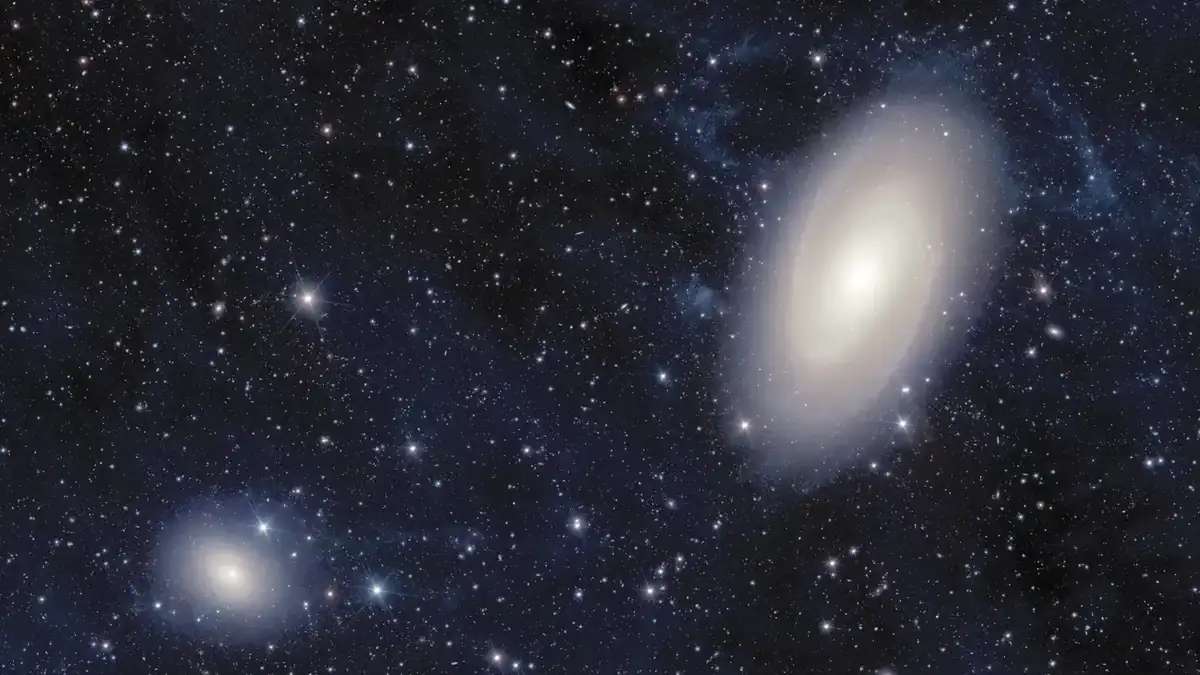
Like Hubble and Webb, Euclid observes from space, above the Earth’s atmosphere that blurs images and dims light. It can therefore make deep and at the same time wide surveys of the sky, something ground telescopes cannot do. The picture accompanying this report shows the core of the Messier 81 group, at a distance of about 12 million light-years. Messier 81 is a “grand design” spiral galaxy, with a bright centre and clear arms rich in gas and dust. The image covers an area about five times larger than the full Moon, and Euclid recorded it in just over an hour.
To map the Universe in three dimensions, the telescope uses spectroscopy: it splits the light of galaxies into “rainbows,” from which distance and, for the brightest, composition are obtained. The release covers only 14% of the total area Euclid will examine. The full first release (DR1) is expected in mid-2027 and will add weak-lensing observations and calculations of the position of galaxies and clusters in the cosmic web.
Euclid launched in July 2023 and began regular science observations on February 14, 2024. The mission is European, built and operated by ESA, with contributions from member states and NASA, which supplied the detectors of the near-infrared spectrometer and photometer (NISP). Thales Alenia Space was the prime contractor for building the satellite and its service module, while Airbus Defence and Space developed the payload module, together with the telescope. The Euclid Consortium includes more than 2,000 scientists from 300 institutions in 15 European countries, the US, Canada and Japan.