Technology
Hubble: nine gravitational lenses, a “sampler” of the targets NASA’s Roman telescope will test in the hunt for dark matter
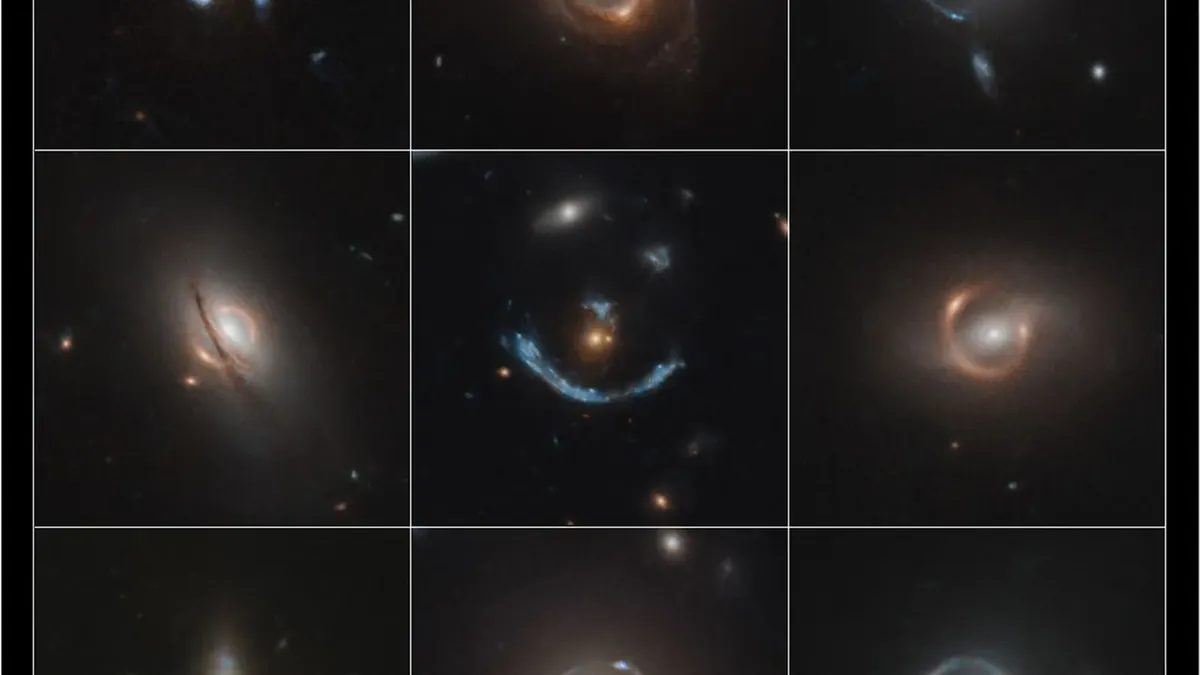
NASA presented a Hubble image with nine gravitational lenses as a sampler of the targets the new Nancy Grace Roman Space Telescope, launched on August 30, 2026, will observe next in the study of dark matter.

Nine gravitational lenses, that is, galaxies that bend and magnify the light of other, much more distant galaxies, were gathered in one image from the Hubble Space Telescope. NASA presented it on Thursday, November 12 as a “sampler” of the targets the new Nancy Grace Roman Space Telescope, launched on August 30, 2026, will observe next. As NASA’s announcement explains, the observations form the basis for the study of dark matter.
The gravitational lens was predicted by Albert Einstein. When a very massive object, such as a galaxy or a galaxy cluster, lies in front of a more distant one, its gravity bends, distorts and magnifies the light passing by. It works like a giant lens in space and lets astronomers see objects far beyond what any telescope could reach alone. In the nine images, the alignment of a distant galaxy with the mass of a foreground galaxy has created distorted, magnified images that appear as arcs around the lens galaxy.
Why mass matters
Their importance lies in mass. By measuring how much the light of the background galaxy is distorted, researchers build models that show how much mass the lens galaxy has and how it is distributed, together with its invisible dark matter. With these models they hope to confirm or refute a theory about dark matter. Hubble’s sharpness can reveal small imperfections in the arcs, hints of small clumps of dark matter. The “cold dark matter” theory predicts many such clumps, with masses from a million to a billion times the mass of the Sun. For comparison, our Galaxy’s dark matter halo weighs about 1.3 trillion solar masses.
Why is Roman needed as well? Hubble sees mainly visible and ultraviolet light, with some infrared, and gives a very detailed picture of individual objects. Roman sees mainly infrared and some visible light, but with a much wider field of view, and makes panoramas of the universe. Hubble will have the better image per lens, while Roman will record many more. If it finds one that is especially interesting, researchers can point Hubble at it again for more detailed observations. The team also wants to use the Hubble images to build a smart tool that will search efficiently for similar arcs in Roman’s future images.
A variety of lenses
The lenses in the image show the variety astronomers expect. In frame A, the background galaxy appears double, as a pair of arcs in an “arc-counterarc” arrangement, magnified by a pair of foreground galaxies. Frame F is an Einstein ring: the alignment is so perfect that the background galaxy almost entirely encircles the lens galaxy. Frame I shows a quadruple lens, with the background galaxy appearing four times, like blurry dots around the lens galaxy. Frame C is also a quadruple lens, with double knots that are probably regions of intense star formation.
The colour of the arcs also has meaning. Blue arcs indicate young stars and reddish ones older stars, and both telescopes will examine these differences to understand how galaxies evolved in the early universe. Most lens galaxies are elliptical, older, denser and more compact galaxies. A lens forms only when the mass density of the foreground galaxy reaches a critical threshold. But not all are alike. In G the galaxy appears elongated, either in reality or because of perspective, while spiral arms can be seen in B and F. These differences help map the evolutionary paths of galaxies.
Frame D stands out, where the lens galaxy has a visible dust lane, rare for a lens galaxy and a detail that Hubble’s sharp visible-light vision reveals with particular clarity. The background galaxy could be an Einstein ring that is “broken” by dust. Because infrared light is blocked less by dust, Roman’s observations will show whether the arcs form a fuller ring.
The lenses were first identified with the Dark Energy Spectroscopic Instrument (DESI) at Kitt Peak Observatory. Hubble followed, and Roman will make new observations. NASA presents it as an example of the cooperation of its “Great Observatories,” which include Hubble, Chandra in X-rays and the James Webb. With Roman in space, as NASA notes, a new window on the universe opens.