Technology
LISA: NASA shows how gravitational waves could reveal exoplanets around pairs of white dwarfs, with confirmation from Webb
Two NASA studies published in The Astrophysical Journal describe how the LISA gravitational-wave observatory could detect a new population of exoplanets orbiting pairs of white dwarfs, with the James Webb Space Telescope confirming them.

A planet orbiting two dead stars may leave its mark not in light but in gravitational waves, the faintest ripples of spacetime caused by bodies in orbit. This is what two studies by NASA astrophysicists show, published on Tuesday, November 10 in The Astrophysical Journal. They describe how the LISA (Laser Interferometer Space Antenna) observatory, now in development, could reveal a new population of exoplanets across our galaxy. NASA published the announcement on its website.
The first study is by Casey McGrath alone, a postdoctoral researcher at the University of Maryland, Baltimore County (UMBC) and NASA’s Goddard Space Flight Center: it examines the method and finds the planetary masses and orbital periods at which it works best. The second looks at how these planets would be confirmed with the James Webb Space Telescope. The idea was first proposed in 2008 by Japanese astronomer Naoki Seto.
The source of the signal will be double white dwarfs: pairs of white dwarfs, the dense remnants of stars like the Sun, about the size of Earth, moving in a very tight orbit. “If there is also an exoplanet in the system, its presence is imprinted in the gravitational signal in a way that we will be able to discover,” McGrath explained. Exoplanets have been found around a few single white dwarfs, but not around a pair, so LISA detections would be a distinct new population.
The principle resembles the radial velocity method, already used with light for planets around nearby stars: the planet tugs on the star with its gravity and makes it wobble, so its spectral lines shift because of the Doppler effect. “Something similar happens with gravitational waves,” said Scott Noble of Goddard. A pair of white dwarfs emits at an almost constant frequency, but a planet of sufficient mass moves it and adds Doppler modulation, which in LISA will appear as sidebands, secondary signals at higher and lower frequencies. McGrath compares it to the radio carrier, where sidebands carry voice or music: here they carry the sign that a planet exists.
An estimated 10 million double white dwarfs with periods under an hour exist in the Milky Way. LISA is expected to pick out about 10,000, along with about 100 mixed pairs with white dwarfs, neutron stars or black holes. For confirmation, the team uses Webb’s infrared: a planet in such a system adds infrared light beyond what the stars themselves would give, and Webb’s instruments easily spot this infrared excess out to at least 500 light-years. In a test system at that distance Webb would detect a planet about five times heavier than Jupiter, while LISA, in ideal conditions, could detect one smaller than Jupiter. As Mary Anne Limbach of the University of Michigan said, joint detections would show the signals are real planets and not false indications.
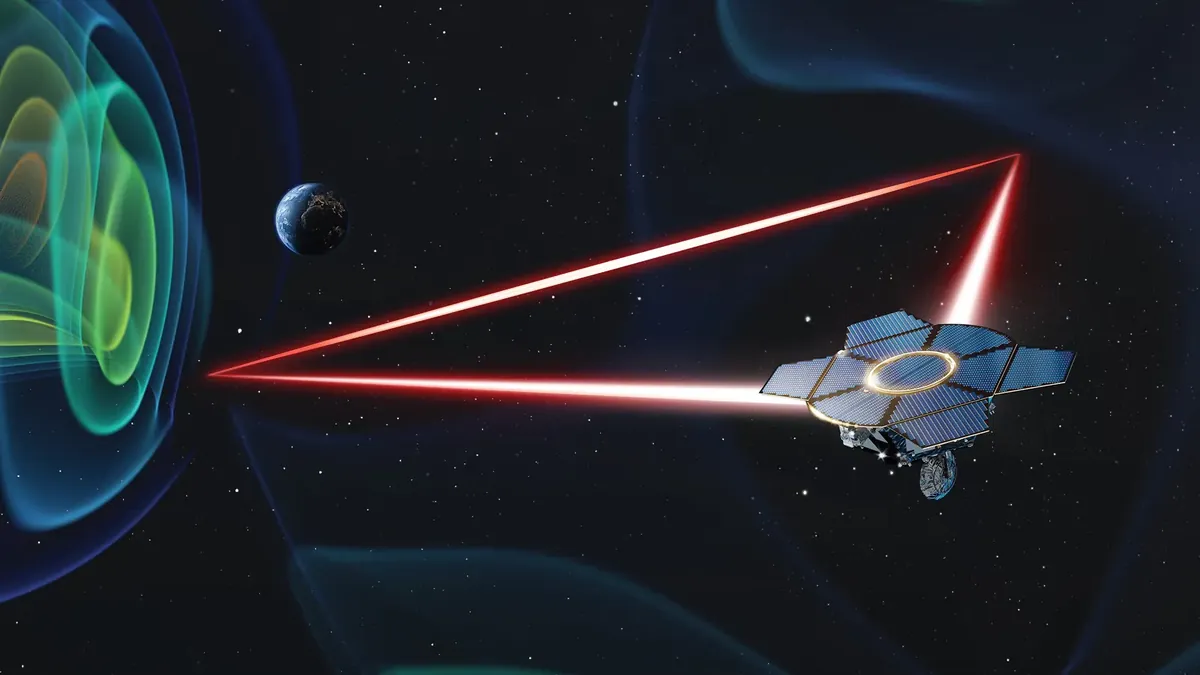
LISA will consist of three spacecraft following Earth in its orbit around the Sun, in a triangle with 2.5-million-kilometre (1.6-million-mile) sides. Each craft will have two telescopes sending and receiving infrared laser beams and will measure changes in distance smaller than the diameter of a helium atom, which is the gravitational-wave signal. The mission is led by the European Space Agency (ESA), with launch in the mid-2030s, and NASA contributes the telescopes, the laser, devices for managing the electric charge of the test masses, data analysis and scientific and engineering support.
Gravitational waves were predicted by Einstein’s general relativity in 1916 and first detected by ground-based observatories in 2015.