Technology
NASA’s Perseverance measures Martian dust fine enough to reach the lungs, with consequences for astronaut suits and habitats
Over 1,645 Martian days, Perseverance recorded fine and ultrafine dust particles stuck to spacesuit material samples, some small enough to enter the lungs and bloodstream. The study is published in PNAS on October 27.

The dust of Mars, which will follow the first humans to the planet, has been measured on the spot for the first time at its smallest sizes. NASA’s Perseverance rover recorded, over 1,645 Martian days, fine and ultrafine particles that stuck to samples of spacesuit materials. Some are small enough to reach the lungs and pass into the bloodstream. NASA announced the findings on Monday, October 26, and the study is published on Tuesday, October 27 in the journal Proceedings of the National Academy of Sciences (PNAS).
The problem is not new. In the Apollo missions lunar dust scratched visors, wore down the outer layers of suits and damaged their seals, and crew members reported symptoms resembling hay fever. Martian grains are rounded by collisions with other wind-driven particles and scratch less than lunar ones. They contain more silica than lunar dust, are enriched in sulfur, chlorine and iron, and dust storms keep them circulating in the atmosphere.
Measurements on materials sent to Mars
The measurements were made on materials NASA had sent to Mars to see how they hold up on its surface. The rover carries five spacesuit fabric samples, 20-millimetre squares, on the calibration target of the SHERLOC instrument. The team analysed there Teflon and Vectran, two materials used in suits. The dust was measured by the PIXL X-ray spectrometer, which has on its own target a sample of Teflon and one of basaltic glass. Because Teflon contains no elements that PIXL detects directly, any signal from it is due to dust sitting on it.
Until now measurements on Mars distinguished particles down to about 3 micrometres. PIXL identified two smaller categories: fine particles under 2.5 micrometres (a human hair is about 70 micrometres wide) and ultrafine ones of around 100 nanometres, about 700 times thinner than a hair. On the PIXL Teflon and the SHERLOC Vectran the particles had an average size of about 2 micrometres, while on the PIXL basaltic glass and the SHERLOC Teflon they ranged from 100 to 300 nanometres. Static electricity seems to determine which particles stick to which material: grains become charged when they collide in the air and each material attracts grains of a different size. The finest stayed in place after years of driving and drilling.
“The existence of Martian dust at these ultrafine sizes had long been predicted, and PIXL gave us the chance to measure it directly on Mars. The larger dust aggregates shake off over time. But the smallest particles remain, and they pose the greatest challenge for human life-support systems,” said Scott VanBommel, a mission scientist at Washington University in St. Louis and lead author of the study.
Health risks and design implications
Chemically, the dust matches the iron- and sulfur-rich composition measured by earlier missions. PIXL also found it enriched in phosphorus and detected signs of calcium sulfate. On Earth, airborne particles under 2.5 micrometres are linked to a range of adverse health effects because they penetrate deep into the lungs and pass into the blood, while ultrafine ones can travel from the nasal cavity to the brain via the olfactory nerve. Martian dust contains perchlorate salts, which can disrupt thyroid function, and reactive iron that causes cell damage. The risk, scientists estimate, depends on the amount of dust and the duration of exposure.
The results can help set dust exposure limits inside habitats, shape safe habits and design ways to remove it. Some materials hold less dust than others, which will guide the choice of materials and protective coatings. Solutions such as suitports, where the astronaut enters a suit attached to the outside of the habitat, and double-chamber airlocks could reduce the dust entering living quarters. “Dust has been a challenge for surface exploration since the Apollo era. Perseverance is giving engineers and flight surgeons measurements they can use long before the first American astronauts reach Mars,” said Lindsay Hays, acting director of the Planetary Science Division at NASA Headquarters in Washington.
NASA is already testing solutions on the Moon. In March 2025 an electrodynamic dust shield, which removes lunar soil with electric fields, flew on Firefly Aerospace’s Blue Ghost Mission 1, while at the Johnson Space Center in Houston engineers test suit components in vacuum chambers ahead of the Artemis missions. Artemis III will test the lunar landers of Blue Origin and SpaceX in 2027, aiming for a landing in 2028, as Geopolitiki reported.
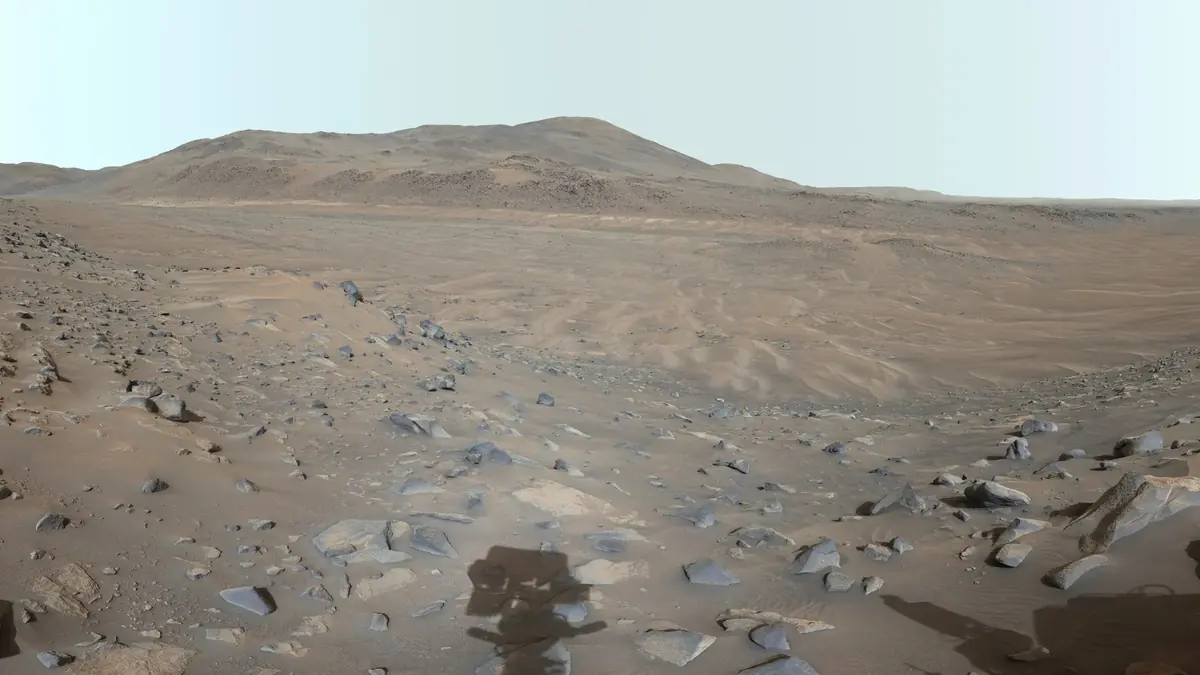
The photograph is from a 360-degree panorama of Neretva Vallis, the dry river channel on the western rim of Jezero crater. It was composed of 217 images from the Mastcam-Z camera on May 20, 2024, the 1,155th Martian day of the mission. Perseverance was built and is operated by NASA’s Jet Propulsion Laboratory (JPL), which is managed by Caltech.