Europe
CRISTAL: Europe’s polar ice satellite completes assembly and passes its first tests
The European Space Agency said on October 26 that Airbus engineers in Friedrichshafen finished assembling CRISTAL, the first Copernicus Sentinel Expansion mission, which has now passed its first tests.

CRISTAL, expected to be the first Sentinel Expansion mission of the Copernicus programme to reach orbit, has moved from assembly to readiness testing. The European Space Agency (ESA) announced on Monday, October 26 that Airbus engineers in Friedrichshafen, Germany completed the satellite’s assembly in September. It is intended to monitor the polar ice.
The name CRISTAL stands for Copernicus Polar Ice and Snow Topography Altimeter. The satellite carries the first dual-frequency altimeter radar, together with a microwave radiometer. These instruments will measure and record changes in the thickness of sea ice, in the depth of the snow covering it and in the elevation of land ice sheets.
Solar panels, launcher adapter, qualification review
Once assembly was complete the phase of system testing began. The first deployment test of the solar panels, which power the satellite, was the highlight of the period. It checked that the mechanisms and software sequences work correctly together, so that the satellite’s solar “wings” open without a problem once it reaches orbit.
A second test was carried out with launch service provider Avio. Engineers confirmed that the satellite fits the launch adapter, the part that fixes it to the rocket, and that the release mechanism that will separate it from the launcher and leave it in orbit works.
In parallel the project team held the intermediate qualification status review. It examined where qualification and verification of the equipment, instruments and subsystems stand, ahead of the qualification tests to be carried out on the satellite as a whole. ESA’s CRISTAL project manager, Kristof Gantois, said: “Everything is going very well and the satellite passed these tests with flying colours.”
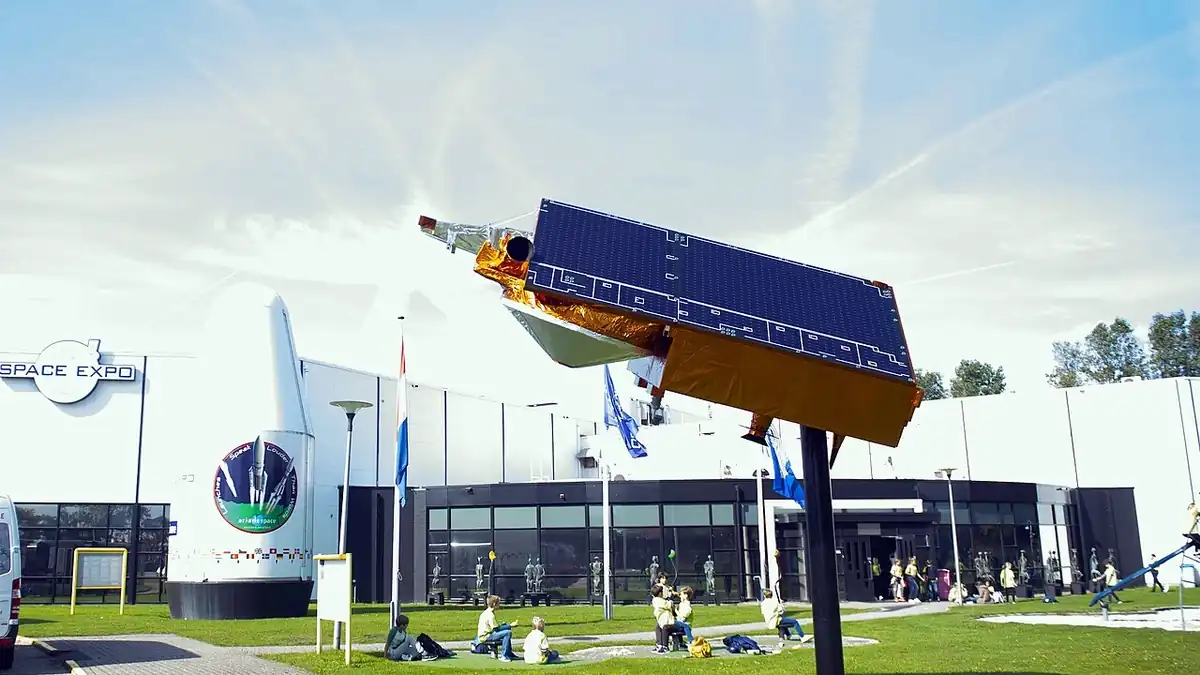
The next stage will take place in the Netherlands. Gantois said the satellite will be moved from Airbus’s facilities to ESA’s facilities in that country, where it will spend most of 2027 in rigorous environmental testing. The aim is to confirm that it will withstand launch and the harsh conditions of space.
Launch from late 2027
The launch target is set between the end of 2027 and early 2028. CRISTAL is expected to be the first of the “Sentinel Expansion” missions, the new expansion missions of Europe’s Copernicus programme, to reach orbit. It will continue the long radar time series of ice elevation measurements for at least two more decades, after ESA’s research mission CryoSat and other earlier missions. For this reason a second satellite, CRISTAL-B, is planned, to launch toward the end of CRISTAL-A’s operational life so that observations are not interrupted.
The mission also has practical uses, since it is operational. Its data will support maritime activities in the polar oceans, applications for coastal and inland waters and monitoring of ocean topography. Precise ice measurements, which ESA describes as perhaps the most vulnerable part of the Earth system, will also help better understand climate processes and their impacts. More details on the tests are in the ESA announcement.
ESA also works with Greek bodies. Planetek Hellas started a project with ESA to design Greece’s Space Resilience Hub, while in the ERMIS-3 experiment Greece achieved its first laser optical link with a low-orbit satellite, with ESA among the partners. The Greek microsatellite programme, which Geopolitiki has analysed, is also being implemented with the help of ESA and the Hellenic Space Center.