Technology
NASA: six presentations at Supercomputing 2026 – and the 20.13-petaflop Athena supercomputer
NASA will give six technical talks at booth 4038 at SC26 on November 17-19, and the Ames-based Athena supercomputer, at 20.13 petaflops peak, runs in a modular facility cooled by outside air.

NASA will present six technical talks at booth 4038 of the Supercomputing 2026 (SC26) exhibition, the conference on supercomputers and high-performance computing. The “Tech Demos” programme the agency published on Friday, November 6 covers Tuesday, November 17, Wednesday, November 18 and Thursday, November 19. Each talk is given three times on the same day, every half hour.
On Tuesday, November 17, at 10:00, 10:30 and 11:00, Tom Clune speaks on “Type-safe Templates in Fortran 2028,” code templates with type checking in the Fortran language. At 1:00, 1:30 and 2:00 p.m. Brad Richardson presents “Mixing and Matching and Multiple Versions, Oh My!” At 4:00, 4:30 and 5:00 p.m. Jeff Becker explains how the NAS Parallel Benchmarks, NAS’s performance tests, are ported to use OpenMP Target Offload, the feature of the OpenMP parallel programming standard that moves computation from the central processor to accelerators.
On Wednesday, November 18, at 1:00, 1:30 and 2:00 p.m., Sujay Kumar presents high-resolution hydrological simulations, for mapping water availability and extreme events. At 4:00, 4:30 and 5:00 p.m. Chris Tanner speaks on “Modular Supercomputing Data Centers at NASA.” On Thursday, November 19, at 10:00, 10:30 and 11:00, Jeff Triplett presents the use of the Open OnDemand and ColdFront tools at bp and at NASA, titled “Subsurface to Stellar.”
Athena and the modular approach
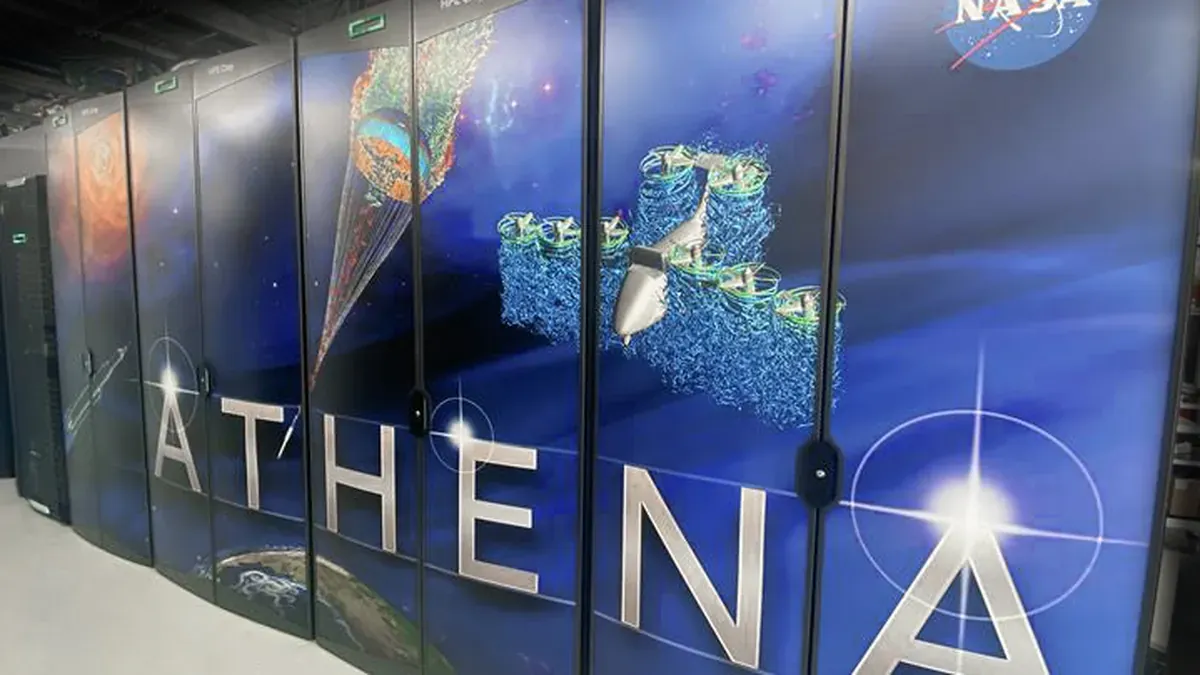
The subject of Mr Tanner’s talk, modular data centers, is the choice made by NAS (the NASA Advanced Supercomputing division), the computing centre at Ames Research Center in California, which houses Athena, NASA’s most powerful supercomputer. The system sits in the Modular Supercomputing Facility (MSF), an installation of modular units outside the main building. It consists of four HPE Cray EX4000 racks with 1,024 nodes, AMD EPYC 9745 128-core processors at 2.4 GHz and 768 GB of DDR5 memory per node. In total it has 262,144 cores, 786 TB of memory and a theoretical peak performance of 20.13 petaflops, more than 20 million billion operations per second.
The name comes from the Greek goddess of wisdom and strategic warfare, half-sister of Artemis and Apollo, whose names are borne by NASA space missions. Pleiades, which operated since 2008, has been retired: all its nodes were permanently shut down in January 2026, while Aitken, Electra, Cabeus and Endeavour continue to operate.
The modular approach exploits the mild climate of Silicon Valley. MSF units are cooled by outside air and fans and need water only on very hot days. In its first year of operation, NASA recorded that cooling needed only 16% of the energy of NAS’s traditional centre and that water consumption fell by 91%. Electra, housed in two modular units, saves 5,000 gallons of water a day (about 19,000 litres). The MSF site, an acre in size (about 4,000 square metres), can host up to 16 units for computing and data storage.
These systems also support NASA’s missions. Aitken, which preceded Athena as the agency’s most powerful system, was used by Ames engineers for simulations of the launch environment at Kennedy Space Center for Artemis program missions, computing aerodynamic loads on the rocket, the mobile launcher, the tower structures and the flame trench. For comparison, the Greek supercomputer DAEDALUS at Lavrio was inaugurated with a measured performance of 85.69 petaflops, while Athena’s 20.13 petaflops is a theoretical peak value.