Technology
Teghaza 001: a Martian meteorite more than 4.1 billion years old, among the oldest ever found on Earth, reveals Mars’s ancient crust
A pink rock found in the Sahara in 2022 turned out to be a piece of Mars more than 4.1 billion years old. NASA says Teghaza 001 is one of the oldest Martian meteorites ever found, and a study in Science traces it to the southern highlands.

A pink rock found in the Sahara in 2022 has turned out to be a piece of Mars more than 4.1 billion years old. NASA announced on Thursday, October 29, 2026 that the meteorite Teghaza 001 is one of the oldest ever identified from the Red Planet. The study was funded by the agency and published in the journal Science, and the announcement comes from NASA’s Jet Propulsion Laboratory (JPL), as NASA explains.
The rock weighs almost 800 grams and is named after the Teghaza salt plain in Mali, where it was found. It is one of about 435 meteorites recorded from Mars. When it was discovered nobody knew its age or origin. The answer came from scientists who dated its minerals and found it is part of the planet’s ancient crust.
From the Sahara to a “Rosetta Stone for Mars”
Martian meteorites share a history: an impact ejected them from Mars’s surface and, after a journey through space, they ended up on Earth, in the hands of scientists. Collectors often find them in deserts or snowy plains, where they stand out in an otherwise barren landscape. To confirm their origin, the minerals and chemistry of a sample are compared with measurements from NASA missions to Mars such as the Viking landers and the Curiosity and Perseverance rovers.
The University of New Mexico first identified it as Martian, from its oxygen isotopes, which act as a geochemical fingerprint of every planetary body. The sample resembled a sergeottite-like rock, the most common class of Martian meteorites. Yang Liu of JPL, a specialist in planetary samples, nearly declined to examine it, having seen many. In the end she looked and found unusual textures and minerals she had never seen, among them zircon crystals. These crystals record the conditions under which a rock formed and allow precise dating.
Francois Tissot of Caltech contributed to the dating with a method developed by his group. Instead of dissolving the whole sample, individual grains were analysed in place, in a piece smaller than a fingernail, using the rubidium-strontium method. The technique is precise and fast and preserves rare samples for future studies. “Right now we’re one of very few labs in the world that can do this kind of dating, and the first to date such an old Martian meteorite,” Tissot said.
The result surprised Liu. The minerals had been altered by Martian water about 4.1 billion years ago, so the rock formed even earlier. Its texture, oxygen isotopes and chemistry point to a much more dynamic water cycle on early Mars. “Only after looking at it carefully did we realise this meteorite is truly unique,” she said. One of the study’s reviewers called it a “Rosetta Stone for Mars”.
Among the three oldest, with a link to the southern highlands
Teghaza 001 is one of the three oldest Martian meteorites found on Earth. ALH84001 consists almost entirely of one mineral and has a similar age, while “Black Beauty” formed about 2.1 billion years ago and is made of small fragments of volcanic rock. Teghaza 001 stands out because it combines several igneous, that is volcanic, minerals. These show how the planet’s crust came from cooling magma and was later altered by groundwater. Its mineralogy matches what NASA’s Mars Reconnaissance Orbiter has observed in the heavily cratered southern highlands of Mars.
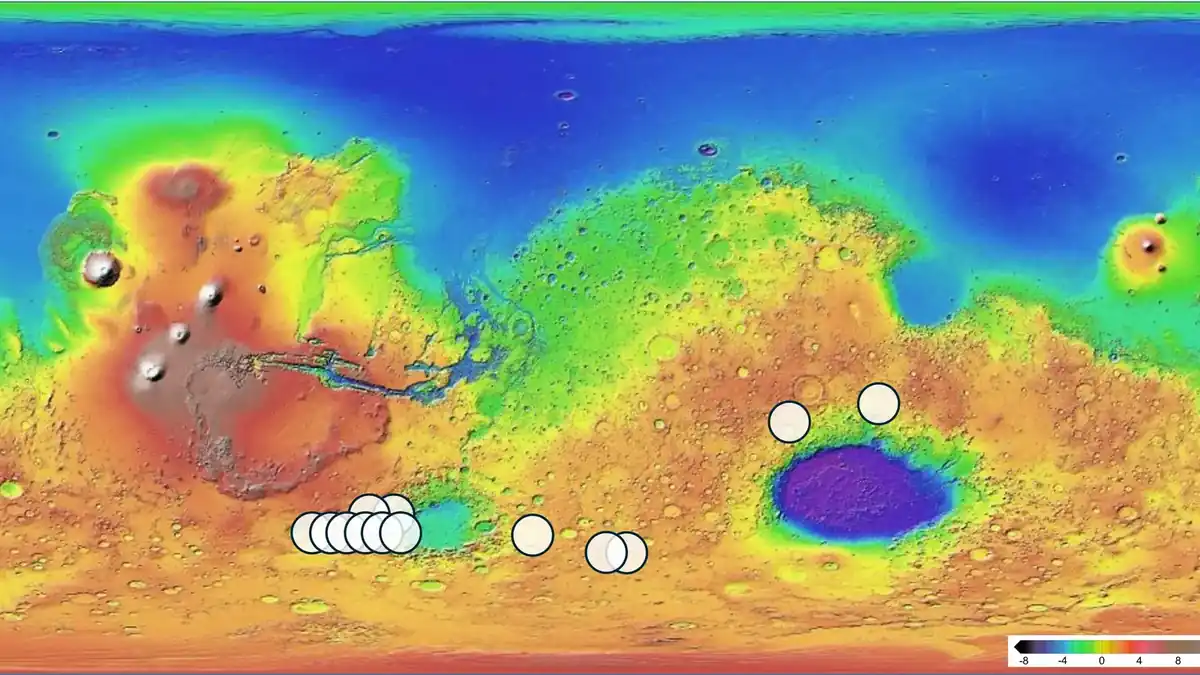
Nobody will ever learn the exact place of origin. But the study identifies 13 areas of Mars with mineralogy and chemistry that match the meteorite and ties it to highlands in the southern hemisphere. Data from the Mars Orbiter Laser Altimeter on Mars Global Surveyor served as the map’s backdrop, while the areas were marked using Mars Reconnaissance Orbiter data. Lee Saper, second author and now a scientist at NASA’s Ames Research Center, spoke of “the first piece of Martian crust from a region of Mars we never had a sample from”.
In June another study in Science Advances had presented the meteorite’s water content and how water shaped the early surface of the planet. Liu and her colleagues now await what the rest of the scientific community will add. “We’ve only just scratched the surface,” Liu said.