Greece
Greece and Egypt to continue consultations on extending the 2020 EEZ delimitation – a joint answer to the Turkish–Libyan memorandum
Foreign Ministers George Gerapetritis and Badr Abdelatty rejected the ratification of the 2019 Turkey–Libya memorandum and agreed to continue consultations on extending the geographical scope of the 2020 Greece–Egypt EEZ delimitation agreement, in full compliance with international law and UNCLOS.

Athens and Cairo are answering the illegal Turkish–Libyan memorandum jointly. Foreign Minister George Gerapetritis and his Egyptian counterpart Badr Abdelatty categorically rejected the ratification of the 2019 Turkey–Libya memorandum by Libya’s House of Representatives. They also agreed to continue consultations on extending the geographical scope of the Greece–Egypt EEZ delimitation agreement of 2020, in full compliance with international law and the UN Convention on the Law of the Sea (UNCLOS).
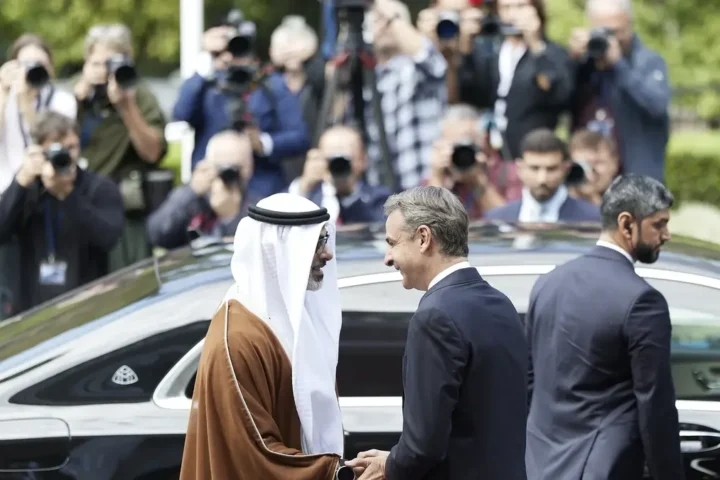
The two ministers spoke by phone on Thursday, October 22, the day Prime Minister Kyriakos Mitsotakis received the Crown Prince of Abu Dhabi at the Maximos Mansion. The Foreign Ministry said on X that the discussion focused on the strategic partnership between Greece and Egypt and on developments in the Eastern Mediterranean. Abdelatty wrote on X: “I discussed with the Greek foreign minister the strategic relations and developments in the Middle East and the Eastern Mediterranean, and we agreed to continue consultations on the delimitation of maritime borders in accordance with international law and the United Nations Convention on the Law of the Sea.”
What extending the 2020 agreement means
The agreement signed by Greece and Egypt in August 2020 delimited only part of their maritime zones, between the 26th and 28th meridians. It was signed in Cairo by then Foreign Minister Nikos Dendias and his Egyptian counterpart Sameh Shoukry, and subsequently ratified by the parliaments of both countries. It was the answer of Athens and Cairo to the Turkish–Libyan memorandum of November 2019, since the two zones overlap. The sections east and west of the delimited section were left open for future negotiations. Extending its scope means delimitation in those areas as well. To the east, that area meets the maritime zone claimed by Turkey and Libya under the 2019 memorandum, which ignores Crete.
The joint stance comes a day after Egypt publicly rejected the ratification of the memorandum by the Libyan House and while the US called for good-faith negotiations. Athens and Cairo are thus moving along the same line of the international Law of the Sea, against a text that neither country recognises.