Greece
State Department on the Turkish–Libyan memorandum: “good-faith negotiations” – while Greece raises it at the UN Security Council
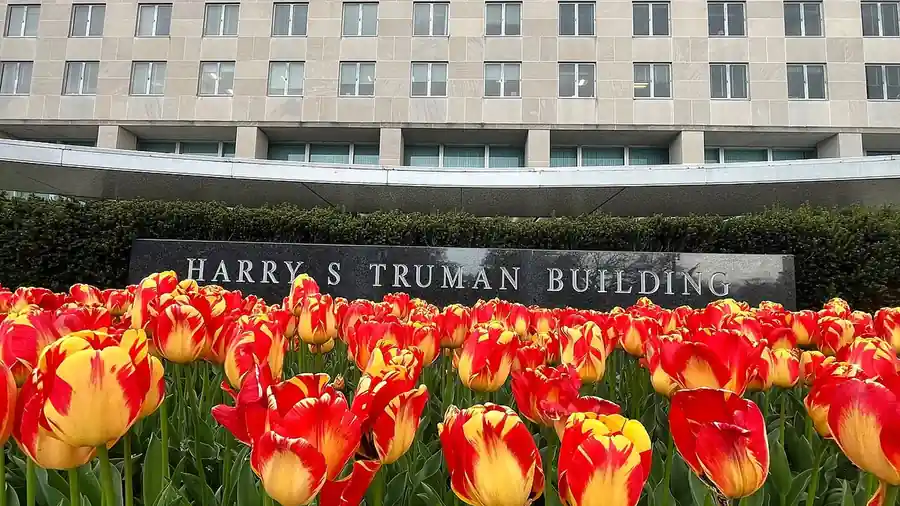
Responding to a question from Greek public broadcaster ERT, a State Department spokesperson urged “partners in the Eastern Mediterranean” to resolve maritime disputes through good-faith negotiations, without condemning the memorandum. Meanwhile Athens raised the issue for the first time at the UN Security Council.

The US State Department has responded for the first time to the Libyan House of Representatives’ approval of the illegal Turkish–Libyan memorandum, without condemning it. A spokesperson, answering a question from Greek public broadcaster ERT, called on “partners in the Eastern Mediterranean” to resolve their disputes over maritime zones through good-faith negotiations, and on Greece and Turkey to discuss bilaterally.
The question concerned how Washington views the ratification of the memorandum and whether it is concerned that it will raise tension in the region and create uncertainty for American energy investments and exploration. “We encourage our partners in the Eastern Mediterranean to resolve their differences over maritime zones through good-faith negotiations,” the spokesperson said. “Resolving maritime zone issues serves the interests of all sides and opens the way for commercial investment and exploration activities that will benefit the entire Mediterranean region.”
“Greece and Türkiye are both NATO allies. We encourage them to conduct a bilateral dialogue to address any points of disagreement between them,” the spokesperson added. The answer stays within the general line of equidistance and is a long way from the position of the Europeans, who speak of an agreement that is “null and void”. EU High Representative Kaja Kallas told Hakan Fidan that the memorandum violates the sovereign rights of third states, while Israel and Egypt condemned it openly.
At the Security Council
At the same time Athens brought the issue to the UN Security Council for the first time. Greece’s Permanent Representative, Ambassador Aglaia Balta, spoke in the closed consultations on Libya on instructions from Foreign Minister George Gerapetritis. She intervened in her national capacity, since Greece holds the Council presidency in October, and warned of the risks that the decision of the eastern Libyan House poses to stability and security in the Eastern Mediterranean.
Balta stressed that geography does not change and that the Law of the Sea is not rewritten by unilateral decisions. She recalled that Greece approached the Libyan authorities in good faith on the delimitation of maritime zones and that it supports the unification of Libyan institutions, but not at the expense of the sovereign rights of third countries. Until now the positions of the sides had reached the UN only through letters and maps, while France, a permanent member of the Council, has considered the memorandum invalid since 2020.
Gerapetritis has said the memorandum “will not be implemented” and that Greece is ready to use every lawful means, including the extension of its territorial waters. Ankara, for its part, accuses its critics of disinformation and insists the agreement is lawful.