Defense Industry
“Antaios”: the Greek 6×6 ground robot that carries 600 kg – what the parade showed about the Army’s UGVs
The Greek-designed 6×6 unmanned ground vehicle “Antaios” passed in the October 28 parade: 600 kg payload, 8 hours’ endurance and low signatures, built for the last kilometres before the front line.

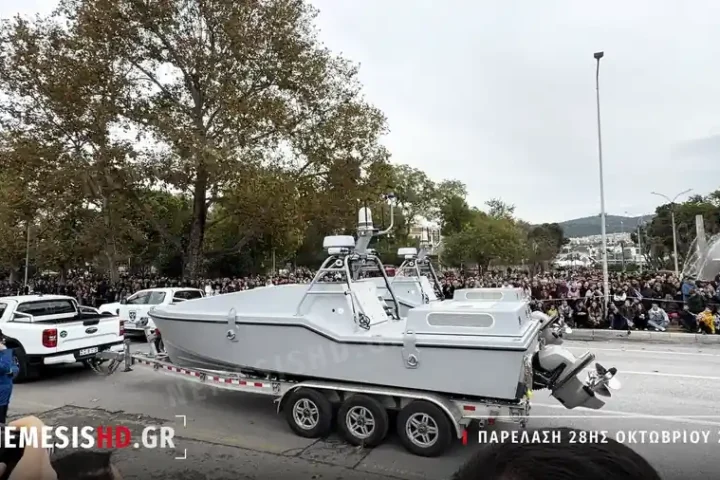
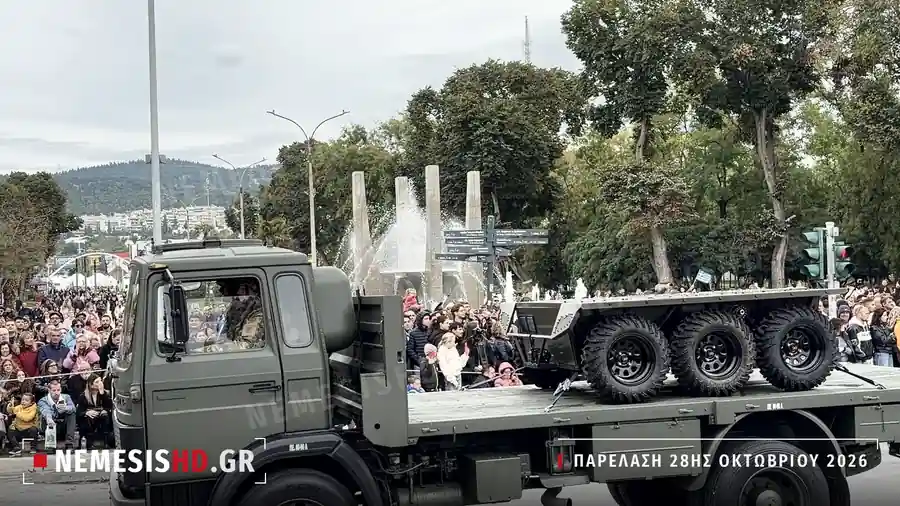
“Antaios” is a Greek ground robot that is not designed to fight but to do the job that in Ukraine costs many lives: carrying ammunition, water and casualties over the last kilometres before the front line, where every movement of a person or vehicle is spotted by a drone and hit within minutes. It was presented in the military parade of October 28, 2026 in Thessaloniki, on an Army truck, and is of Greek design and manufacture. It belongs to a category of systems that Ukraine has shown to be essential on the modern battlefield.
What “Antaios” is: the official characteristics
According to the official description of the parade’s systems, “Antaios” is an unmanned ground vehicle (UGV) with a six-wheel (6×6) architecture and a high-strength frame. It carries a payload of 600 kg and has an operational endurance of up to 8 hours, while its acoustic and thermal signatures are particularly low, meaning it makes very little noise and is hard to see on a thermal camera, which for a front-line vehicle is as important as armour. The missions it is intended for are resupply, rescue of soldiers and evacuation of casualties, and surveillance and reconnaissance, while depending on configuration it can act as a communications carrier or a weapons carrier.
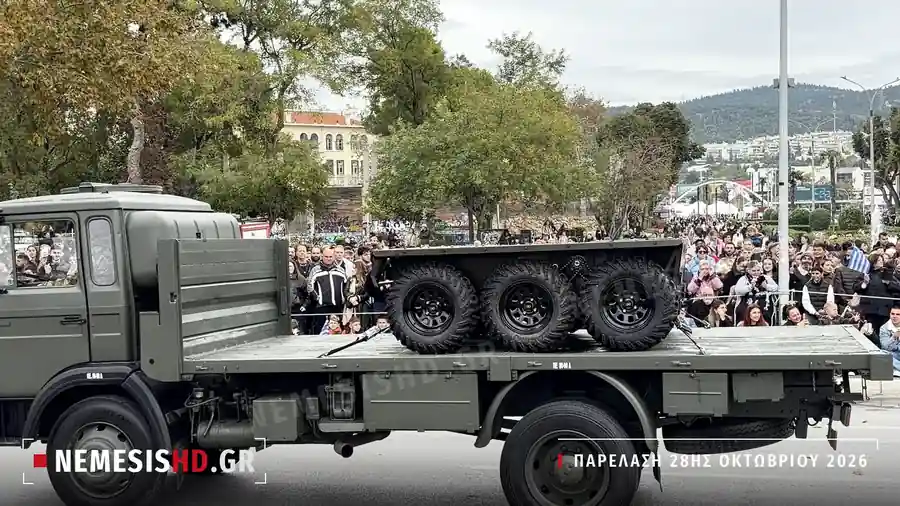
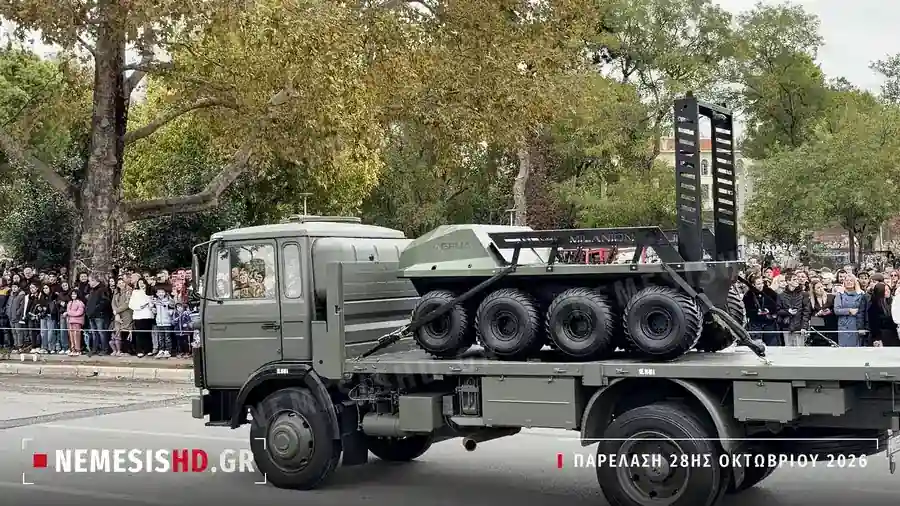
In the photographs “Antaios” is a low, flat platform with six large off-road wheels and no superstructure, with a “mule” logic: the load, a stretcher or a weapons system is mounted on the platform. The low profile helps it hide behind embankments, hedgerows and ruins, and its six wheels give traction in mud and rough terrain without the complexity and weight of tracks. It is the same class of vehicle as the Ukrainian Frodo and the dozens of similar platforms that Ukraine now sends to the front in large numbers.
Why ground robots changed the front-line supply chain
In Ukraine the “dead zone” in front of the positions widened in three years from a few hundred metres to several kilometres, because FPV drones and loitering munitions hit anything that moves. A resupply truck or an armoured ambulance is now a high-priority target, and the evacuation of a casualty can be delayed for days. UGVs solved part of the problem in a simple way: if the robot is hit, a machine is lost and not its crew. That is why Ukrainian units now do much of their front-line resupply with ground robots, and several have carried out casualty evacuations and offensive missions with armed UGVs.
For the Hellenic Army, the scenario that looks most like Ukraine is Evros: a flat, open field along the river, where a clash would take place under dense drone surveillance from both sides. There a vehicle that carries 600 kg of ammunition or casualties on stretchers, quietly and with a small thermal trace, can keep a platoon alive without risking drivers. The same vehicle, as a communications carrier, can carry a relay or antenna to link positions without line of sight, and as a weapons carrier can lift a machine gun on a remote station or anti-armour weapons. On the islands, the same role can be filled on rocky terrain and trails where a crewed vehicle would be exposed.
What must follow the parade
“Antaios” takes its name from the giant of mythology, son of Gaia, who was invincible as long as he touched the earth, because from it he drew his strength, until Heracles lifted him into the air and defeated him. For a ground vehicle, the name fits perfectly. The real test, however, is what a parade does not show: the resilience of the control link in an electronic-warfare environment, where the Ukrainians end up more and more often with optical fibres and relays, the degree of autonomy in movement, the cost, the ease of repair by the units themselves and, above all, the number. Ukraine counts its robots not in units but in thousands, because they are lost constantly. If “Antaios” goes into serial production, it will have to enter the organisation of every infantry unit as an expendable asset, like drones, and not as expensive equipment kept for exercises..