Military & Defense
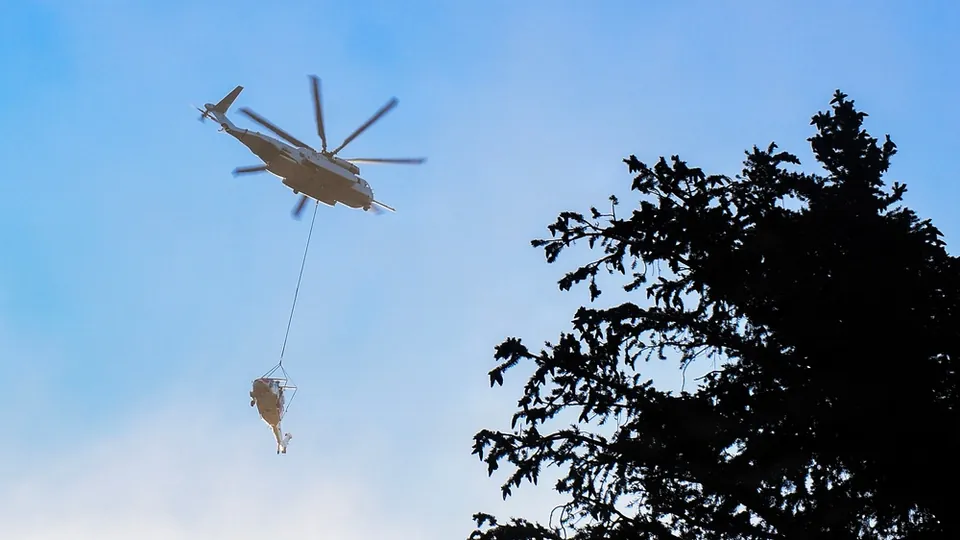
U.S. Marine Corps CH-53K lifts a downed MH-60S Seahawk out of the Sierra Nevada with a 70-foot long-line
A U.S. Marine Corps CH-53K carried a downed U.S. Navy MH-60S out of the Sierra Nevada on a 70-foot long-line, delivering it to China Lake without further damage, the programme office says.

A U.S. Marine Corps CH-53K King Stallion has lifted a downed U.S. Navy MH-60S Seahawk off a mountainside in California’s Sierra Nevada, carrying it on a long-line to an airfield without causing further damage, according to a Naval Air Systems Command release published on 4 November 2026. The recovery took place in late September, and the helicopter, which the release says suffered no damage in a hard landing, is expected to fly again without extensive maintenance.
The release, issued by the H-53 Heavy Lift Helicopters programme office (PMA-261) and distributed through DVIDS, describes the MH-60S as belonging to Air Test and Evaluation Squadron (VX) 31. It landed hard at an elevation of about 10,000 feet and could not take off again because of the angle of the terrain. The aircraft, which weighs nearly 16,000 pounds, was then lifted by a CH-53K of Marine Operational Test and Evaluation Squadron (VMX) 1 and delivered to an airfield at Naval Air Weapons Station China Lake. The release does not describe the cause of the landing or mention any injuries.
Why the CH-53K was the only option
The remote site and its altitude made the job difficult. Getting people and equipment to the spot was hard, and the release says defuelling the helicopter to cut its weight would have been extremely difficult. According to the programme office, the CH-53K was the only aircraft able to carry out the recovery given the power required and the restrictive terrain.
Major Lee Henderson, the VMX-1 pilot and lead planner, said the team combined established MH-60S crane-lifting procedures and the hoist sling with a 70-foot long-line to spread the load and keep clear of obstacles. Because that line is longer than the standard U.S. Marine Corps sling line used across the military, the operation also served to certify the CH-53K for its use.
Rigging built in under two weeks
Engineers from the Naval Air Warfare Center Aircraft Division (NAWCAD) Cargo Lab and Structures Lab developed a special rigging configuration. Instead of lifting by the main rotor head, they used the helicopter’s built-in lift points and the hoisting sling designed for them, so as to preserve its structural integrity. Only the main and tail rotor blades were to be removed to protect them in transit. The H-60 Fleet Support Team at Marine Corps Air Station Cherry Point, North Carolina, advised on configuration and weight reduction.
The team tested a commercially available long-line with a Defense Supply Center crane up to 20,000 pounds at Naval Air Station Patuxent River, Maryland, then ran the data through flight clearance. Brandon Norris, the Structures Lab team lead, said it took less than two weeks from the squadron’s request to complete testing and obtain the clearances, using existing infrastructure to cut costs.
Michele Hoefer, an aerospace engineer at the Cargo Lab, said the heavy weight, the elevation, the distance and the weather put the CH-53K “in the corner of its envelope” for power and fuel. Henderson said the helicopter’s available power, its precision flight-control system and its ability to calculate power available in real time from engine performance and environmental conditions reduced the risk of the lift.
What it shows
The release presents the operation as a demonstration of an integrated Navy and Marine Corps team working in an austere environment and notes that it let the CH-53K be certified for the longer line. No further recoveries are announced in the material read for this article.