
Defense Industry
Corsair: the Saronic autonomous vessel the Hellenic Navy wants, the evaluation and the request for 30+ craft
Saronic’s Corsair autonomous surface vessel passed in the October 28 parade after Greece completed its evaluation and asked the US to buy it. Official data, the Navy’s plans and how it fits with the Greek unmanned boats.

Saronic’s Corsair is the vessel with which the Hellenic Navy is testing what “autonomous” really means at sea: not a remote-controlled speedboat, but a craft that decides its own route and cooperates with other craft in a swarm, with a human keeping final control. The American vessel passed in the military parade of October 28, 2026 in Thessaloniki right behind the Greek “Pyrpolitis” craft, as it had been displayed next to them at the October 13 inauguration of the unmanned-systems training centre at Skaramangas (our report: “Pyrpolitis”: the Hellenic Navy’s new Greek-made unmanned vessel). Greece has already completed its evaluation and has asked the US to buy it, which brings it close to acquisition.
What the Corsair is: Saronic’s official data
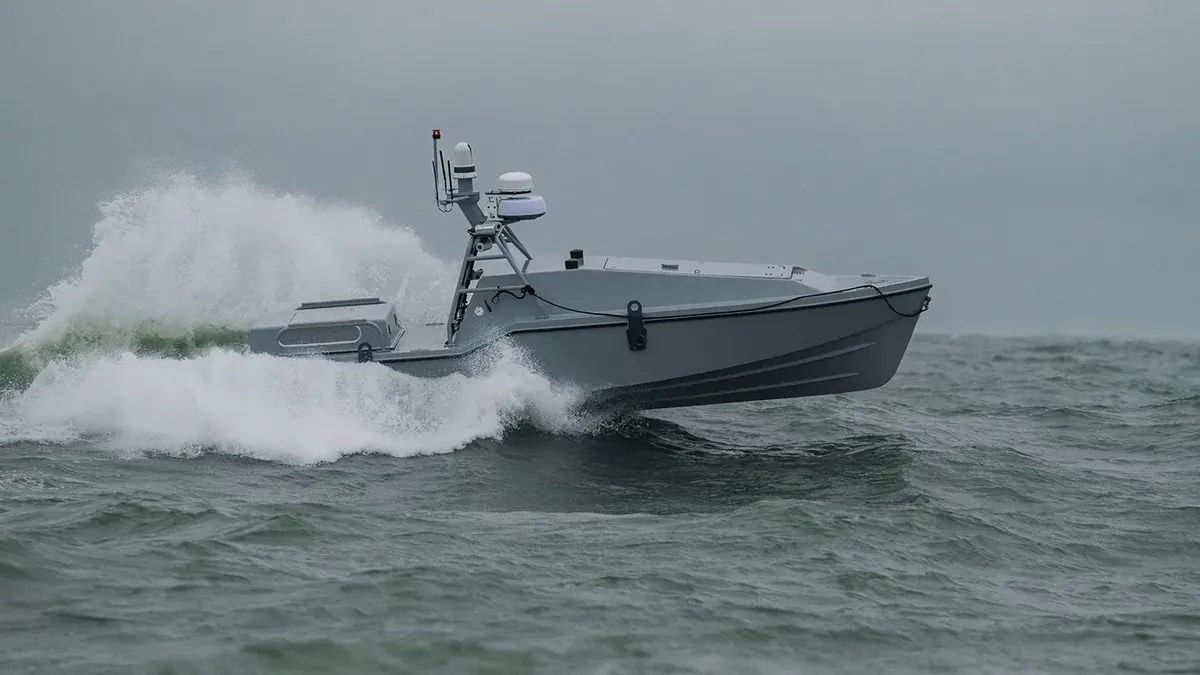
Saronic Technologies is a company from Austin, Texas, founded to build only autonomous surface vessels. According to its official data, the Corsair is an autonomous surface vessel (ASV) 24 feet long, about 7.3 metres, with a payload of up to 1,000 pounds (about 454 kg), a range of more than 1,000 nautical miles and a speed of more than 35 knots. Range is what sets it apart from small attack craft: with over a thousand miles, a Corsair could cross the Aegean from end to end several times before needing refuelling, and so stay for days in a surveillance area. In the parade the two outboard engines and the tall mast with sensors and antennas stood out, the “eye” and “voice” of the craft.
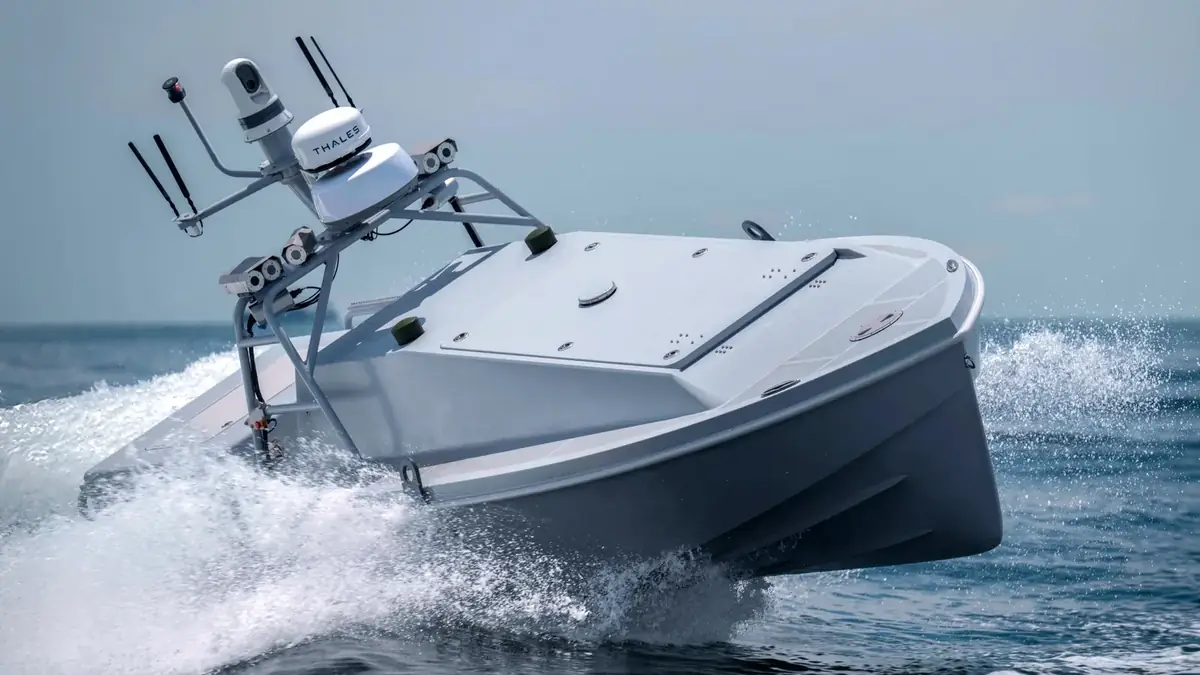
The real difference, however, is in the software. Saronic designs its vessels with mission-level autonomy: the operator sets the area and the purpose, and the craft plans its own route, avoids obstacles and other ships and adapts its course to the sea state, while many craft can share data and act in coordination. The control interface runs in a browser and can be integrated into existing command systems, while communications are multi-channel, with options for a jamming environment. The company also says the vessel is built in large numbers and is “attritable”, that is, designed so that its loss in a high-risk mission is acceptable.
The Navy’s evaluation and the request to the US
The Hellenic Navy tested the Corsair with fleet units taking part, including in tactical cooperation with warships. Defence Minister Nikos Dendias described its role as “surveillance, reconnaissance and cooperative autonomous action in swarms”, and at the Skaramangas inauguration he drew the distinction between unmanned and autonomous systems, saying the autonomous one “is a further step” that uses artificial intelligence “under the final control of the human factor”, with “enormous potential” for an archipelagic environment such as the Aegean. On the basis of the evaluation, the Greek government sent the US a Letter of Request for the vessels through the Foreign Military Sales (FMS) programme, as Baird Maritime recorded. According to military sources cited by Hellas Journal, the request is for more than 30 craft and the American answer is expected within 2026. The request is the first step of the FMS process: the US offer (LOA) follows, and only after it is accepted is there a contract.
Corsair, “Pyrpolitis” and “Anemogiannis”: how they fit together
That the Corsair passed in the parade with the Greek “Pyrpolitis” craft and shortly before the “Anemogiannis” was no coincidence, because the three vessels are not competitors but complementary. The “Pyrpolitis” and the “Anemogiannis” are Greek, smaller and cheaper craft that can be produced in numbers and used as weapons, while the Corsair is a long-range platform of advanced autonomy, better suited to surveillance, reconnaissance and coordinating a swarm. A Navy that has both could set up a network in which Corsairs find and track targets in the Aegean and the Greek attack craft deliver the strike, with the frigates and operations centres having a continuous picture without exposing crews. The crucial requirement for the Greek side, if the purchase goes ahead, is access to the software and interfaces, so that American and Greek craft can really talk to each other.