
Greece
The Hellenic Navy’s FDI HN “Kimon” class frigates: full analysis – the systems, the weapons and the programme
A complete guide to the Hellenic Navy’s four FDI HN “Kimon” class frigates: contracts and deliveries, the platform, the SETIS combat system, Sea Fire radar, 32 Aster 30, Exocet, sonars, helicopters, upgrades to 2030 and Greek industry.

The FDI HN frigates of the “Kimon” class are the first new front-line ships the Hellenic Navy is receiving since the MEKO 200HNs of the 1990s, and their power comes from the cooperation of radar, missiles, sonar, helicopter and digital architecture in a single combat system. In the full configuration of the class, as recorded by the Hellenic Navy General Staff, each ship carries 32 Aster 30 air-defence missiles, the Sea Fire fixed-array radar, eight Exocet MM40 Block 3C anti-ship missiles, a RAM close-in defence system, a CAPTAS-4 Compact towed sonar and a hangar for an MH-60R helicopter together with Camcopter S-100 unmanned aircraft. “Kimon” was delivered in December 2025 and has been in Greece since January 2026, “Nearchos” raised the Greek flag on October 30, 2026, “Formion” is delivered in December and “Themistoklis” by 2028. We will examine the ship system by system: the platform, its digital heart, the sensors, each layer of air defence, surface warfare and anti-submarine warfare, the flying assets, the Standard configurations up to 2030, Greek industrial participation and the issues that remain open. We will update our full guide at each new milestone of the programme.
From the “3+1” to four frigates: contracts, cost and deliveries
The contracts were signed on March 24, 2022 and ratified by Law 4891/2022. Contract 016B/21 covers three frigates with an option for a fourth, together with MU90 torpedoes and CANTO torpedo countermeasures from Naval Group, spare parts and crew training, while contract 017B/21 covers the in-service support of the ships, with know-how transfer and technical assistance. In the contract as amended in 2025, the first three ships in the basic Standard 1 configuration are priced at €659.5 million, €654.5 million and €639.46 million, the “additional capabilities” of the Standard 2 configuration at €68.3 million for each ship, the 15 MU90 torpedoes at €41 million and the 54 CANTO countermeasures at €6 million. Together with spares, studies and training, and after the discount provided for, the three-ship strand reaches €2.255 billion, while the initial in-service support period is priced at €138 million. The ships are built at Naval Group’s yard in Lorient, Brittany, in parallel with the French FDIs, and in the Hellenic Navy they form the “Kimon” class, while the export name of the design is Belharra. Greece was the first customer of the FDI outside France, and the Greek version differs from the French mainly in air defence, with twice the number of Aster missiles and a RAM system.
The fourth frigate came back onto the table in September 2024, when Minister of National Defence Nikos Dendias announced at the launch of “Nearchos” the start of negotiations for a 4th FDI and for cruise missiles. KYSEA approved the acquisition on September 17, 2025 and the same day the bill amending the two contracts was tabled in Parliament, voted as Law 5235/2025 (Government Gazette A’ 173/7.10.2025), and in mid-November 2025 the General Directorate for Defence Investments and Armaments (GDDIA) and Naval Group signed the contract for “Themistoklis”. The amended contract prices the fourth frigate, delivered directly in a Standard 2+ configuration, at €791.6 million, and with studies, spares and the upgrade to Standard 2++, after the €18 million discount, the total strand for the fourth ship comes to €791.4 million. The support contract adds a new in-service support period of €56.2 million. The new contract covers the fourth frigate and its maintenance, as well as extending new capabilities to the whole FDI HN fleet, while Naval Group commits that 25% of the value of the fourth ship will be Greek participation. The Greek programme now includes four contracted ships.
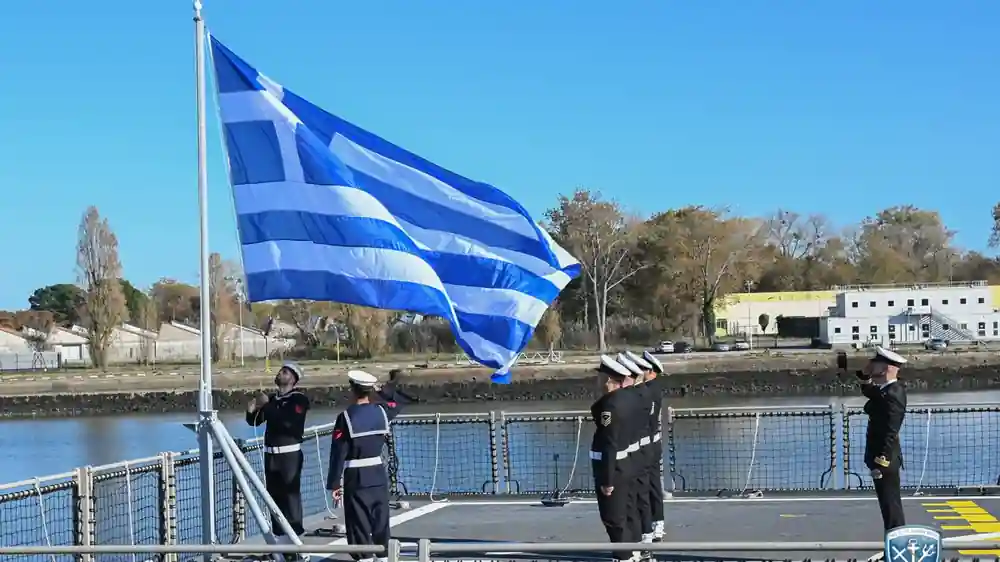
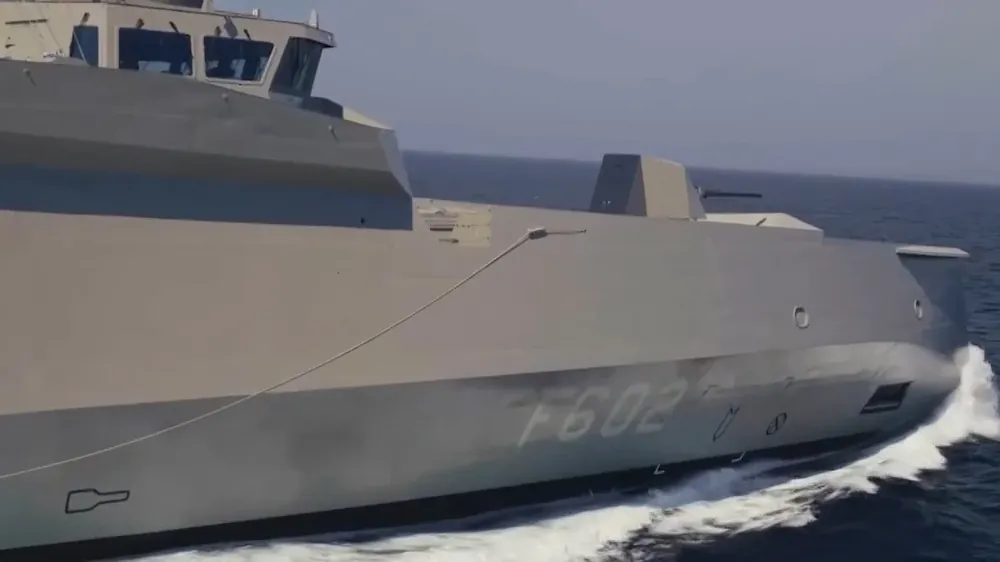
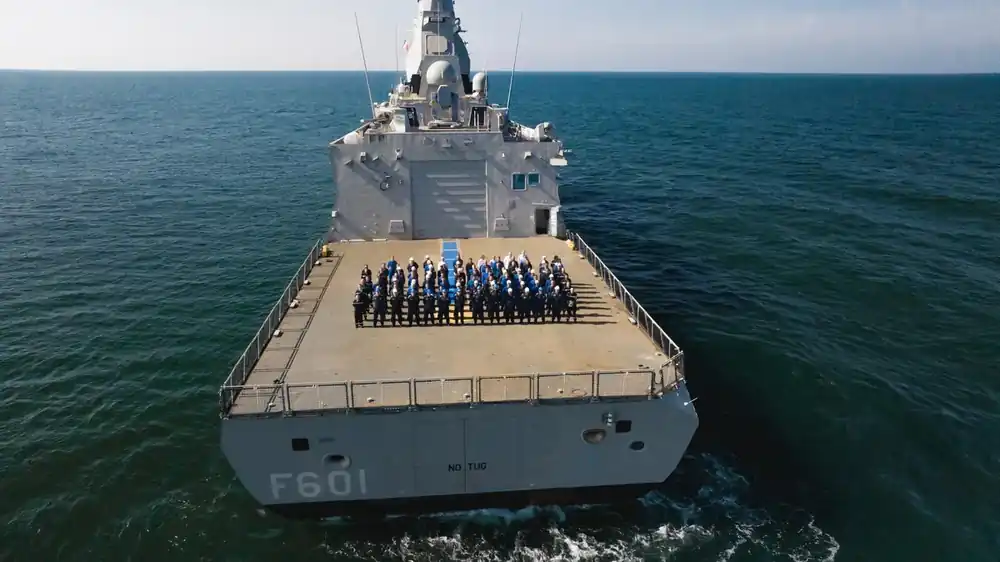
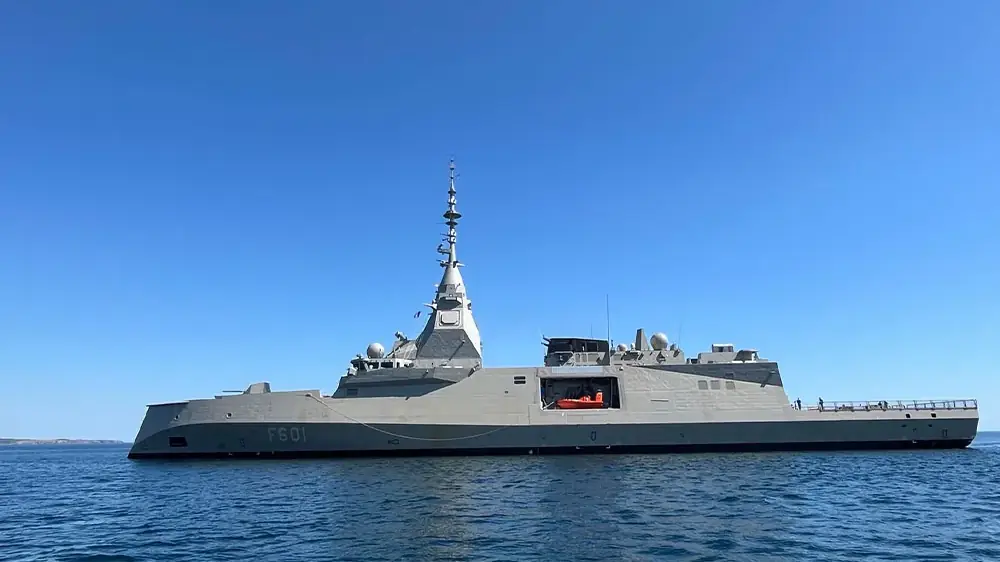
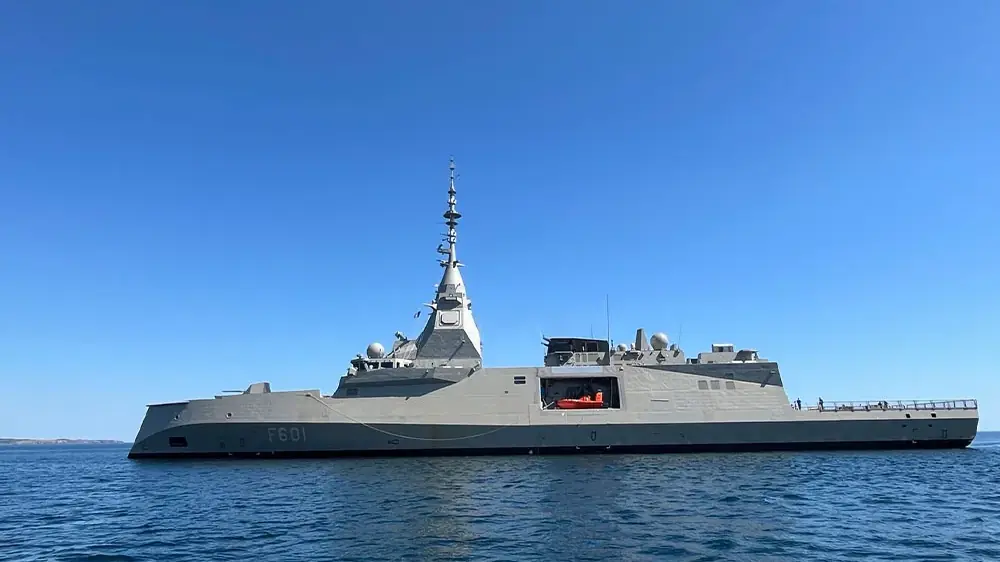
“Kimon” (F-601) was launched on October 4, 2023, began sea trials in May 2025 and raised the Greek flag in Lorient on December 18, 2025, less than four years after signature and two months after the delivery of the first French FDI, “Amiral Ronarc’h”. From Lorient she called at Brest, where she loaded her Aster 30 missiles, and arrived in Greece on January 15, 2026. In March 2026, two months after her arrival, she deployed to Cyprus together with the frigate “Psara” to protect the island at the start of the war in the Middle East. “Nearchos” (F-602), which was launched on September 19, 2024 and put to sea for the first time in February 2026, was delivered on October 30, 2026 in the presence of Nikos Dendias, with an acceptance crew of 128; we covered the flag raising at Lorient. “Formion” (F-603), launched on June 4, 2025, put to sea for trials on June 22, 2026 and is delivered in December 2026, but will remain in Lorient until spring 2027, since the contract provides that work on the ship’s Standard 2 and 2+ will be done in France by April 30, 2027. “Themistoklis” is being built in Lorient and the contract provides for her delivery in a Standard 2+ configuration by December 31, 2028.
| Ship | Status (November 2026) and contract deadlines |
|---|---|
| “Kimon” (F-601) | Delivered 18/12/2025 in Standard 1, in Greece since 15/1/2026. Standard 2 and 2+ in Greece by 31/10/2027 |
| “Nearchos” (F-602) | Delivered 30/10/2026 at Lorient, in Standard 2. Standard 2+ in Greece by 31/1/2028 |
| “Formion” (F-603) | Delivery in December 2026 in Standard 1. Standard 2 and 2+ in France by 30/4/2027 |
| “Themistoklis” | Under construction, delivery in Standard 2+ by 31/12/2028 |
The platform: inverted bow, CODAD propulsion and space for special operations
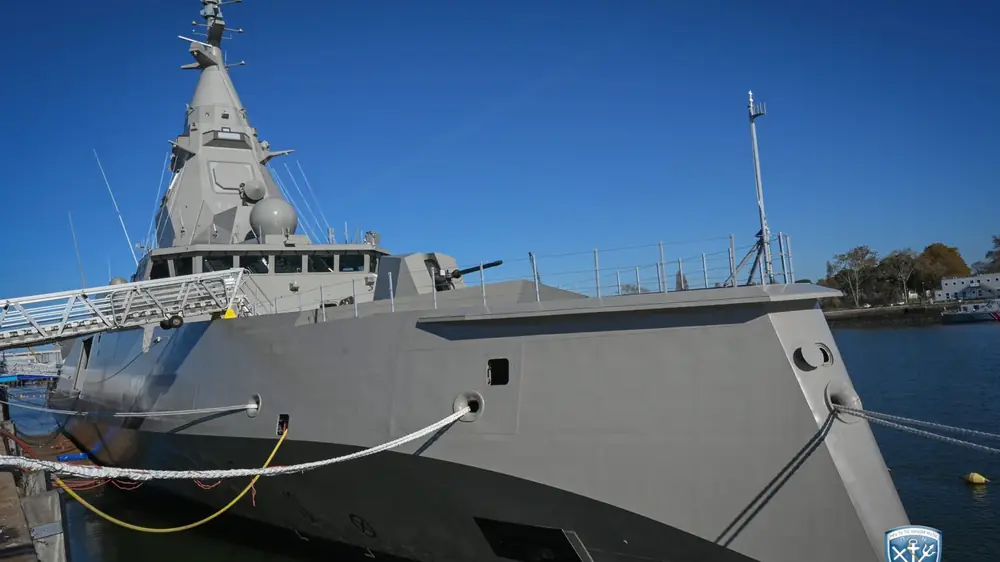
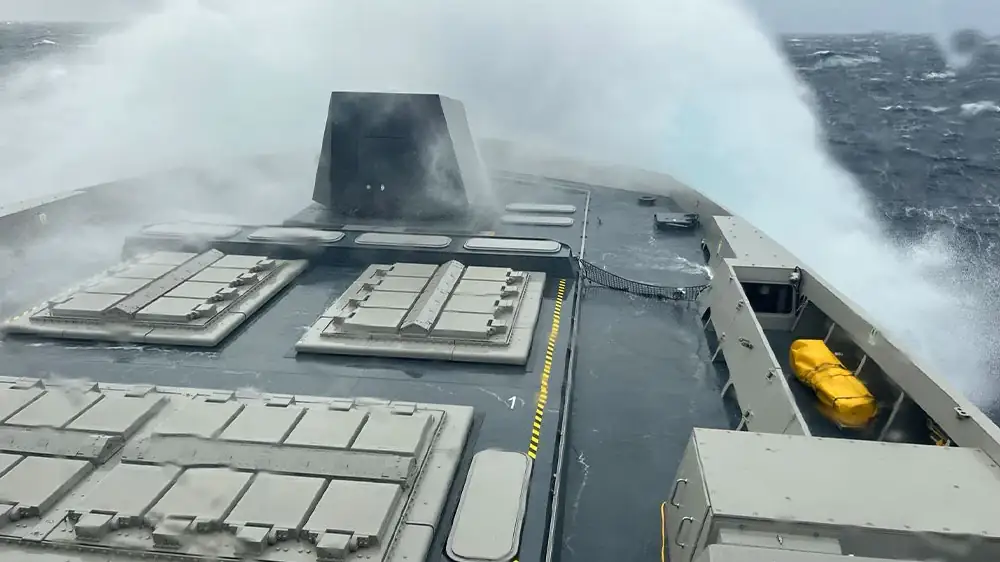
“Kimon”, like every Greek FDI, is 121.6 metres long, 17.7 metres wide, with a draught of 6.2 metres and a displacement of 4,603 tonnes. She is significantly smaller than a 142-metre, roughly 6,000-tonne FREMM. Her most recognisable feature is the inverted bow, like that of the Averof: its most forward point is at the waterline and the stem leans backwards as it rises, the opposite of a conventional bow. This shape cuts through the wave instead of riding over it, reduces pitching (the ship’s fore-and-aft “rocking”) and lets the vessel keep speed in bad weather, while a steadier ship also means a steadier platform for the radars, launchers and flight deck. The first French FDI tested this behaviour in the Atlantic in sea state 7, that is, with waves of 6 to 9 metres. The hull and superstructure have flat, sloped surfaces for a smaller radar cross-section (the ship’s “footprint” on radars), a tradition of the French Navy since the La Fayette frigates of the 1990s.
Propulsion is CODAD (Combined Diesel and Diesel), that is, diesel engines only, combined according to the speed required, without a gas turbine. Four MTU 8000-series diesel engines, each up to 8,000 kW, give about 32 MW in total on two shafts. Maximum speed is 27.5 knots, range reaches 5,000 nautical miles at 15 knots and endurance 45 days of operations without replenishment.
Automation allows a small crew: the FDI was designed for a crew of 125 and 28 additional personnel, and the Greek version has accommodation for 149 people with the embarked helicopter. Naval Group also designed the FDI for the immediate deployment of special forces, a mission of particular value in the Aegean, with its hundreds of islands and islets.
| Characteristic | FDI HN “Kimon” class frigate |
|---|---|
| Dimensions | 121.6 × 17.7 × 6.2 m |
| Displacement | 4,603 tonnes |
| Propulsion | CODAD, 4 MTU diesel engines, 2 shafts |
| Speed / range | 27.5 knots / 5,000 nm at 15 knots, 45 days |
| Accommodation | 149 people |
| Combat management system | SETIS (Naval Group) |
| Radar | Sea Fire (Thales), 4 fixed AESA antennas |
| Sonar | Kingklip Mk2 (hull-mounted), CAPTAS-4 Compact (towed) |
| Air defence | 32 Aster 30 in 4 Sylver A50, RAM 21 missiles |
| Surface warfare | 8 Exocet MM40 Block 3C, 76/62 Super Rapido gun, 2 Lionfish 20 mm |
| Anti-submarine warfare | 4 torpedo tubes (2 twin) for MU90, CANTO countermeasures |
| Flying assets | 1 MH-60R or S-70B-6 and 2 Camcopter S-100 |
The digital ship: SETIS, two data centres and cyber protection
The FDI is presented as the first “digital” frigate, and behind the marketing phrase there is a real change of architecture. On older warships each system had its own computers, which communicated with each other through interfaces. On the FDI a large part of the ship’s software is hosted virtually in two data centres, in a redundant architecture designed from the outset with protection against cyber attacks, so that the ship’s operation does not depend on a single point. The same scheme allows the gradual upgrading of the ship, which directly interests the Hellenic Navy for the next thirty years: Naval Group designed the FDI to evolve through successive upgrades, instead of a mid-life modernisation programme like the one under way today on the MEKO 200HNs.
On this base runs Naval Group’s SETIS combat management system. SETIS gathers the data of the radar, sonars, electronic warfare, optronics and data links into one tactical picture and assigns targets to weapons. This also explains the Standard configurations: a weapon is fully exploited when it is integrated into SETIS together with the other weapons and sensors. The ship also has an integrated Thales communications suite and an identification friend-or-foe (IFF) system, with radio and satellite links in several frequency bands, based on NATO standards so that the frigate can act as a node within allied formations.
A lesser-known innovation is the dedicated station for countering asymmetric threats, from which the fight against small and nearby targets in the air and on the surface is coordinated, with the light guns and the Safran PASEO XLR panoramic optronic systems. When a ship faces simultaneous threats from the air and from fast boats or drones at short range, the air-defence battle continues without being burdened by close-range defence. For a navy operating in narrow passages, near coasts and among dense civilian shipping, like the Aegean, a separate station has practical importance.
The integrated mast and the Sea Fire radar
The frigate’s main air sensors are gathered on a single mast with the characteristic pyramid shape, so as to have continuous 360-degree coverage without “blind” sectors from other masts or superstructures. The main sensor is Thales’s Sea Fire multi-function radar, and Greece was its first customer outside France. Sea Fire is a fully digital solid-state radar with four fixed AESA (active electronically scanned array) antennas, that is, antennas that do not rotate but steer the beam electronically through many small transceivers. It operates in the S band (E/F in NATO nomenclature) with gallium nitride (GaN) transceivers, and simultaneously performs long-range air surveillance, surface surveillance and guidance of the air-defence missiles. For the Sea Fire of the French FDIs, the French Directorate General of Armaments (DGA) gives air coverage above 300 kilometres and 80 kilometres on the surface, 360-degree coverage in azimuth and 90 degrees in elevation and up to 1,000 tracks simultaneously. Each antenna measures 2 × 2.5 metres and weighs two tonnes, and the radar is designed to deal with complex threats too, such as ballistic and hypersonic missiles.
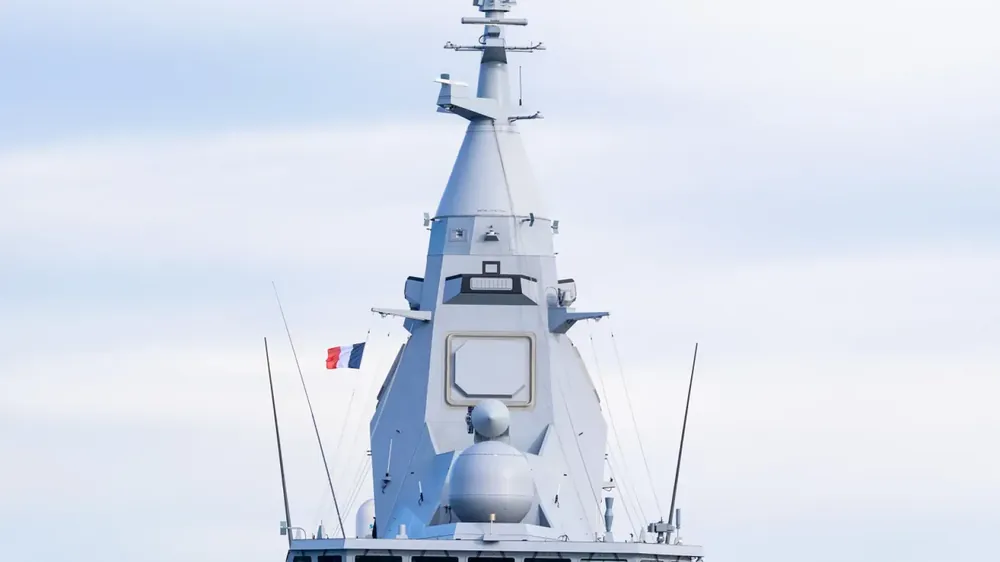
A rotating antenna “re-sees” each target once per rotation, while Sea Fire’s four fixed antennas can return to a threatening target as often as needed, carry out volume search in other sectors in parallel and send course updates to several missiles already in the air. This matters against missiles that fly a few metres above the sea and appear on the radar horizon only a few tens of kilometres away, where every second of reaction counts, as the combat scenario against the Atmaca and Tayfun shows. Next to Sea Fire, the ship carries Thales fire-control radar for the 76 mm gun, and the PASEO XLR panoramic optronics, which passively track small targets on the surface and in the air without emitting.
Area air defence: 32 Aster 30 in four Sylver A50
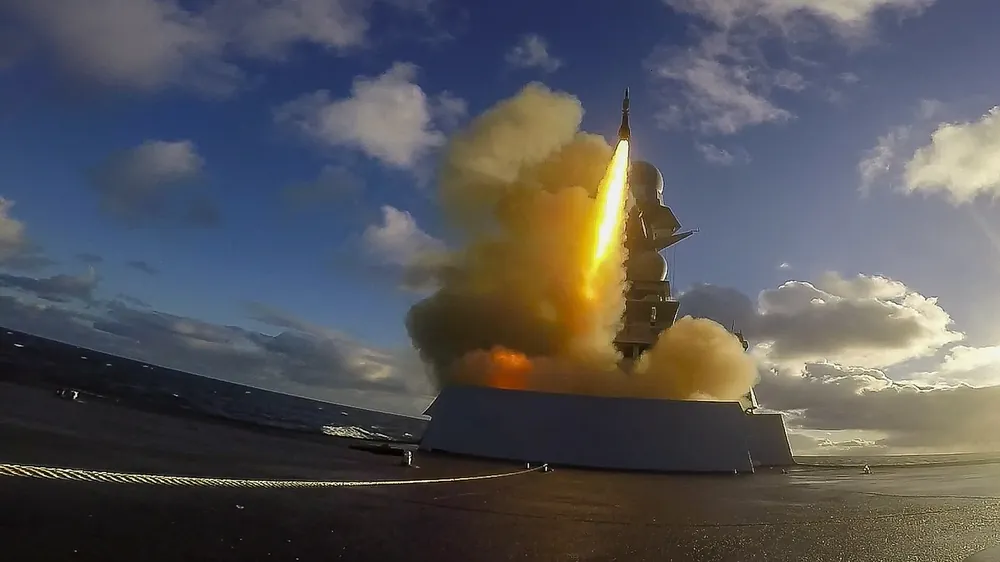
The frigate’s main weapon is the 32 MBDA Aster 30 Block 1 (B1) missiles, in canisters inside four eight-cell Sylver A50 vertical launchers on the foredeck. The first ships of the French version carry two launchers and 16 missiles, and France decided to equip its last two FDIs with 32 cells, essentially following the Greek configuration. In the contract, the system of 16 of the 32 missiles belongs to the additional capabilities of Standard 2. The Aster 30 weighs 450 kilograms, is 4.9 metres long and reaches Mach 4.5, with a range over 120 kilometres and an intercept altitude of up to 20 kilometres. It is a two-stage missile: after the first stage burns out, the terminal section, a light and very agile “dart”, is guided in the final phase by its own active Ku-band radar seeker. Its characteristic feature is the PIF-PAF system, the combination of aerodynamic control and direct thrust control, which allows the missile very sharp manoeuvres in the last leg of flight, so that it “corrects” its course exactly when a manoeuvring target tries to escape it. With the Aster 30 the frigate also protects other ships in its area, such as a convoy or an amphibious force, that is, it performs area air defence.
The B1 version adds capability against short-range ballistic missiles, which for Greece means an FDI in a suitable position can help protect specific points on land, such as a port or a base. The newer Aster B1NT, with a Ka-band seeker, extends protection to medium-range ballistic missiles, to heavily manoeuvring targets and to hypersonic threats. For the Greek FDIs the B1NT is a potential future upgrade and not a contracted capability. The Aster has been used in real engagements by European ships in the Red Sea, and in October 2025 a French frigate shot down with an Aster 30 a target simulating a hypersonic missile.
Close-in defence: RAM, the 76 mm gun and Lionfish
Behind the Aster there are three more layers. The first is the RAM (Rolling Airframe Missile) system, the launcher of 21 RIM-116 missiles on the roof of the hangar. The RIM-116 is a short-range missile that, once launched, needs no guidance from the ship: it has dual guidance, with a passive radio-frequency seeker that homes on the emissions of the incoming missile’s radar and an infrared seeker for the terminal phase. It is intended for anti-ship missiles that have passed the outer layer, but also for asymmetric targets in the air and on the surface. The Hellenic Navy already knows the system from the “Roussen” class missile boats, while the French FDI does not carry RAM. In the contract, the RAM system belongs to the additional capabilities of the Standard 2 configuration, explained below.
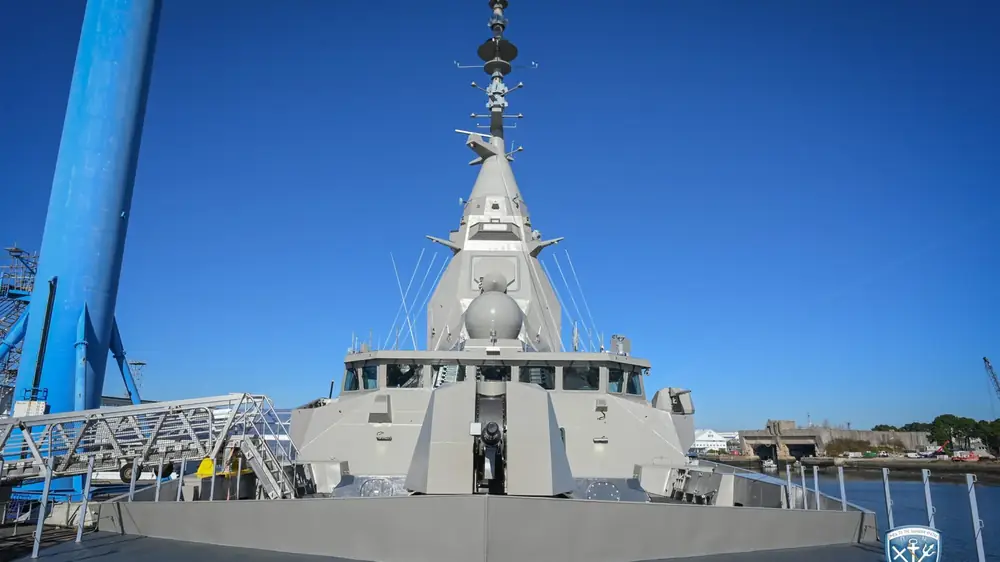
The second layer is the Leonardo 76/62 Super Rapido gun, mounted in a low-radar-signature dome on the foredeck. It fires up to 120 rounds per minute with 80 rounds ready to fire, has a reaction time under three seconds and a maximum range of 16 kilometres with conventional ammunition, reaching 20 kilometres with extended-range ammunition. It is used for fire against ships and coasts, for warning shots in navigation-control incidents and, with the fire-control radar, as complementary defence against air targets. The third layer is the two Leonardo Lionfish 20 remotely operated guns, which in the Greek version replaced the French version’s Narwhal. They fire 20×128 mm NATO ammunition, have 250 ready rounds, a rate of fire of 100 to 300 rounds per minute in controlled fire and up to 1,000 in a burst, with an effective range over 2,000 metres. It is the weapon for fast boats, naval drones and small aerial drones, threats that the wars in the Red Sea and the Black Sea brought to the fore.
Electronic warfare and decoys: the battle before launch
The electronic warfare suite of the FDI HN is digital and comes from Thales. Its core on the FDI is Sentinel, a radar electronic support measures (R-ESM) system that detects, identifies and maps the radars of ships, aircraft and missiles around the frigate. Its value is twofold: it warns when a missile seeker “locks” onto the ship and gives the operations room a picture of who is emitting and from where, without the frigate revealing its position by turning on its own radars. This data enters SETIS together with the Sea Fire picture.
To deceive missiles, the Greek version carries four Lacroix Sylena decoy launchers, each with 12 electromagnetic SEALEM and 4 infrared SEALIR decoys, which “pull” a missile’s seeker away from the ship or confuse it before it locks on. In the contract the air-defence decoy launching system (AAW DLS) belongs to the additional capabilities of Standard 2. For defence against torpedoes, the ship carries two Naval Group launchers for CANTO countermeasures, which create false acoustic targets so that the torpedo loses the real one, and the contract provides 18 CANTO countermeasures for each of the first three ships. Electronic warfare and decoys are the “soft kill”, the missiles and guns the “hard kill”, and the FDI combines them.
How it all works together: the frigate’s layered defence
The value of the systems described is seen when one watches them work together against an anti-ship missile attack. Before anything is even launched, Sentinel can detect the radar emissions of a ship or aircraft searching for the frigate, and SETIS can combine them with what the helicopter, the S-100 and the other units of the fleet see, so that the commanding officer knows from which direction the threat is coming. When the missiles are launched, they fly low and Sea Fire sees them as soon as they pass the horizon. From that moment the radar tracks each target separately, SETIS calculates which is most dangerous and assigns the Aster missiles, and Sea Fire sends course updates to the Asters until they open their own seekers. At the same time, the Sylena launchers fire decoys to divert any missile that keeps coming.
Whatever gets past the Aster and the decoys reaches RAM, in the last kilometres, and whatever remains meets the 76 mm gun. At the same time the Lionfish, from the asymmetric-threats station, can deal with fast boats or drones approaching from another direction. The logic of layers is that no weapon needs to be perfect, as long as each layer reduces the number of threats reaching the next. The limit of the chain is numerical: indicatively, with 32 Aster cells and a two-missiles-per-target tactic for a higher probability of kill, a frigate in Standard 2 can engage with the outer layer up to 16 incoming missiles before relying only on RAM and the guns. That is why the number of cells, missile stocks and cooperation with other ships, with which the FDI shares the picture and the defence, matter.
Surface warfare: Exocet MM40 Block 3C
For surface warfare the frigate carries 8 MBDA Exocet MM40 Block 3C anti-ship missiles in two quadruple launchers. Block 3C is the newest version of the Exocet family, which the French DGA qualified and took delivery of in 2024, with a 250-kilometre-class range, a new latest-generation active radar seeker with better target selection and resistance to electronic jamming, and salvo synchronisation, so that several missiles reach the target simultaneously from different directions. It flies very low over the sea with reduced thermal and radar signature, can follow complex three-dimensional trajectories with waypoints and, with GPS guidance, can also strike land targets near the coast.
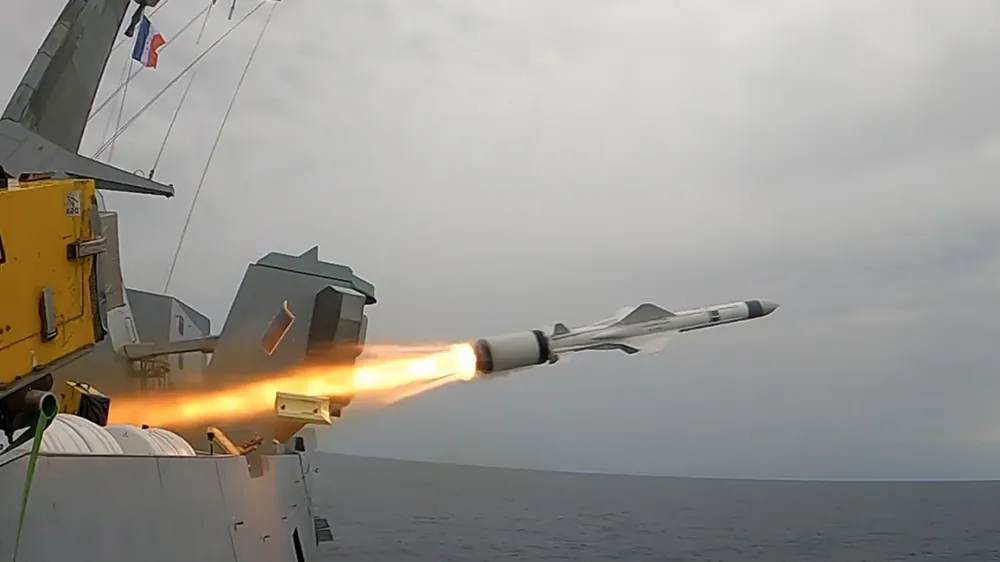
A 250-kilometre missile, however, is only as useful as the ship’s ability to “see” the target beyond the horizon. Sea Fire, like any ship’s radar, sees surface ships up to roughly the horizon, and the DGA gives 80 kilometres of coverage on the surface, so full exploitation of the Exocet goes through the helicopter, the Camcopter S-100, other units of the fleet and the data links. The Block 3C Exocets of the frigates add to the Navy’s coastal Exocet batteries Block 2, and together they create a web of anti-ship missiles in the Aegean and the Eastern Mediterranean.
Anti-submarine warfare: Kingklip Mk2, CAPTAS-4 Compact and MU90
The FDI inherits the anti-submarine tradition of the French FREMMs, which have distinguished themselves in anti-submarine warfare, with the same family of CAPTAS-4 towed sonar and the same MU90 torpedoes. The ship carries two complementary Thales sonars. The Kingklip Mk2 is a medium-frequency hull-mounted sonar, active and passive, covering the area around the frigate. The CAPTAS-4 Compact is a low-frequency, variable-depth towed active and passive sonar: its acoustic source and hydrophone array are towed behind the ship and can operate at different depths, getting around the propagation limits created by the thermocline, the layer of water where temperature changes sharply. The Compact version has the same detection performance as the basic CAPTAS-4, with 20% less weight and about half the installation footprint. Low frequencies travel farther in water, which is why the CAPTAS-4 can detect submarines at distances a hull sonar does not reach. Its role in the Aegean is examined in our analysis of the CAPTAS-4 Compact.
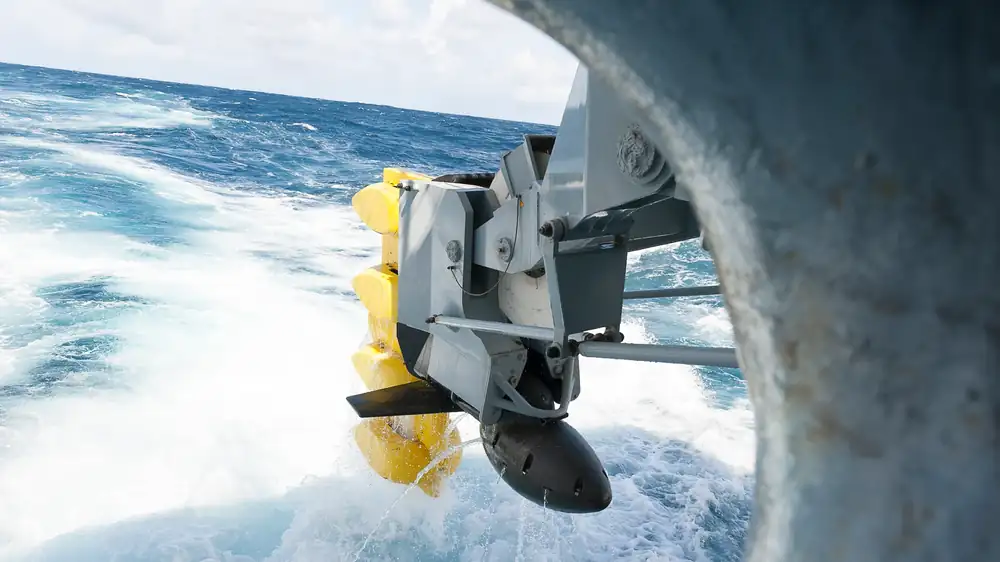
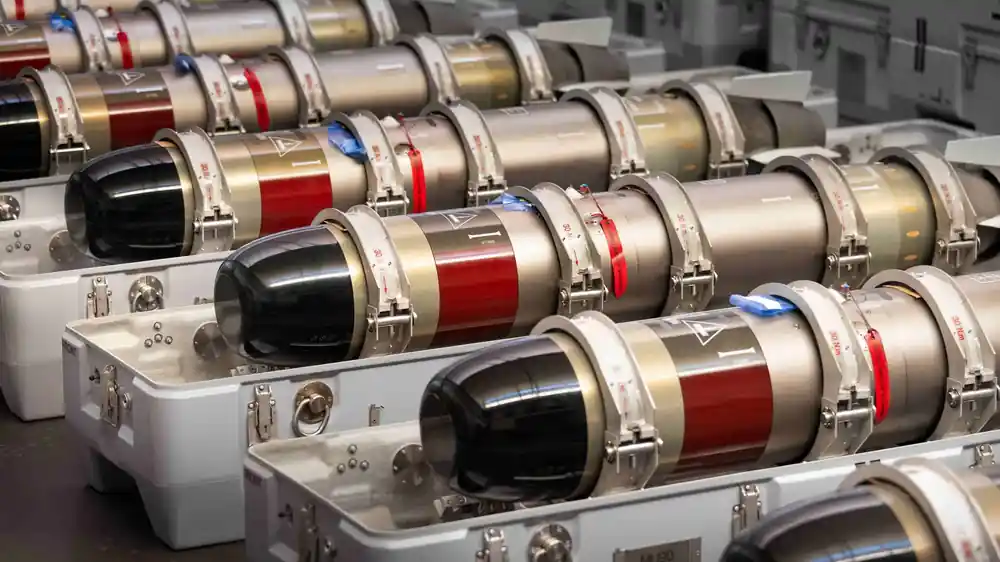
For engagement, the ship has four torpedo tubes in two twin launchers for Naval Group MU90 Impact lightweight torpedoes, and the contract provides five torpedoes for each of the first three ships. The MU90 weighs 304 kilograms, is 2.85 metres long and 323.7 millimetres in diameter, moves at 30 to 50 knots and operates at depths from 3 to over 500 metres, even in shallow water under 25 metres, with a range of 12 kilometres. The shallow-water capability is especially important for a theatre like the Aegean, where modern air-independent propulsion (AIP) submarines can move quietly near coasts and islands. In practice, however, the frigate will rarely hunt a submarine alone at close range. The CAPTAS-4 detects from afar, and the helicopter, with its dipping sonar, sonobuoys and torpedoes, goes to the spot while the ship keeps its distance from the submarine.
MH-60R and Camcopter S-100: eyes beyond the horizon
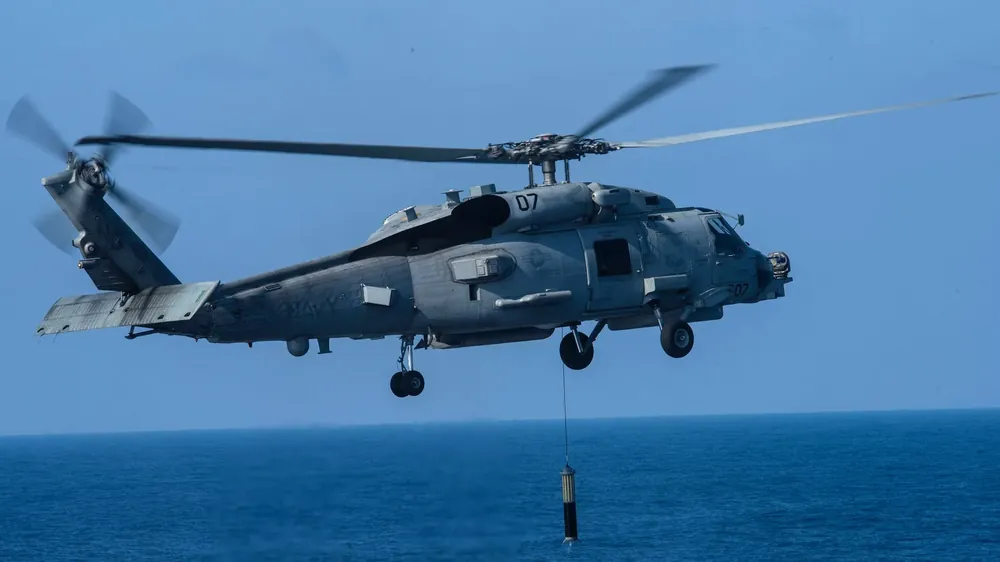
The FDI’s hangar was designed for a ten-tonne-class helicopter and for unmanned helicopters, with the Hellenic Navy planning two Camcopter S-100s per ship. In the Greek version this means the MH-60R Seahawk, while the ship can also receive the Navy’s S-70B-6 Aegean Hawks. Greece ordered seven MH-60Rs through the US FMS programme, four in July 2020 and three in April 2021, and the first three were presented on March 20, 2024 at the Naval Helicopter Base at Kotroni, with two more received a few days ago. The MH-60R carries the ALFS dipping sonar, based on Thales’s FLASH, sonobuoys, a maritime surveillance radar and lightweight torpedoes, and the Hellenic Navy has already fired guided APKWS rockets from it. With the helicopter, the frigate extends its anti-submarine warfare many tens of kilometres away and gains “eyes” over the horizon for surface warfare.
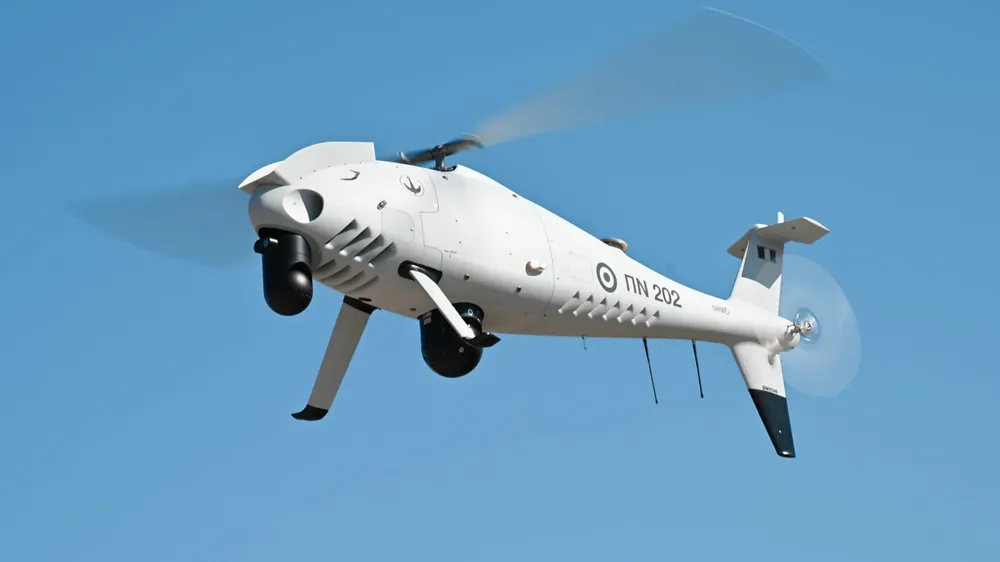
The second flying asset is the Camcopter S-100 from Austria’s Schiebel, whose contract was announced on February 13, 2026: four systems, for “Kimon”, “Nearchos” and “Formion” and one operating from land for training. In April 2026 the acceptance of the first two systems, with four aircraft, was completed at the Naval Helicopter Base at Kotroni. The S-100 has a maximum take-off weight of 200 kilograms, in a typical configuration carries 34 kilograms of payload for up to ten hours, operates beyond line of sight at distances up to 200 kilometres and can fly without GPS, which is valuable in a region with frequent jamming. The Greek S-100s carry the Wescam MX-10 electro-optical and thermal sight and the PT-8 Oceanwatch wide-area camera, which detects small objects over large stretches of sea, and anti-submarine warfare is among the missions for which the Hellenic Navy procured it. A ship that has both a manned and an unmanned helicopter can maintain continuous surveillance for many hours and keep the MH-60R available for pursuit and attack. The S-100 marked “PN 201” was shown to the public at the Thessaloniki parade on October 28, 2026, as we covered in Camcopter S-100 “PN 201”: the eyes of the FDI frigates.
From Standard 1 to the Standard 2+++ of 2030
The Greek FDIs evolve in successive configurations, which the amended contract defines as Standard 1, Standard 2, Standard 2+ and Standard 2++. The move to Standard 2 includes the contract’s “additional capabilities”, that is, the system of the 16 extra Aster missiles, the RAM system and the decoy launching system, together with “complementary capabilities” that complete each configuration. The physical installation of a launcher on the ship is not the same as its full integration into SETIS, that is, its control by the same system that manages the other weapons and sensors. That is why the RAM launcher is already installed and functional on “Kimon”, but its integration into SETIS, and thus the full capability, is completed with Standard 2, as happened with “Nearchos”.
The contract sets a different delivery configuration for each ship: “Kimon” and “Formion” are delivered in Standard 1, “Nearchos” in Standard 2 and “Themistoklis” in Standard 2+. For “Kimon” the work for Standard 2 and 2+ is done in Greece, with a deadline of October 31, 2027. For “Formion” the corresponding work is done in France by April 30, 2027, and “Nearchos” moves to Standard 2+ in Greece by January 31, 2028. Standard 2++ is completed in Greece for all ships: for “Nearchos” by April 2029, for “Formion” by June 2029, for “Kimon” by September 2029 and for “Themistoklis” by March 31, 2030.
After the September 2025 KYSEA, the Minister of National Defence said that “Themistoklis”, delivered in Standard 2+, will reach Standard 2++ with “1+10 increased capabilities”, cited among them the missiles of the European ELSA programme and added that the three earlier frigates will reach the same level, as the contract provides. In Parliament, on October 2, 2025, Nikos Dendias linked the upgrade with the introduction of Sylver A70 launchers for cruise missiles, within the available fiscal space. The final goal was announced at the delivery of “Nearchos” on October 30, 2026: all four Greek FDIs will be upgraded by 2030 to Standard 2+++, a configuration whose content has not been made public in detail. The 2030 goal must be distinguished from what has already been contracted: long-range strike capability still requires a launcher, a missile and a contract.
The difference between the launchers explains why long-range strike still requires new equipment. The Sylver A50 is long enough for the Aster, but not for a naval cruise missile like MBDA’s MdCN, which needs the longer Sylver A70. If one of the four A50s is replaced by an A70, the frigate will gain eight positions for cruise missiles but lose eight Aster positions, unless Aster launch from the new launcher is also certified. Greece has not ordered cruise missiles for the Greek FDIs, and was not among the six countries that signed the letter of intent for ELSA in February 2026, while France has already ordered the new MdCN Mk2 version. That is why the Turkish press headlines about a “ship with 1,000-kilometre missiles” describe a future option and not the armament with which “Nearchos” was delivered.
Greek industry in the programme
The programme also has an industrial dimension. Greek industrial participation in the first three frigates is estimated at 12%, while for the fourth Naval Group has committed to 25%. The participation includes construction work and subsystems, and more than 75 Greek companies take part in Naval Group’s frigate and submarine programmes, with work from Piraeus and Salamis to Volos, Thessaloniki and Florina. Salamis Shipyards and Naval Group Hellas have built in Greece hull sections that were integrated into ships of the series, Greek and French. The initial agreement provided for 21 sections, of which 15 had been delivered by June 2026, when the “Themistoklis” section also arrived at Lorient. One step further go the ten contracts with Greek companies signed by Naval Group at Euronaval in November 2026: the agreement with Salamis Shipyards concerns building sections for the Swedish FDIs, that is, Greek industry now extends to ships of a third country through Naval Group’s international production chain.

Sweden’s choice of the FDI also concerns the Hellenic Navy. More ships of the same family in three navies mean a larger user base for maintenance, spares and future upgrades, and may lead to new weapons and systems that could also pass to the Greek ships. The support of the ships in service has been assigned to Naval Group and will be carried out together with its subsidiary Naval Group Hellas and Greek industrial partners, without the share of Greek industry in this strand having been announced.
Greek, French and Swedish FDIs: the differences
The FDI is now being built for three navies, and the comparison shows what the Hellenic Navy chose. The first French ships carry two Sylver A50 launchers with 16 Aster 15 and Aster 30 missiles. The French ships have no RAM and carry Narwhal remotely operated guns and an NH90 helicopter. The four Swedish FDIs of the Luleå class will carry Aster 30 and CAMM-ER missiles, the latter in a new Naval Group cold-launch launcher, 57 and 40 mm guns, RBS15 anti-ship missiles and Torped 47 torpedoes. The Greek version stands out for its 32 Aster 30, the RAM in the hangar, the four Sylena decoy launchers and the Lionfish, that is, for a configuration with an emphasis on air defence and defence against saturation, reflecting the threats of the Aegean and the Eastern Mediterranean.
| FDI HN (Greece) | FDI (France, first ships) | FDI Luleå class (Sweden) | |
|---|---|---|---|
| Vertical launchers | 4 Sylver A50, 32 Aster 30 | 2 Sylver A50, 16 Aster 15/30 | Sylver A50 for Aster 30 and a cold-launch launcher for CAMM-ER |
| Close-in defence | RAM 21 missiles | No RAM | 40 mm gun |
| Main gun | 76 mm | 76 mm | 57 mm |
| Anti-ship | 8 Exocet MM40 Block 3C | 8 Exocet MM40 Block 3C | RBS15 |
| Torpedoes | MU90 | MU90 | Torped 47 |
What remains open
Several issues remain open. The first is the content of Standard 2+++, beyond the Standard 2+ and 2++ the contract already provides. The second is long-range strike, which needs an A70 launcher, a choice of missile and a contract, and which affects the number of Aster cells. The third is ammunition stocks: 32 cells is a strong number, but their value is judged by the available stocks of Aster and RAM for reloading and training firings, an issue Nikos Dendias linked in Parliament to fiscal limits. The fourth is ballistic missile defence, with the Aster B1NT as a potential future upgrade beyond the Aster 30 Block 1.
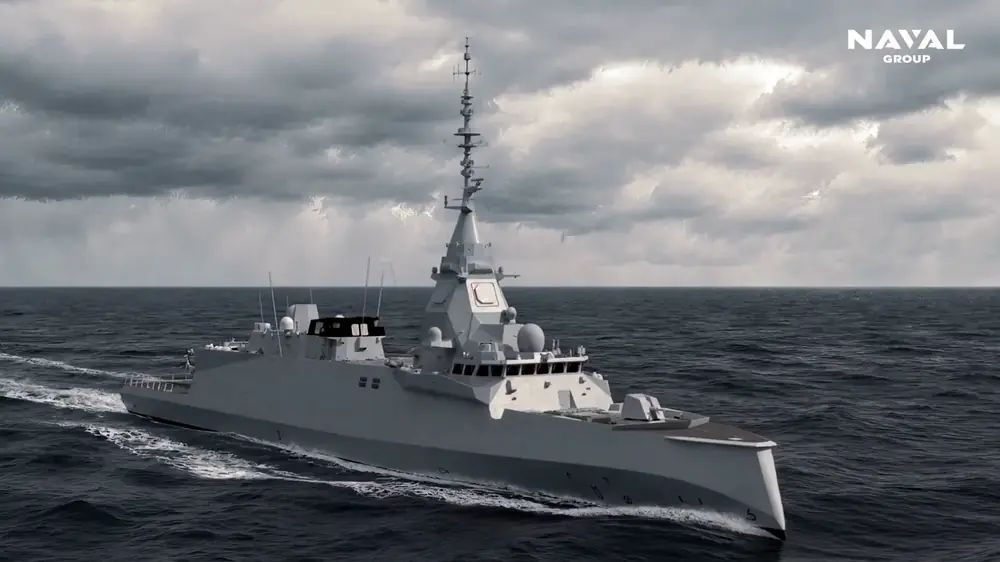
The fifth is the new versions of the FDI. At Euronaval 2026 Naval Group presented the FDI as a family of frigates, with variants carrying more weapons and mission modules (containers) for loitering munitions, drones to shoot down drones, missiles or laser weapons, without technical characteristics having been made public yet and without any Greek commitment to additional ships. The sixth is manning. The FDI was designed for a small crew thanks to automation, but four front-line ships, together with the Bergamini frigates expected from Italy, need trained radar, sonar, electronic warfare and digital-systems operators in a Fleet already under manning pressure. On that will depend, to a large extent, the operational value of the ships after 2028.
Related analyses: the Sea Fire radar, how the FDI HN’s AESA radar works; the CAPTAS-4 Compact, detecting submarines below the thermocline; the Aster 30 B1NT and the Greek FDIs; the Camcopter S-100 “PN 201”; the delivery of “Nearchos” at Lorient; and Greek participation in the FDIs.
Frequently asked questions about the Hellenic Navy’s FDI frigates
- How many FDI frigates is Greece buying? Four: “Kimon”, “Nearchos”, “Formion” and “Themistoklis”. The original March 2022 contract covered three ships with an option for a fourth, which was activated by a contract in November 2025.
- When are the FDI frigates delivered? “Kimon” was delivered on December 18, 2025 and “Nearchos” on October 30, 2026. “Formion” is delivered in December 2026 and will remain in Lorient until spring 2027 for Standard 2 and 2+, while the contract provides for the delivery of “Themistoklis” by the end of 2028.
- What radar do the FDI HN frigates have? Thales’s Sea Fire, a digital multi-function radar with four fixed AESA antennas on the integrated mast, which simultaneously performs air and surface surveillance and guides the Aster missiles.
- How many Aster 30 missiles does a Greek FDI have? 32 Aster 30 Block 1, in the Standard 2 configuration, in four eight-cell Sylver A50 launchers, against 16 Aster 15 and Aster 30 on the first ships of the French version. The missiles are guided by the Sea Fire radar.
- Can the Greek FDIs fire cruise missiles? Not in the current configuration. The Sylver A50 launchers accept Aster missiles, while for naval cruise missiles such as the MdCN the Sylver A70 launcher is required. The upgrade has been described by the Minister of National Defence, but there is no contract for cruise missiles.
- What is Standard 2 on the Greek FDIs? It is the configuration that adds, under the contract, the system of 16 extra Aster missiles, the RAM system and the air-defence decoy launching system. The contract provides for the upgrade of all four ships to Standard 2++ by 2030, and the official goal is Standard 2+++.
- Which helicopter does the FDI HN frigate carry? The hangar takes a ten-tonne-class helicopter, the MH-60R Seahawk or the S-70B-6 Aegean Hawk, and two Camcopter S-100 unmanned helicopters.
- How much is the Greek participation in the FDIs? Greek industrial participation in the first three frigates is estimated at 12%, while for the fourth Naval Group has committed to 25%. More than 75 Greek companies take part in Naval Group’s frigate and submarine programmes.