Asia-Pacific
JPMRC 27-01: U.S. Army moves from the Hawaii drop zone to a long-range maritime air assault
After a 3,000-mile airborne insertion from Alaska, the 25th Infantry Division and allies are fighting on Hawaiʻi and preparing a long-range air assault over the Pacific.

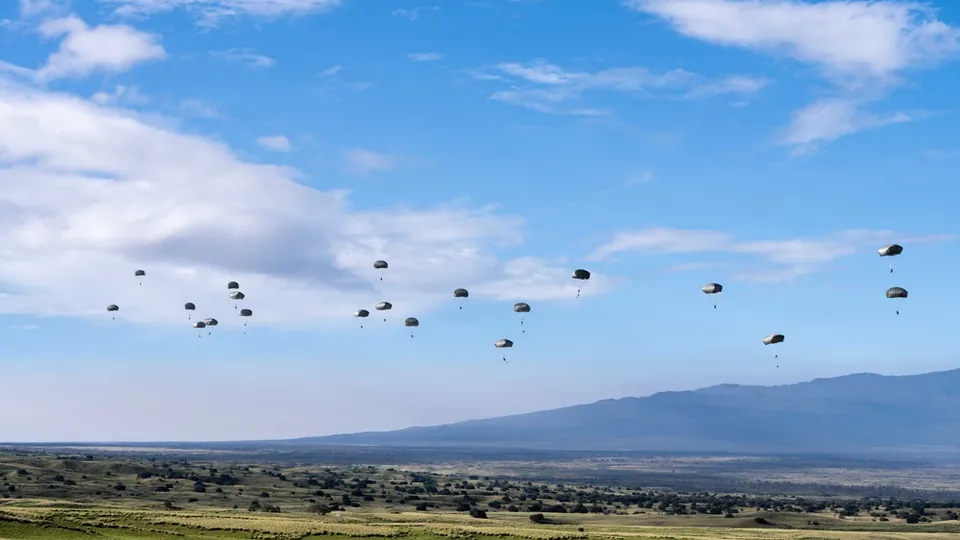
U.S. Army forces in Hawaii have moved from the parachute drop to a sustained ground fight in the Joint Pacific Multinational Readiness Center (JPMRC) Rotation 27-01, and a long-range air assault over open water is planned next, according to a U.S. Army account published on November 7, 2026.
The exercise follows an airborne insertion by roughly 300 paratroopers of the 11th Airborne Division, who flew about 3,000 miles from Alaska to the island of Hawaiʻi. With the drop zones secured, the 25th Infantry Division and its partners have shifted into a multi-battalion ground phase, the Army said.
From the drop zone to the sea
Forces are now moving at night and under strict electronic emission control, setting conditions for what the Army calls a Long-Range Maritime Air Assault. Elements of the 2nd Mobile Brigade are to be flown deep into contested terrain by the 25th Combat Aviation Brigade. Aviation and sustainment units are meanwhile running distributed arming and refuelling points across the island chain, so that the force can stay supplied without revealing its positions.
Lt. Col. Jo Nederhoed, the 11th Airborne Division’s public affairs director, said the exercise shows the ability to deploy rapidly from two separate staging bases on two continents and to project combat power across the U.S. Indo-Pacific Command area.
Networks built for a contested battlefield
A parallel event, Lightning Surge 6, is testing the 25th Infantry Division’s communications. Maj. Gen. Jeff VanAntwerp, the division’s commanding general, said it is one of two divisions currently equipped with a next-generation command-and-control system, with a cloud-based architecture that pushes computing power from brigades down to company level. Soldiers are using tactical mesh radios and secure, unclassified data layers. VanAntwerp described a shift away from a localised “troops in contact” mindset towards a dispersed, large-scale force-on-force approach.
Allies in the fight
JPMRC 27-01 involves military personnel from the Republic of Korea, Singapore, France, New Zealand, Japan and the Maldives, according to U.S. Army descriptions of the rotation. The account says Republic of Korea Army reconnaissance teams reached the Big Island aboard New Zealand aircraft the day before and observed the drop zones ahead of the air assaults.
Col. Aidan Shattock, a New Zealand Army officer who serves as the 25th Infantry Division’s deputy commander for interoperability, said the partnerships are long-term and that deterrence depends on building interoperability before a crisis, through secure communications, coordinated strikes, shared intelligence and mutual sustainment.
Why it matters
JPMRC is U.S. Army Pacific’s main regional combat training centre. It runs training across the Hawaiian Islands, Alaska and other Indo-Pacific locations, concentrating on archipelagic, jungle and arctic terrain. The long-range overwater movement of troops by air, tested here with allied participation, reflects the geography of the Pacific, where distances are large and forces must operate dispersed. The U.S. Army has not published results of the maritime air assault, which was scheduled for later in the exercise.