Europe
Sirens in Kaliningrad over a suspect aerial object, and Lithuania denies any involvement
Air-raid sirens sounded in Russia's Kaliningrad exclave on Saturday evening. Governor Alexei Besprozvannykh said the warning reacted to a suspect object from the Lithuanian side but there was no threat. Vilnius denied any involvement.

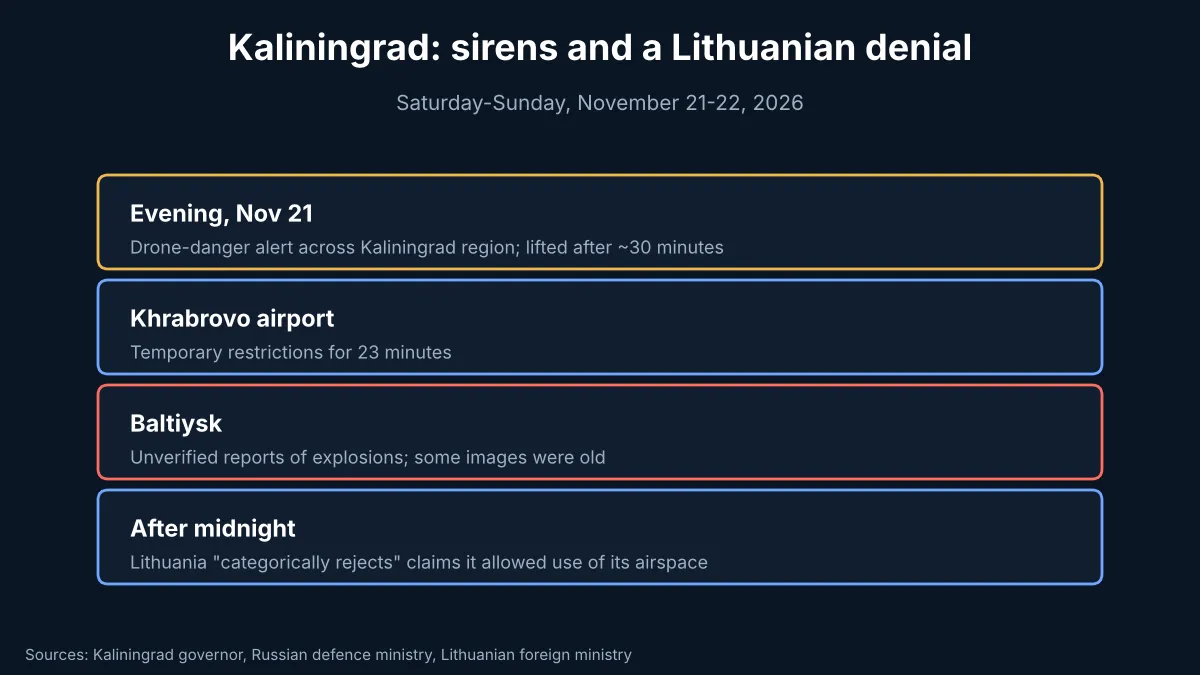
Air-raid sirens sounded on the evening of Saturday, November 21 in Russia’s Kaliningrad exclave, between Lithuania and Poland. Regional governor Alexei Besprozvannykh explained in a post that the “Drone danger” warning system was activated in the Neman area. “It reacted to a suspect object from the Lithuanian side. Specialists carried out all the necessary checks, there is no threat,” he wrote, asking residents for understanding. The alert sounded in districts of Kaliningrad city, in Svetlogorsk, Zelenogradsk, Sovetsk and on the Curonian Spit, and was lifted about half an hour later.
At about the same time, at 19:22, Kaliningrad’s Khrabrovo airport went into a regime of temporary restrictions, with arrivals and departures only by agreement. The restrictions lasted 23 minutes and were then lifted. The same airport had dozens of delays and cancellations earlier on Saturday because of the drone attack on the Leningrad region and the Gulf of Finland, where the Russian cargo ship Sparta II, bound for Kaliningrad, was hit.
Unverified reports from Baltiysk
Less than an hour after the first alert the sirens sounded again. Ukrainian Telegram channels reported multiple explosions and drone sounds in Baltiysk, the port that hosts the main base of Russia’s Baltic Fleet. The Exilenova+ channel gave coordinates from geolocated video showing Russian air defence in action and assessed the target to be the fleet’s port infrastructure. It speculated that the drones detected in the morning over the Gulf of Finland may have continued toward Baltiysk.
Some of the material that circulated proved to be old. Ukrainian activist Serhii Sternenko, who initially wrote about a strike on Baltiysk, later corrected that a photograph open-source analysts presented as a strike on the Russian town was genuine but showed the aftermath of a strike on Iran’s Qeshm island, near the Strait of Hormuz, published on November 8. The Russian defence ministry said that from 08:00 to 20:00 Moscow time on Saturday, 47 Ukrainian drones were shot down over the Leningrad, Pskov, Bryansk, Belgorod and Kursk regions and Crimea. In its overnight tally on Sunday morning it spoke of 170 drones over regions of western and southern Russia, Crimea, the Azov and the Black Sea.
Lithuania’s denial
Lithuania responded shortly after midnight on Sunday, November 22. Foreign Minister Kęstutis Budrys published a statement from his ministry that “categorically” rejects the “false claims” on social media of Lithuanian involvement in the drone attack on the Kaliningrad region. “The Republic of Lithuania has never authorised the use of its airspace for attacks against targets in the Russian Federation, nor in the present case,” the statement says. Vilnius had experienced, a few days earlier, a night of drone alerts and NATO fighter scrambles.