Europe
UK to lead three AUKUS undersea sensor payloads for uncrewed submarines, due across the three navies from 2027
The UK will lead development of a synthetic aperture sonar, an anti-submarine sensor and a non-kinetic effector for uncrewed underwater vehicles under AUKUS Pillar 2, after a week of trials in San Diego.

The United Kingdom will lead development of three advanced sensor payloads for uncrewed underwater vehicles under the AUKUS partnership, the UK Ministry of Defence announced on 27 October. The announcement closes a week of testing at the Maritime Big Play exercise in San Diego, where Australian, British and American crewed and uncrewed systems operated together.
The three payloads are a Synthetic Aperture Sonar, a Deployable Anti-Submarine Warfare Sensor and a Deployable Non-Kinetic Effector. According to the ministry, they will collect detailed underwater information, deploy sensors to detect and classify underwater threats, and generate underwater effects. They are meant to let uncrewed vehicles watch large ocean areas and protect undersea infrastructure. The payloads are due to be available across the three nations’ vehicle fleets from 2027.
The work is the first signature project under AUKUS Pillar 2, the strand of the trilateral partnership that pools the defence-technology sectors of Australia, the UK and the United States. The ministry says the project positions AUKUS at the forefront of autonomy and uncrewed systems at sea, and describes it as a step toward a UK “Hybrid Navy” that blends crewed and uncrewed platforms.
What was tested in San Diego
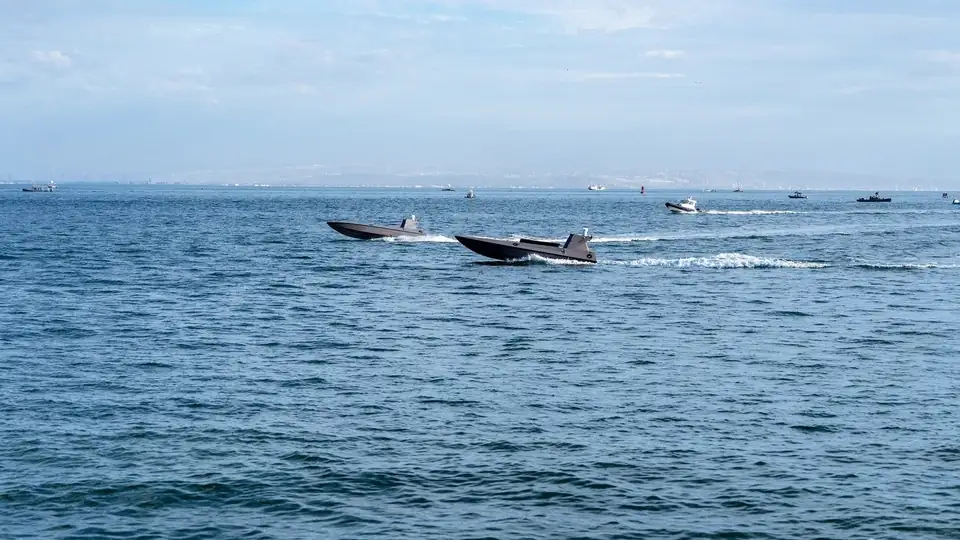
At Maritime Big Play-Pacific, the three nations tested how their systems work together across four strands: anti-submarine warfare, lethality, contested resupply, and subsea and seabed warfare. The UK led the anti-submarine strand, contributing thirteen uncrewed surface vehicles, two anti-submarine targets and four underwater gliders from six industry partners. The ministry says the testing supports the shift to a Hybrid Navy able to detect underwater threats to the UK and its allies’ critical undersea infrastructure.
Royal Navy Captain Keith Taylor said the event gives AUKUS a chance to “turn autonomy into operational advantage”, by bringing scientists, industry and warfighters together and developing common control solutions so that diverse autonomous systems can operate as one. Our earlier report on the first week of trials covered AUKUS partners test more than 40 autonomous maritime technologies off Southern California.
Industry and funding
The exercise also showcased two of the four UK winners of the AUKUS Maritime Innovation Challenge: SEA Ltd, based in Frome, and Decision Analysis Services Ltd, based in Basingstoke. With A2i of Dorchester and the US company MSI Transducers, they make up the four suppliers sharing £3 million of funding to develop ways of commanding, controlling and coordinating undersea systems. The ministry said 12 UK industry partners took part in the exercise.
Minister for Defence Readiness and Industry Luke Pollard said the UK is “all in on AUKUS” and that British innovation would sit at the heart of the partnership. Sir Stephen Lovegrove, the Prime Minister’s Special Representative on AUKUS, said the UK is stepping forward to lead development of three of the most advanced undersea sensor payloads any of the three nations has fielded. The ministry also tied the programme to the Defence Investment Plan, which it says sets out £298 billion of UK defence spending over the next four years.
The announcement follows what the ministry called a strong month for Pillar 2 delivery, including the test firing of a US-Australian heavyweight torpedo from a UK extra-large uncrewed underwater vehicle, XV Excalibur, described as a first for an uncrewed submarine. On the crewed side of AUKUS, see USS Colorado to be the first US submarine rotating through Australia under AUKUS.