Middle East & North Africa
Lebanon: Prime Minister Salam warns against a new “reckless adventure” after Khamenei’s “unity of fronts” remarks
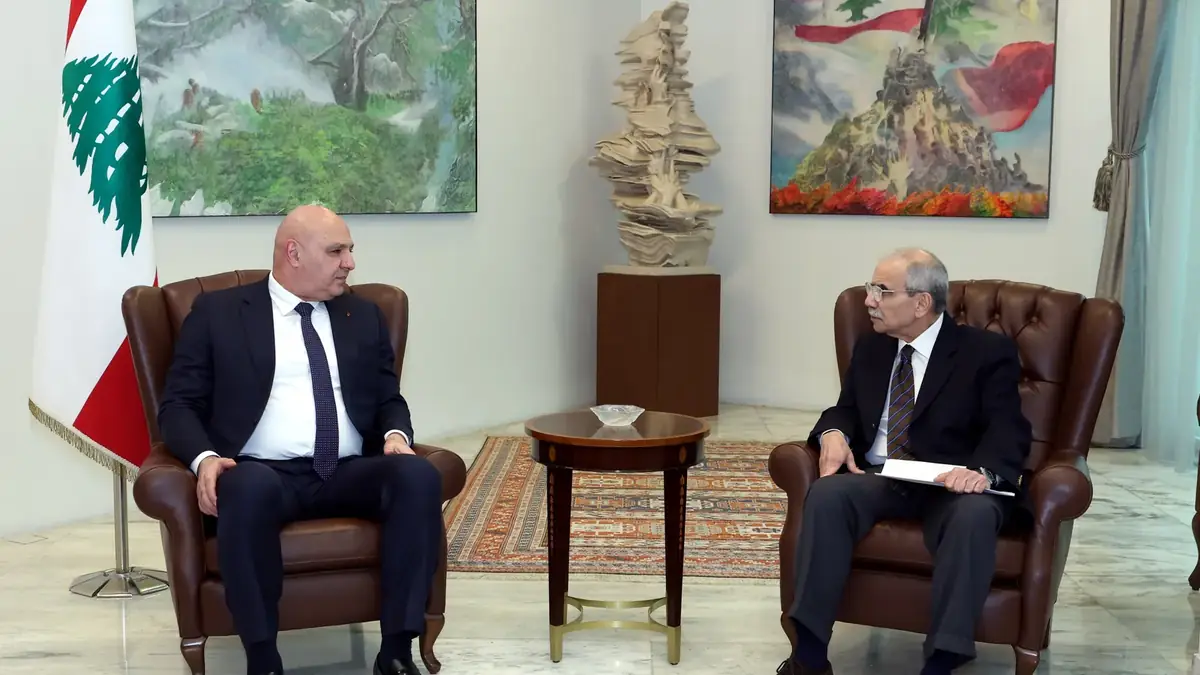
Lebanese Prime Minister Nawaf Salam warned that Lebanon must not be dragged into a new “reckless adventure” for foreign interests, as fears grow in Beirut that Hezbollah could rejoin a war on Iran’s side.

Lebanese Prime Minister Nawaf Salam warned on Wednesday, November 4 that the country must not be dragged into a new “reckless adventure” on behalf of foreign interests, while fear is growing in Beirut that Hezbollah could enter a war again on Iran’s side in the event of fresh attacks. He spoke after meeting President Joseph Aoun, on the same day an Israeli drone struck two suspects in the south, and two days after a Lebanese minister proposed by Hezbollah made an official visit to Damascus, the first since the fall of Assad.
Salam insisted that decisions of war and peace belong solely to the state and its constitutional institutions. “With the danger of war returning to the region, I warn again that Lebanon must not be dragged into any new reckless adventure on behalf of foreign interests, nor be pushed into conflicts whose consequences it cannot bear,” he said, recalling that the Lebanese, and especially the residents of the south, “have paid a heavy price in lives, livelihoods and homes”. He added that they will not accept the country becoming a battleground again for other people’s conflicts.
In the same message the prime minister condemned any Lebanese individual or group interfering in the internal affairs of Arab countries, especially through military action that threatens their security, and referred to the “latest statement by the government of sister Yemen”, without giving details. Such actions, he said, can only harm Lebanon and the interests of its people.
“Unity of fronts” and Berri’s assurance
A Lebanese official said that Parliament Speaker Nabih Berri has assured Aoun and Salam that Hezbollah will not be drawn into a new war. “But the decision is not his. It is in Tehran,” the official remarked. According to the same official, the government’s concern was triggered by the recent remarks of Iran’s Supreme Leader, Mojtaba Khamenei, on the “unity of fronts”, which he described, at a meeting with military commanders, as a strategic factor for a new political and security order in the Middle East. The Iranian leader has asked senior armed forces commanders to prepare an immediate and effective response to any military threat, saying that Tehran’s retaliation will not be limited by geographic boundaries.
The organisation is also in the spotlight in Yemen, where Interior Minister Ibrahim Ali Haidan said that 21 foreign experts direct Houthi operations, 14 from Iran’s Revolutionary Guards and seven from Lebanon’s Hezbollah. Hezbollah rejected the accusation as “baseless”. Israel, for its part, is asking Beirut to keep the organisation out of a new war. On Wednesday Israeli drones flew all day over the south, Beirut and Baabda, even over the presidential palace.
IDF strike at Kabrikha
The IDF announced that it struck “two suspects observing IDF soldiers” near Kabrikha, outside the security zone in southern Lebanon, “in order to eliminate the threat” to the forces operating there, and that it remains committed to the Israel–Lebanon agreement. According to local reports, a Hermes 450 drone hit a motorcycle. One of the two was killed and the other wounded. The dead man is Nasr Mohammed Younes, a paramedic with the Islamic Message Scouts, an organisation linked to the Amal movement, an ally of Hezbollah. It is one of the first targeted strikes on individuals in Lebanon in weeks; see our report on the rare targeted strike.
The Labour Minister in Damascus
On Monday, November 2, Labour Minister Mohammad Haidar, who was proposed by Hezbollah, crossed into Syria at the Masnaa–Jdeidet Yabous border crossing with a delegation led by Deputy Prime Minister Tarek Mitri. At the Tishreen Palace they were received by Syrian Foreign Minister Asaad al-Shaibani. They discussed the return of Syrian refugees, trade, border security and education. Haidar spoke of “ministerial work unrelated to party background”, while a Hezbollah spokesman said the organisation supports “whatever strengthens relations between the two countries”.
The next day, Tuesday, November 3, Damascus announced that it had foiled a plan to attack the Homs refinery by a cell which, according to the Syrian authorities, is linked to Hezbollah. The organisation denies it.