Analysis
Cyprus missing persons explained: the CMP, the ECHR and the search
More than 900 people missing since the 1960s and 1974 are still unaccounted for in Cyprus. Who the CMP is, what the numbers show and what the European Court of Human Rights found against Turkey.

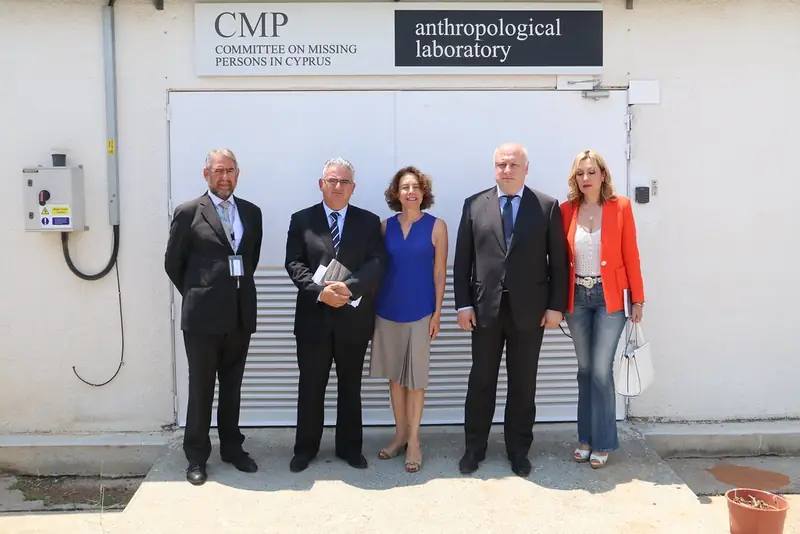
A CMP laboratory worker shows a photograph to visitors during a 2019 visit by an OSCE delegation (archive photo). Photo: OSCE Parliamentary Assembly, CC BY-SA 2.0
More than 900 people who vanished in Cyprus in the 1960s and in 1974 are still missing, and the island’s Committee on Missing Persons (CMP) is racing the clock to find them. Most of the cases date from the Turkish invasion of 1974, and the European Court of Human Rights has found Turkey in violation of the Convention over the missing persons. This explainer sets out who the CMP is, what the numbers say and what the Court decided.
Key points
- The CMP works from an official list of 2,002 missing persons; the UN Secretary-General reported in July 2026 that 1,076 of them had been formally identified.
- Of those still missing, 745 are Greek Cypriots and 172 are Turkish Cypriots, according to the CMP figures reported by the Associated Press on 23 November 2026.
- In 2014 the European Court of Human Rights ordered Turkey to pay EUR 30 million for the relatives of the missing persons and EUR 60 million for the enclaved Greek Cypriots of the Karpas peninsula.
- The search is getting harder: the AP reports that the CMP has found only eight sets of remains so far this year, as witnesses die and construction covers possible burial sites.
What is the Committee on Missing Persons in Cyprus?
The CMP is a bicommunal body made up of a Greek Cypriot member, a Turkish Cypriot member and a third member appointed by the United Nations. According to the UN Secretary-General’s report of 6 July 2026, its bicommunal teams of scientists are mandated to recover, identify and return the remains of people who went missing in 1963/64, in 1974 and in the period between. The UN supports the work.
Eight teams of Greek Cypriot and Turkish Cypriot scientists dug across the island during the latest reporting period, which ran from 16 December 2025 to 17 June 2026. The report says they identified seven individuals as missing persons in that time. Since operations began in 2006, the Committee has exhumed or received the remains of 1,718 people on both sides of the island.
How many people are still missing?
The CMP keeps an official list of 2,002 names. The table below puts the published figures side by side; they come from different dates and should not be mixed.
| Figure | Number | Source |
|---|---|---|
| Persons on the CMP official list | 2,002 | UN Secretary-General, report of 6 July 2026 |
| Formally identified | 1,076 | UN Secretary-General, as of the June 2026 reporting period |
| Remains exhumed or received since 2006 | 1,718 | UN Secretary-General, report of 6 July 2026 |
| Identified, per the CMP | 1,085 | Associated Press, 23 November 2026 |
| Still missing: Greek Cypriots | 745 | CMP figures, reported by the AP |
| Still missing: Turkish Cypriots | 172 | CMP figures, reported by the AP |
The UN report also notes that 14 missing persons were identified during the reporting period, 13 of them on the official list, and that the remains of two people were returned to their families for burial. The list covers both communities, but the Greek Cypriot share of those still unaccounted for is far larger than the Turkish Cypriot one.
What did the European Court of Human Rights decide?
The case is Cyprus v. Turkey (application no. 25781/94). In its Grand Chamber judgment of 10 May 2001, the Court found numerous violations of the European Convention on Human Rights by Turkey, arising from the military operations it conducted in northern Cyprus in July and August 1974 and the continuing division of the island. A Court press release of 12 May 2014 records that, for the missing persons, the Court had found violations of Article 2 (right to life), Article 3 (prohibition of torture and inhuman or degrading treatment) and Article 5 (right to liberty and security).
On 12 May 2014 the Grand Chamber ruled on compensation. It held that Turkey must pay Cyprus EUR 30,000,000 for the non-pecuniary damage suffered by the relatives of the missing persons, and EUR 60,000,000 for the non-pecuniary damage suffered by the enclaved Greek Cypriot residents of the Karpas peninsula. The Court said the sums were to be distributed by the Cypriot government to the individual victims, under the supervision of the Committee of Ministers of the Council of Europe. The claim concerned 1,456 missing persons and the enclaved residents of Karpas.
The same press release records a continuing violation of Article 1 of Protocol No. 1: Greek Cypriot owners of property in northern Cyprus were denied access to, and the use and enjoyment of, their property, and were given no compensation. The Court added that full compliance with its findings could not be reconciled with any complicity in the unlawful sale or exploitation of Greek Cypriot homes and property in the north. For the wider legal picture, see Loizidou v. Turkey explained: the ECHR rulings on northern Cyprus.
Why is the search getting harder?
In a report published on 23 November 2026, the AP described a dig at a demolished hotel in Lapithos, on the occupied northern coast, where, the AP says, a construction worker spotted human bones in a trench but the remains were entombed under the hotel’s concrete foundations and stayed there for 38 years. The AP says that, since the CMP unearthed 177 bodies in 2015, its success rate has dwindled, with only eight found so far this year.
Leonidas Pantelides, the Greek Cypriot member of the CMP, told the AP: “Time is our biggest enemy at the moment because our witnesses are disappearing, families are leaving us, buildings are going up everywhere.”
What is still unresolved?
The UN report says the Committee continues to seek information on burial sites from the archives of countries that kept a military or police presence in Cyprus between 1963/64 and 1974. The Turkish Cypriot office of the CMP continues to have access to Turkish army aerial photos taken in 1974, while the Greek Cypriot office is researching the archives of the Republic of Cyprus National Guard for 1974. The report adds that the CMP received the 2025 Cyprus Peace Prize on 16 February 2026 and that countries with missing-persons cases, including Armenia, Colombia and Syria, ask it for advice.
The missing persons are one strand of a wider legal and political problem: an island divided since 1974, a UN force in the buffer zone and a Turkish military presence in the north. For the background, read Cyprus problem explained: 1960, 1974 and the UN buffer zone, UNFICYP explained: the UN force in Cyprus since 1964 and Varosha explained: the fenced-off Famagusta quarter and the UN.
Sources
This article rests on the UN Secretary-General’s report on the UN operation in Cyprus (S/2026/550), the European Court of Human Rights press releases of 6 May 2014 and 12 May 2014 on the Cyprus v. Turkey just satisfaction judgment, and the Associated Press report of 23 November 2026 from Lapithos, which relays the CMP’s latest figures.