Middle East & North Africa
Syria and Jordan: 11 agreements and a joint inquiry into the deadly strikes in Daraa – what al-Shaibani said about Yemen
Syria and Jordan signed 11 memoranda and a protocol in Damascus on November 9, and said a joint committee has finished its inquiry into the October strikes in Daraa; al-Shaibani again denied sending troops to Yemen.

Syria and Jordan signed on Monday, November 9 in Damascus 11 memoranda, executive programmes and a cooperation protocol, and announced a joint inquiry into the Jordanian air strikes of October in southern Syria, which cost civilian lives. The texts were signed at the close of the third session of the two countries’ Higher Coordination Council, in the presence of Foreign Ministers Asaad al-Shaibani and Ayman Safadi.
The agreements cover public administration, agriculture, civil aviation, education and scholarships for 2027-2029, the environment, investment, youth and food security. Standing out are the railway link memorandum, which opens the way for a transport corridor from Saudi Arabia through Jordan and Syria to Turkey, and the cloud-seeding programme in the Yarmouk river basin. Mr al-Shaibani said bilateral trade nearly tripled within a year, to 330 million dollars, that 20 of the 22 Syrian ministries work directly with Jordanian ones, and that natural gas has been reaching Syrian power stations via Jordan since January. They agreed to modernise the Jaber-Nasib border crossing so it operates around the clock, with separate lanes for trucks and passengers and electronic customs, while 47 million dollars was approved for restoring the international highway.
Committee on the Daraa strikes
The October 26 strikes in Daraa province, which Jordan had linked to the attack on the Greek Orthodox church in Karak, as we reported, were a rare test for relations between the two countries, which had broadened after the overthrow of Assad in December 2024. Damascus had counted seven civilians dead, among them three children. Mr al-Shaibani said the joint security and technical committee set up to investigate the circumstances finished its work on Monday and that its findings and recommendations are already being implemented, together with measures to compensate the victims. “Syrian blood is as precious to us as Jordanian blood,” said Mr Safadi, who expressed condolences to the families. The same committee, he added, agreed on counter-terrorism coordination mechanisms.
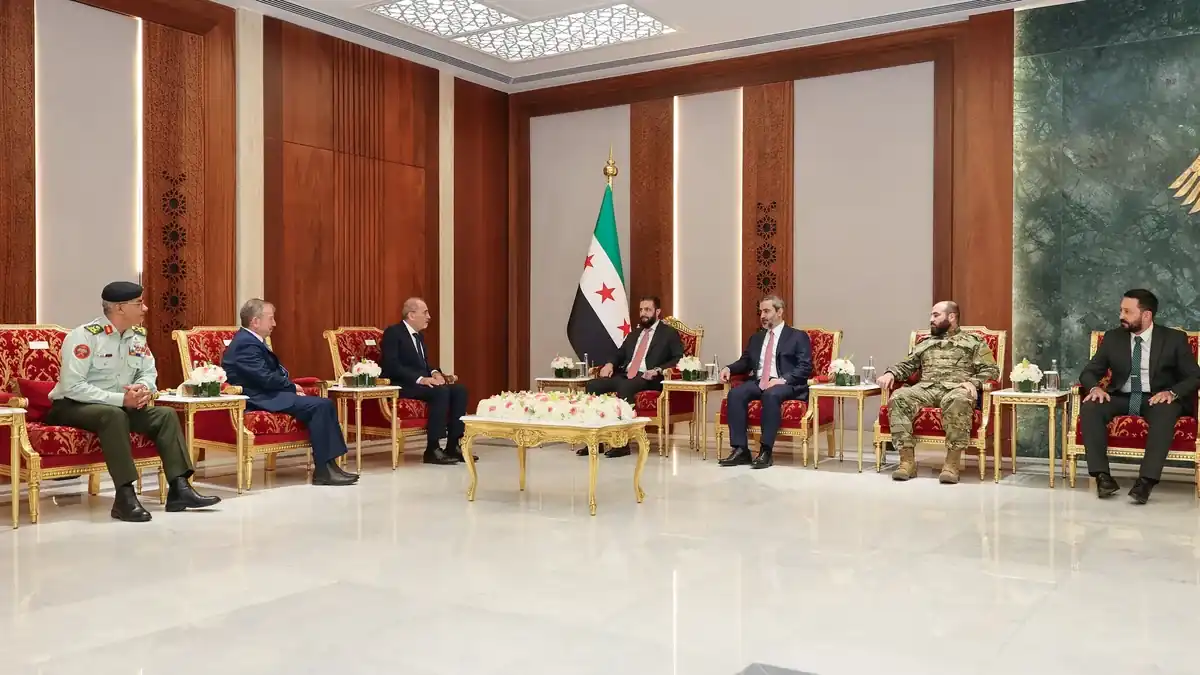
The Jordanian minister was also received by President Ahmed al-Sharaa at the People’s Palace in Damascus. The meeting was attended on the Syrian side by the foreign minister, the chief of the General Staff and the head of the General Intelligence Service, and on the Jordanian side by the director of the General Intelligence Directorate and the chairman of the Joint Chiefs of Staff.
No troops to Yemen
At the joint press conference with Mr Safadi, Mr al-Shaibani again denied that Syria is sending troops to Yemen, two days after a Syrian diplomatic source’s denial. This time he spoke himself, officially. The country, he said, has no troops in Yemen nor a plan to send any in the immediate future. The military agreement with Saudi Arabia concerns the rebuilding of Syria’s armed forces. “Any plan to deploy Syrian forces abroad will be announced publicly, it will not be done in secret,” he stressed. He condemned the Houthi threats against Riyadh, while Mr Safadi expressed Amman’s solidarity with Saudi Arabia. The Jordanian minister also asked Israel to withdraw from all Syrian territory it occupied after December 8, 2024.