Europe
Hera arrives at the asteroids Didymos and Dimorphos: the ESA spacecraft’s new image shows the moonlet half hidden
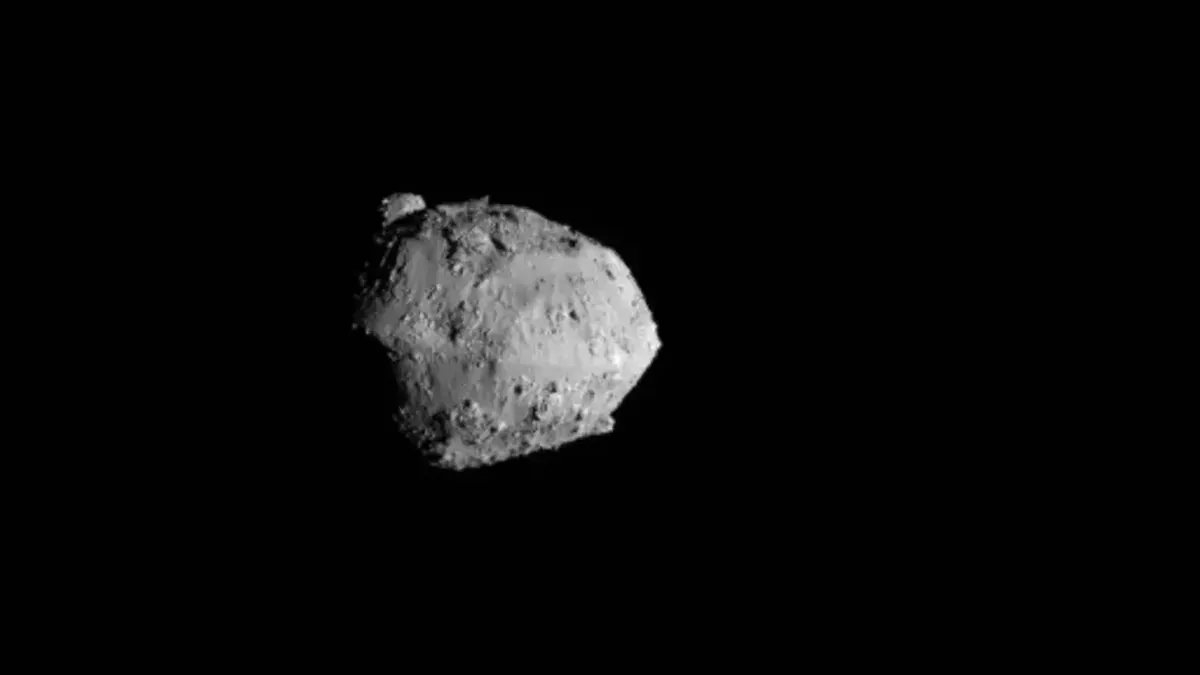
ESA’s Hera, Europe’s first planetary defence mission, has reached the Didymos–Dimorphos double asteroid and begun its survey. A new image from 56 km shows Dimorphos half hidden behind Didymos.

The European Space Agency’s (ESA) Hera spacecraft, Europe’s first planetary defence mission, has reached the Didymos–Dimorphos double asteroid system and begun its survey. ESA announced on Wednesday, November 11 that the craft is 25 to 30 kilometres from the pair and has entered the “early characterisation phase.” The next day, Thursday, November 12, it released a new image in which Dimorphos can be seen half hidden behind Didymos.
The shot was taken from 56 kilometres and shows one side of Didymos, which is 780 metres across. A small part of Dimorphos, 151 metres across, peeks out near its top. After the first close-up of Didymos (our report) released on November 5, the new image shows the variety of its surface geology: large boulders, smoother areas and an unexpectedly sharp ridge on the equator.
The ridge may be explained by the rotation speed. Didymos, which looks like a spinning top, makes one turn every 2.2 hours, almost at the limit of breaking apart. Numerical models suggest the fast rotation may make surface material roll from higher latitudes toward the equator, and may even shed material from the asteroid itself, which would explain the existence of Dimorphos. Dimorphos orbits a little more than a kilometre from Didymos, and a few boulders can be seen on its upper side. Detailed images of both asteroids will be released on Wednesday, November 25.
Orbits in straight lines
The spacecraft does not fly around the asteroids the way an ordinary space mission moves. The gravity of Didymos is about 40,000 times weaker than Earth’s and that of Dimorphos 200,000 times, so a circular orbit is not feasible. Hera moves around the common centre of mass of the two bodies at a speed of just 12 centimetres per second, like a quickly crawling insect, and almost in straight lines. Alternating every three and four days, as it moves away from the pair, it fires its thrusters and changes course by 90 degrees. It thus traces “rectangular orbits” around the two asteroids and keeps the distance of 25 to 30 kilometres.
The method comes from the experience of the Rosetta mission and is safe: if one thruster firing fails, the spacecraft simply drifts away, with no risk of collision. Next month Hera will move closer for the “detailed characterisation phase,” with more complex bow-tie paths made of hyperbolic arcs, starting from about 20 kilometres. Mission scientist Michael Kueppers said the images will show for the first time what a small asteroid looks like after an impact at very high speed. “Hera will show which of our models’ predictions was the right one, if any was!” he said.
Answers after DART
The experiment took place on September 26, 2022, when NASA’s 580-kilogram DART (Double Asteroid Redirection Test) spacecraft hit Dimorphos at 6.1 km/s. The collision shortened its orbital period by about 33 minutes. For this “kinetic impact” to become an established defence method, answers are needed: did it leave a crater or change the whole shape of the asteroid, what are its composition, structure and mass, and why did the deflection exceed the simulations. We have presented these questions in the ten mysteries of Dimorphos (our report), while Hera’s first separate sighting of the two asteroids (our report) came earlier.
Hera is controlled from ESA’s European Space Operations Centre (ESOC) in Darmstadt, Germany, with contact for about eight hours a day at a distance of 196.5 million kilometres, through four 35-metre deep-space antennas in Argentina, Spain and Australia. In the coming months Hera will examine Dimorphos up close, with multiple instruments and two shoebox-sized CubeSats, with an ultimate goal of landing.