Technology
NASA ESCAPADE: the two spacecraft got a push from Earth with an engine burn and are heading to Mars, arriving in September 2027
NASA’s twin ESCAPADE spacecraft each flew past Earth with an engine burn on November 7 and 9, a first for a Mars mission, and are on their way to the Red Planet, arriving in September 2027.

Twice in two days NASA carried out a manoeuvre it had never tried before on a mission to Mars. The two identical spacecraft of the ESCAPADE mission each passed close to Earth while firing their engine at the same time, to combine the planet’s gravity with the thrust of the burn (a powered gravity-assist manoeuvre, also known as an Oberth manoeuvre), and are now heading for the Red Planet, as NASA announced on Monday, November 9, 2026. Arrival is scheduled for September 2027.
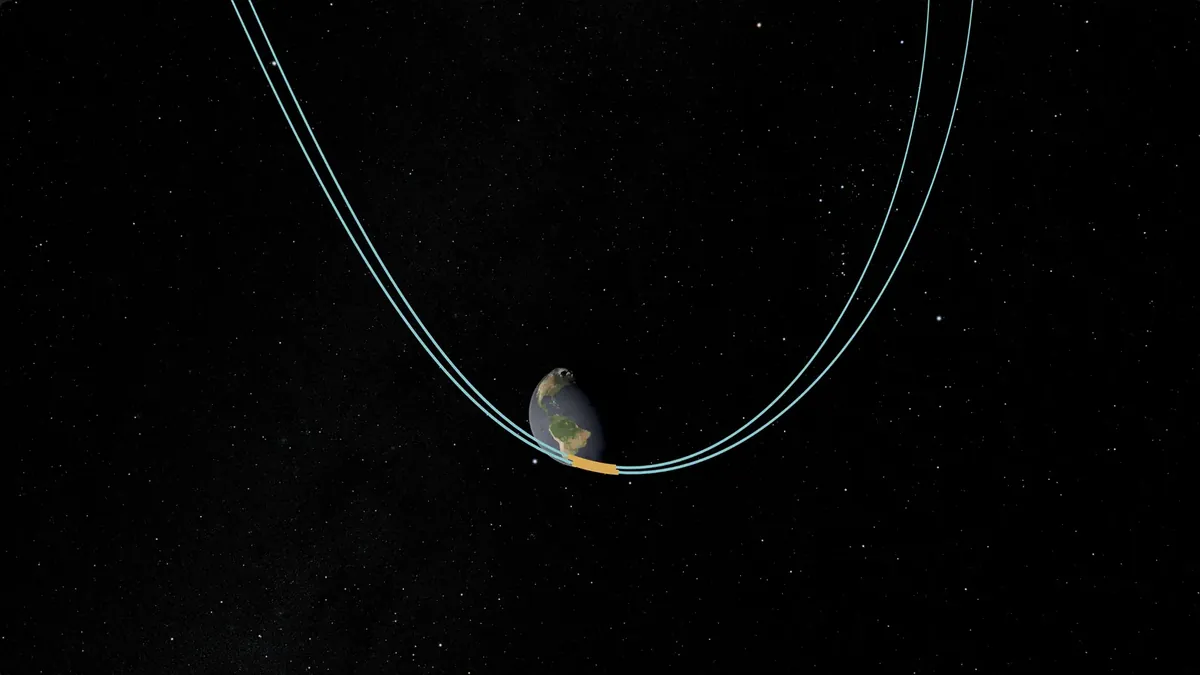
The spacecraft were launched on November 13, 2025 from Space Force Station at Cape Canaveral, Florida, on Blue Origin’s New Glenn rocket. At the time Earth and Mars were on opposite sides of the Sun, so instead of a direct route the two spacecraft entered a first-of-its-kind “waiting” bean-shaped orbit around Lagrange point 2 (L2), a point of gravitational balance about 1.6 million kilometres (one million miles) from Earth, on its side opposite the Sun. From there they returned toward Earth to use it as a “slingshot” once the two planets were again in a favourable position.
The first spacecraft reached its closest point to Earth on Saturday, November 7 at 5 a.m. US Eastern time (12:00 Greek time), at an altitude of about 1,600 km (1,000 miles) above the surface. There it also completed the “trans-Mars injection” burn, the engine firing that commits it to the route to the planet, lasting about nine minutes. The second followed two days later, on Monday, November 9 at 6 a.m. US Eastern time (13:00 Greek time), at an altitude of about 1,050 km (650 miles).
A few days before the manoeuvres, NASA had explained in a blog post what each spacecraft gains from the burn: its speed increases by more than 1,600 km/h (1,000 mph), from about 10.1 to 10.8 kilometres per second (from about 30 to 31 Mach). At that final speed a spacecraft would cover the distance from Washington to San Francisco in under seven minutes. Each spacecraft is about the size of an ordinary refrigerator.
“This is the first time NASA has used a powered Earth flyby to send a spacecraft to Mars, and now we have performed the manoeuvre twice, flawlessly, in just two days,” said Asal Naseri, acting deputy flight director in the Heliophysics Division at NASA headquarters in Washington. Jeff Parker of Advanced Space, the mission’s lead designer, explained that with the waiting orbit and the Earth flyby ESCAPADE opens a new road to Mars: a mission can be launched almost at any time and then get a push from Earth’s gravity, instead of waiting every two years for the planets to align for a direct launch.
A ten-month journey, then two orbits around Mars
A ten-month journey follows, during which the spacecraft will make a series of orbit-correction manoeuvres. The Mars orbit insertion burns are scheduled for September 7 and 9, 2027: each spacecraft will fire its engine for about 11 minutes to slow down and enter orbit. It will take a few months for the two spacecraft to reach their first science configuration, in which they follow one another in the same orbit, and science operations are expected to begin in June 2028. Six months later they will move to different orbits, one farther from Mars to observe the incoming solar wind and the other closer to record in real time how the planet reacts. That phase will last five months.
The aim is to study how the solar wind, the stream of matter from the Sun moving at about 1.6 million km/h (one million mph), interacts with Mars’s environment and how this leads to atmospheric loss. Principal investigator Rob Lillis of the University of California, Berkeley stressed it will be the first science mission to coordinate two orbiters around Mars, and the first time coordinated observations of the Martian environment will be made simultaneously from two different points. Michele Cash, programme scientist at NASA headquarters, noted that the findings may help in planning and preparing for future human exploration of Mars.
The two spacecraft have already collected science data in the waiting orbit, passing several times through the tail of Earth’s magnetosphere, the part of the planet’s magnetic environment that the solar wind stretches away from Earth, on the side opposite the Sun. On the ten-month trip they will also study solar wind dynamics between Earth and Mars.
The mission is funded by NASA’s Heliophysics Division and belongs to the SIMPLEx programme, which supports innovative lower-cost missions in the solar system. It is led by the Space Sciences Laboratory (SSL) of the University of California, Berkeley, with key partners Rocket Lab, NASA’s Goddard Space Flight Center, Embry-Riddle Aeronautical University, Advanced Space and Blue Origin. Rocket Lab’s press kit for the mission says the company designed and built the spacecraft in Long Beach, California: each has a mass of 535 kilograms with propellant and 209 kilograms without.