Greece
The Abeille Marengo sails from Heraklion for the seabed surveys of the Greece–Cyprus cable – what GSI and ADMIE announced
The French survey vessel Abeille Marengo has left Heraklion for the survey areas of the Greece–Cyprus interconnector; GSI and ADMIE announced the departure, while Ankara’s counter-NAVTEX sets up the next test for Greek-Turkish relations.

The French survey vessel Abeille Marengo has cast off from the port of Heraklion and is heading for the seabed survey area of the Greece–Cyprus electricity interconnector. The departure was announced on Tuesday, November 10 in a joint press release by Great Sea Interconnector S.A. (GSI) and ADMIE, Greece’s transmission system operator.
The two companies explain that the surveys concern the development and laying of the cable. The first step will not be the seabed mapping itself: the vessel will first calibrate its instruments and then move on to the surveys, within the areas set by the navigational warnings (NAVTEX) of the competent Greek and Cypriot authorities.
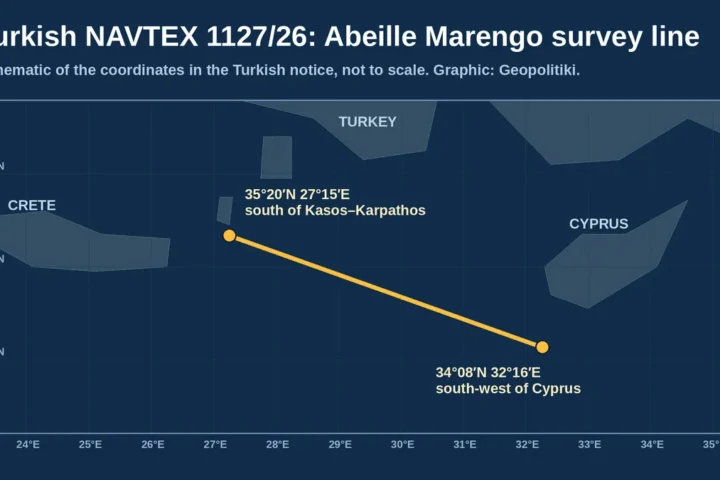
The departure closes a week of activity around the project. On Friday, November 6, Foreign Minister George Gerapetritis signed the survey and laying permit, following a request by France’s Nexans on behalf of GSI, and the Heraklion Station of the Hydrographic Service issued NAVTEX 1411/26, which reserves sea areas east and south-east of Crete until March 6, 2027. Ankara responded the same day with its own announcement, 1105/26, from the Antalya station, claiming that part of the area south of Kasos belongs to the Turkish continental shelf and that Turkey has not given its consent. The Turkish foreign ministry also said it had “cancelled” the NAVTEX of Athens and Nicosia.
The Greek side insists that the only permits for the works are those granted by Greece and Cyprus. Prime Minister Kyriakos Mitsotakis said the same day that he expects it to be a journey “without turbulence” and that the French note verbale to Turkey was a simple notification and not a request for permission. He also stressed that the country is ready for any eventuality, recalling the summer of 2020. Deputy Foreign Minister Alexandra Papastavrou had likewise stated that the only country that granted a permit is Greece.
The cable, also known as the Great Sea Interconnector, is a project of common European interest and will connect Crete’s electricity system with Cyprus’s, ending Cyprus’s energy isolation. As Mr Mitsotakis reminded, the previous survey off Kasos had been carried out within Greek territorial waters. For the legal background see our explainer on the cable and the law of the sea.
The test of the coming days
This time, however, the vessel is expected to move also outside territorial waters, in areas that Ankara claims as part of its continental shelf. There it will be seen whether the Turkish reaction stays on paper, with announcements and statements, or takes the form of a presence at sea. That is why the coming days will be the real test for Greek-Turkish relations: whether the “calm waters” of recent years can hold when a Greek, Cypriot and European project passes through seas that Turkey claims.