Greece
Çekirge in Hürriyet: Turkish warships for “12 countries”, an aircraft carrier in 2027 and Oruç Reis as “proof” against Greece and Israel
Hürriyet columnist Fatih Çekirge devoted his October 11 Sunday column to Turkish naval power, from corvette exports to Malaysia and Pakistan to a carrier due in 2027, and ends by asking for a naval officer as Chief of the General Staff.

Hürriyet columnist Fatih Çekirge devoted his Sunday column of October 11 to Turkey’s naval power, under the headline “Turkish warships on the world’s seas: exports to 12 countries”. He begins with the launch of a ship which, he writes, will be exported to Indonesia, and ends by asking for a naval officer as Chief of the General Staff.
Malaysia and Pakistan
Çekirge presents the three-corvette programme for the Royal Malaysian Navy as the first export of a warship by the Turkish defence industry to the Asia-Pacific. According to him, the last of the three ships is being launched, so that all three will have been put into the water within four months. The figures he gives: length 99.56 metres, displacement 2,500 tonnes, maximum speed 26 knots and a crew of 111. The equipment includes Roketsan’s ATMACA anti-ship missile, Havelsan’s combat management system, and a 3D search radar and remotely controlled stabilised gun from ASELSAN.
For Pakistan he cites the Babur-class MILGEM corvettes, of which two are being built at the Istanbul Naval Shipyard and two in Karachi with technology transfer, plus a replenishment ship. He then lists the countries for which, in his words, warships of various classes are being built: Portugal, Romania, Azerbaijan, Turkmenistan, Nigeria, Qatar, the United Arab Emirates, Ukraine and Indonesia. The headline speaks of 12 countries, while the text names 11.
“An aircraft carrier in 2027”
Çekirge draws on an earlier conversation with the Commander of the Turkish Naval Forces, Admiral Ercüment Tatlıoğlu. He writes that the Turkish military was known in NATO mainly as a land force, while it now combines naval, submarine and air power, with the “clearest example” being the aircraft carrier that, he writes, will be launched in 2027. He also mentions the UAVs flying from the TCG Anadolu during a NATO exercise in the Baltic, as well as the radars, missiles and unmanned vessels of ASELSAN, Roketsan and Havelsan.
Greece as an argument
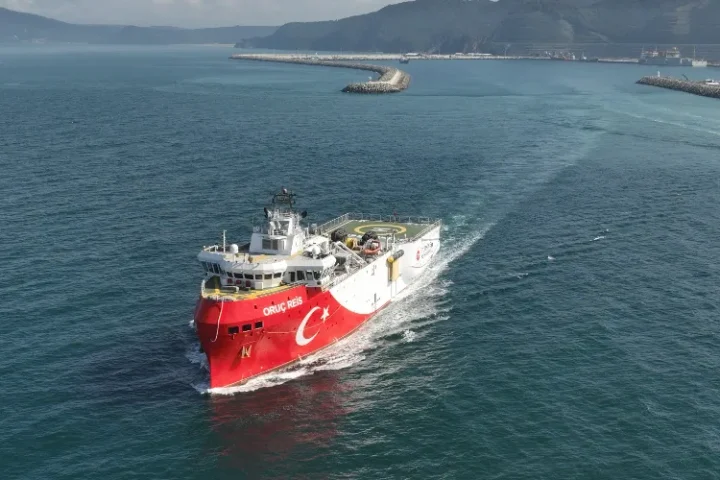
Greece enters the column as a reason for more naval power. “Let us consider the ‘energy partnerships’ that Israel and Greece have set up in the Mediterranean,” he writes. He adds that the Çağrı Bey, which is searching for hydrocarbons off Somalia, and the Oruç Reis, which in his words is “drilling in Cyprus”, are “proof”, with naval forces there to protect them. The Oruç Reis is a seismic survey vessel and was recently at the centre of a new Turkish provocation off Kyrenia in Cyprus.
The column opens and closes with Hayreddin Barbarossa and Preveza, recalling that in 1795 the United States paid tribute to Ottoman Algiers in order to trade in the Mediterranean. The columnist says he is not writing this to provoke a “reckoning” with the United States but to show how quickly balances change, and concludes: “Can’t we also have a naval Chief of the General Staff by now?”