
Opinion Greece
Opinion: Phase C of the new force structure – Electronic warfare needs a plan, funding and a test range, not just a slide
Greece’s new force structure recognises the electromagnetic spectrum as a domain of operations, but announced no funding, equipment or timetable for electronic warfare. An opinion piece sets out five proposals.

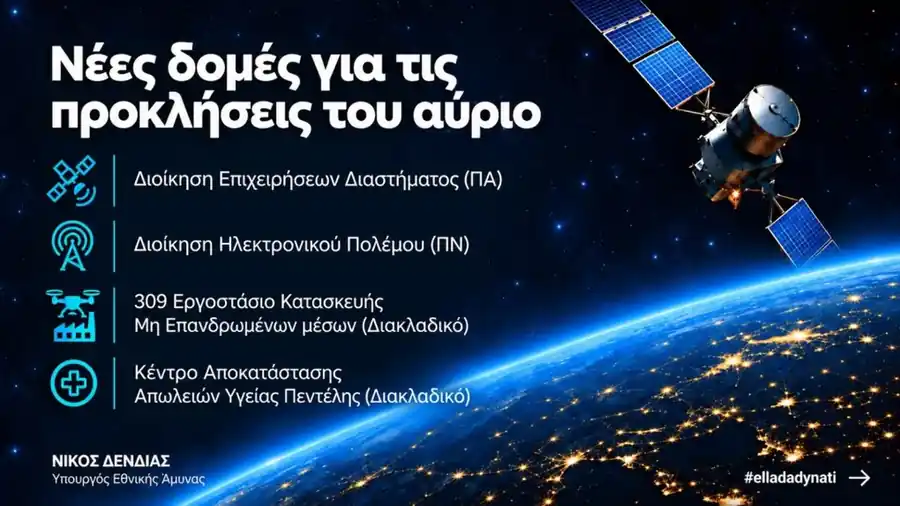
Phase C of the new structure of the Greek Armed Forces took the right first step: it recognised the Electromagnetic Spectrum as a domain of operations, next to sea, air, land, space and cyberspace. But a domain of operations with no funding, no equipment and no test range remains a slide. At the presentation of October 20, Nikos Dendias spoke of the transition to the “joint multi-domain field”, of an automated C5ISR-T command and control system and of unmanned systems as a building block of each Service. For Electronic Warfare, however, the only concrete element was a line on a slide: an Electronic Warfare Command in the Navy. Nothing was said about how it will be staffed, with what funding, with what equipment, with what purchases or partnerships, or what will happen in the Air Force and the Army, the first recipients of electronic threats in a modern war. The direction is right. What is missing is the content.
Space got a plan, the spectrum got a command
The comparison with Space is instructive, because it shows that the ministry knows how to present a domain concretely when it wants to. For Space the minister announced an Air Force Space Operations Command opening in early December, a geostationary satellite, three medium-orbit satellites through the European IRIS² programme and low-orbit SAR radar satellites through cooperation with Poland. For unmanned systems he announced a Brigade at Litochoro, bases in the Navy and the Air Force, and the joint 309 UAV Factory. For Electronic Warfare there was nothing comparable: no programme, no amount, no timetable, no word on how the Navy’s new Command will work with the units of the other Services.
The gap matters because Electronic Warfare is the field that decides whether everything else works. Drones need jam-resistant links, fighters need self-protection against modern radars and missiles, satellites and C5ISR-T need protection from jamming and from spoofing of the GNSS signal (the satellite positioning and timing signal), and the air defence of the “Achilles Shield” needs sensors that detect emissions before the target appears. The war in Ukraine has shown that a drone unit without Electronic Warfare support loses much of its value within weeks, and that the balance in the spectrum shifts every few months. A structure announced without a parallel equipment plan risks becoming yet another command with a staff but no means.
Where Greek electronic warfare stands today
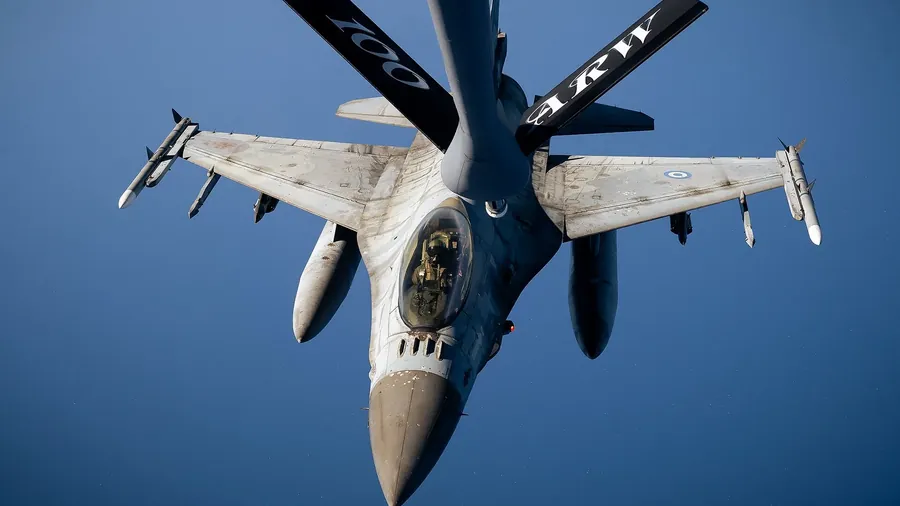
The picture in the Air Force is familiar to those who follow procurement. The F-16s being upgraded to Viper standard at the Hellenic Aerospace Industry (EAB) receive the new AN/APG-83 AESA radar but keep the old ASPIS II self-protection system. An analogue system cannot be synchronised at pulse level with an AESA radar, which limits both functions. The digital Viper Shield, in which the Hellenic Air Force General Staff has shown steady interest, is not included in the programme, while the 2024 US notification for Turkey’s new F-16 Block 70 provided for the digital IVEWS “or equivalent”. For the technical background see our analysis of the F-16 Block 70/72 and Greece’s Vipers. At the same presentation the minister said the updated 2027-2038 procurement plan includes the upgrade of another 70 F-16s to Viper. If these aircraft also leave EAB with ASPIS II, the problem will be pushed into the 2040s.
The situation with airborne radar is no better. The four Erieye EMB-145H aircraft of 380 Squadron have operated since the early 2000s and their availability has been affected by the lack of a support contract, while Saab has proposed a modernisation programme. The Air Force has no stand-off jamming aircraft or pods, that is, means that “blind” enemy radars so strike aircraft can get through, nor a dedicated electronic intelligence aircraft. On land, EAB has developed the KENTAVROS and YPERIONAS systems for detecting and jamming drones, and the country bought Israel’s Drone Dome for €26 million. These are useful steps, but they mostly concern countering drones, not a comprehensive Electronic Warfare network covering radar, communications and navigation across the Aegean and Cyprus.
Five proposals to give the spectrum content
First, a joint command and not only a naval one. The Navy’s Command is positive, but the spectrum is not divided by Service. A Joint Electronic Warfare Centre under the Hellenic National Defence General Staff is needed, to collect the threat library (the “signatures” of Turkish radars, links and jammers), keep it constantly updated and share it with aircraft, ships, air defence units and drones. Without a shared library, each Service will buy and programme its own systems, with the same multiplicity problem that already exists in unmanned systems.
Second, a national joint Electronic Warfare test range. A jamming system, a self-protection pod or a Greek drone cannot be seriously certified without a site where threat simulators emit, telemetry is recorded and results are analysed. Greece already has the base: the Crete firing range, where Patriot missiles were fired on October 14 and the IRIS-T SLM was certified, a range that already hosts missile firings and certifications. Extending it into an Electronic Warfare test range, open to Greek industry and to allies on a paid basis, would give the Armed Forces a tool they lack today and give Greece a role few European countries can offer.
Third, a funded self-protection programme within the new 2027-2038 procurement plan. The upgrade of the next 70 F-16s is the chance to fit a digital Electronic Warfare suite from the start rather than as an afterthought, with provision for the Vipers already delivered. Fourth, jamming and electronic-intelligence pods through European programmes. SAFE and the European Defence Fund finance exactly such joint capabilities, and Greece can join consortia as a partner with production, not only as a buyer. Fifth, Greek industry at the centre. The minister announced a bill requiring 25% participation of the Greek defence industry in every procurement. Electronic Warfare is the field where this participation matters most, because threat libraries and algorithms must be controlled by Greek hands. EAB, with KENTAVROS, has already shown it can.
A slide is not enough
Phase C has many positives: the 309 Factory, the satellite programmes, the savings returned to personnel. That is exactly why Electronic Warfare must not remain its weakest link. The ministry can close the gap the way it did for Space: a public plan with the structure, the programmes, the funding and the timetable, without revealing anything classified. Turkey has been investing in electronic warfare for years, from digital self-protection for its F-16s to ground jamming systems. If Greece really wants to move to the multi-domain field, it must first be able to survive in the spectrum.
Key questions on Electronic Warfare in the new structure
What does Phase C provide for Electronic Warfare? It recognises the Electromagnetic Spectrum as a domain of operations alongside Space and Cyberspace and provides for a new Electronic Warfare Command in the Navy. The October 20, 2026 presentation announced no funding, equipment or timetable for the sector.
What self-protection system do the Greek F-16 Vipers have? The F-16s being upgraded to Viper standard keep the old ASPIS II system. L3Harris’s digital Viper Shield is not included in the programme for now, despite the Air Force’s interest.
What is an Electronic Warfare test range? A site where simulators emit the signals of enemy radars and links, so that self-protection, jamming and drone systems can be tested and certified, with telemetry recorded and results analysed.
Are there Greek Electronic Warfare systems? Yes. EAB has developed KENTAVROS and YPERIONAS for detecting and jamming drones. According to EAB, KENTAVROS detects drone emissions at distances above 150 kilometres in line of sight.