Defense Industry
Saab launches Ocean Barrier, an underwater surveillance system for ports, coasts and critical infrastructure
Saab unveiled Ocean Barrier, a cabled network of seabed and surface sensors that protects coasts, harbours and offshore installations in three zones. It was already demonstrated at REPMUS 2026.

The space beneath the sea surface remains one of the hardest to monitor. Sweden’s Saab answers with Ocean Barrier, an integrated underwater surveillance system it presented on Wednesday, October 28. The company designed it to protect coasts, ports, offshore installations and territorial waters from threats below the waterline.
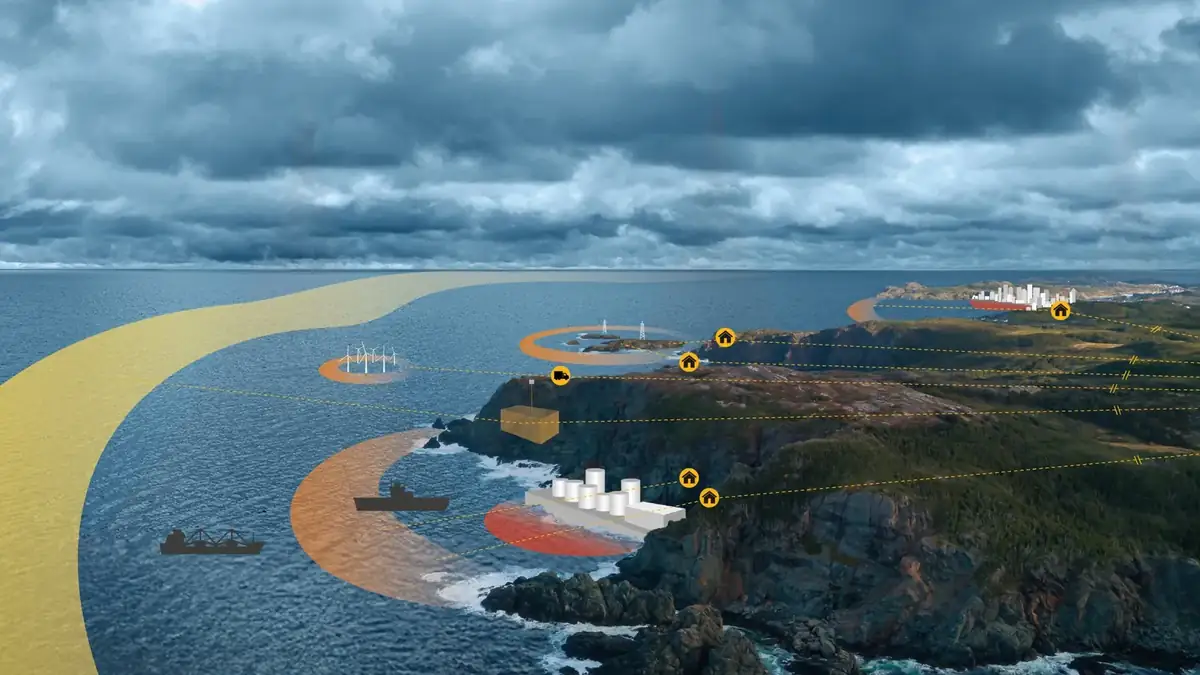
The system rests on three connected elements. Cabled seabed and surface sensors collect target signatures and convert them to digital signals. Shore facilities carry the data and allow the sensors to be controlled, while a surveillance centre, near the sensors or at a remote location, analyses the picture in real time. The operator gets support to classify contacts, surveillance zones and alerts.
Three zones: Detect, Prevent, Protect
Saab organises coverage in three zones named Detect, Prevent and Protect. The outer zone watches large coastal areas and the open sea, detects and classifies contacts at long range and works, as Saab describes it, like an “underwater tripwire” that gives early warning. The middle zone covers archipelagos, channels, gulfs and fjords, where it tracks contacts continuously and predicts their course. The inner zone protects ports, naval bases and power stations at close range with high-resolution surveillance.
The zones can also work on their own, so the same system can cover a single harbour or offshore installation or an entire coastline. The architecture is modular and cyber-secure and accepts sensors from other manufacturers, so it can connect to existing surveillance networks. New capabilities will be added through controlled software updates.
Åsa Schöllin, head of the Underwater Systems business unit in Saab’s naval business area, explained the thinking: “The free flow of goods is the fundamental driving force of the modern global economy. In a grey-zone scenario or in conflict, an attacker may try to disrupt vital sea lanes, hitting both economic activity and military logistics.” Ocean Barrier, she added, provides “continuous awareness” and faster decisions.
According to Saab’s announcement, the system has already shown its capabilities at REPMUS 2026, the leading international exercise and development programme for unmanned maritime systems. There it combined data from different sensors and autonomously handed the targets it was tracking to the exercise’s central command system through a NATO-standard protocol.
Saab has been busy in the naval field this week: on Tuesday, October 27, it presented the Sea Giraffe AMB D naval radar, which reaches up to 250 km against air targets.