Asia-Pacific
US congressional commission: China-Pakistan military ties raise India’s risk of a two-front war
The US-China Economic and Security Review Commission's 2026 report says China's military relationship with Pakistan has made a two-front war an increasingly serious concern for India.

China’s military relationship with Pakistan has turned the prospect of a two-front war into a growing concern for India. That is one of the main findings of the 2026 annual report to Congress of the US-China Economic and Security Review Commission (USCC), published on Wednesday, November 18. Its third chapter, titled “China’s Other Front: India and the Future of US Strategy in the Indo-Pacific”, notes that the May 2025 India-Pakistan conflict showed how Beijing can strengthen Pakistan in a crisis without entering the fighting itself.
Front one: Pakistan and Chinese arms
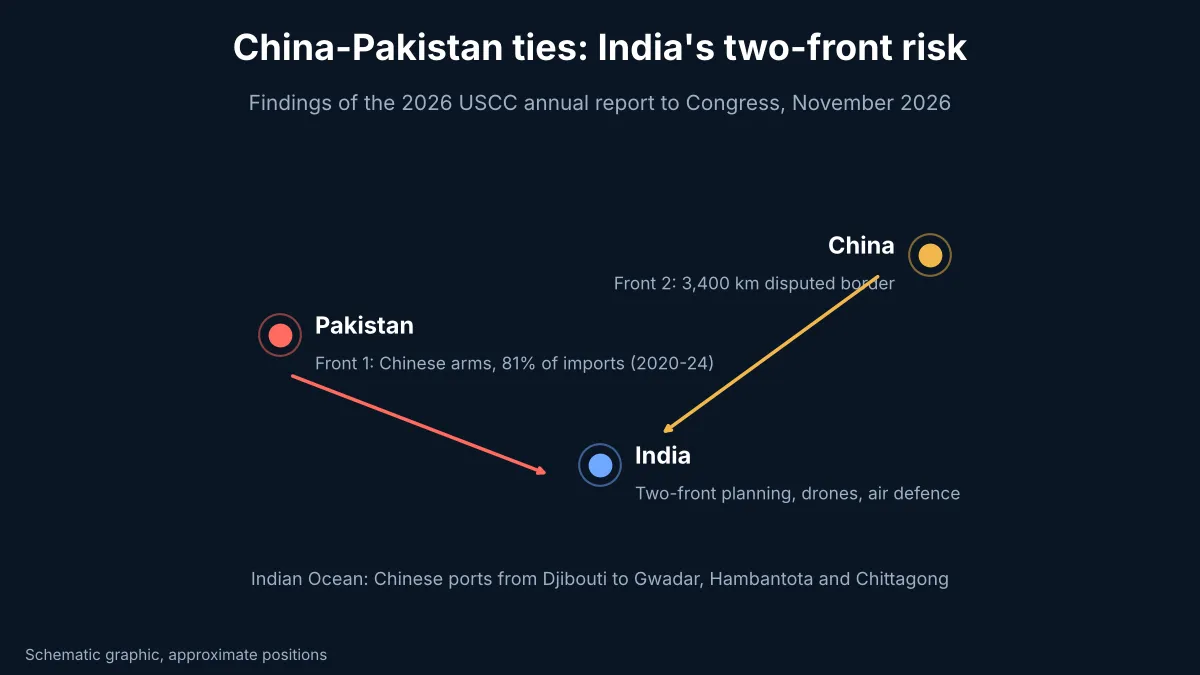
The commission recalls that China is Pakistan’s main arms supplier, accounting for 81% of Pakistani weapons imports in 2020-2024. In the fighting that followed Operation Sindoor, India’s response to the deadly April 2025 terror attack, Pakistan reportedly used advanced Chinese weapons. Indian officials later claimed Pakistan may have received real-time satellite imagery from Beijing, which China’s foreign ministry neither confirmed nor directly denied. In May 2026 an engineer from China’s AVIC told state television CCTV that he and colleagues provided on-site technical support in Pakistan during the conflict.
For the commission, Chinese support raises the risk that a local incident, such as a new border clash or a terrorist attack, escalates quickly across several domains. India has already changed its defence planning since 2025, with an emphasis on drones and on “Mission Sudarshan Chakra”, a multilayer air and missile defence system with a 2035 horizon. In October New Delhi approved acquisitions worth 2.12 trillion rupees including kamikaze drones and counter-drone systems.
Front two: the border and the Indian Ocean
The second front is the border with China. The report calls the 2,100-mile (about 3,400 km) disputed frontier the central fault line in relations and notes that, despite a gradual restoration of ties since late 2024, strategic distrust remains high after the 2020 Galwan Valley clashes. Chinese infrastructure and pre-positioned forces let the People’s Liberation Army mobilise quickly. India is answering by strengthening military infrastructure along the Line of Actual Control (LAC).
At sea, the commission warns that the Chinese naval and survey-ship presence is starting to erode India’s traditional advantages in the Indian Ocean, with ports from Djibouti to Gwadar, Hambantota and Chittagong. Beijing, the report says, is beginning to apply South China Sea tactics there, invoking historic rights and giving Chinese names to undersea features. Among its recommendations, the USCC asks Congress to direct the Secretary of Defense and the Chairman of the Joint Chiefs of Staff to strengthen coordination with India on maritime and seabed surveillance in the Indian Ocean, with systematic information sharing and joint tracking of Chinese ships and submarines.