Asia-Pacific
AUKUS partners tell IAEA board that Australia’s nuclear submarines comply with the NPT
Australia, the UK and the US told the IAEA Board of Governors that AUKUS complies with the NPT and Australian safeguards agreements, rejecting calls for an inter-governmental process.

Australia, the United Kingdom and the United States have again rejected what they call “baseless claims” about Australia’s planned nuclear-powered submarines, telling the board of the International Atomic Energy Agency (IAEA) in Vienna that AUKUS is fully consistent with the Non-Proliferation Treaty (NPT) and Australia’s safeguards agreements. The statement, a right of reply delivered on 19 November on behalf of the three partners, was published by the UK Foreign, Commonwealth and Development Office on 20 November 2026.
The reply came under a Board of Governors agenda item on the transfer of nuclear material in the context of AUKUS and its safeguards. The partners called the item “politically motivated” and said it had “never commanded consensus”. They argued that it adds time and cost to the Board’s work and undermines the Director General’s independent technical mandate, noting that the session had been shortened to three days and that the topic had already been discussed earlier in the week.
The partners’ legal case
According to the statement, the three governments are “fully complying” with their international obligations, including the NPT, the Treaty of Rarotonga and its protocols, and Australia’s IAEA safeguards agreements. They rely on Article 14 of the IAEA’s model comprehensive safeguards agreement, on which they say Australia’s agreement is based, which they describe as the provision allowing states to use nuclear material in naval nuclear propulsion within the safeguards framework.
The partners also said the NPT permits the transfer of nuclear material at any enrichment level, provided the transfer is not for nuclear weapons and is carried out consistently with safeguards obligations, and that transfers of fuel components between nuclear-weapon and non-nuclear-weapon states already take place. Australia’s programme, they said, will be covered by a “robust package” of safeguards and verification measures.
They rejected calls for “an inter-governmental process” on the issue, describing it as an attempt to interfere in the confidential, bilateral engagement between a member state and the IAEA. The Agency’s Statute, the statement said, authorises it to negotiate safeguards and verification arrangements directly and confidentially with member states. The partners added that they welcome discussion of naval nuclear propulsion under items proposed by the Director General.
Rotational force in Western Australia
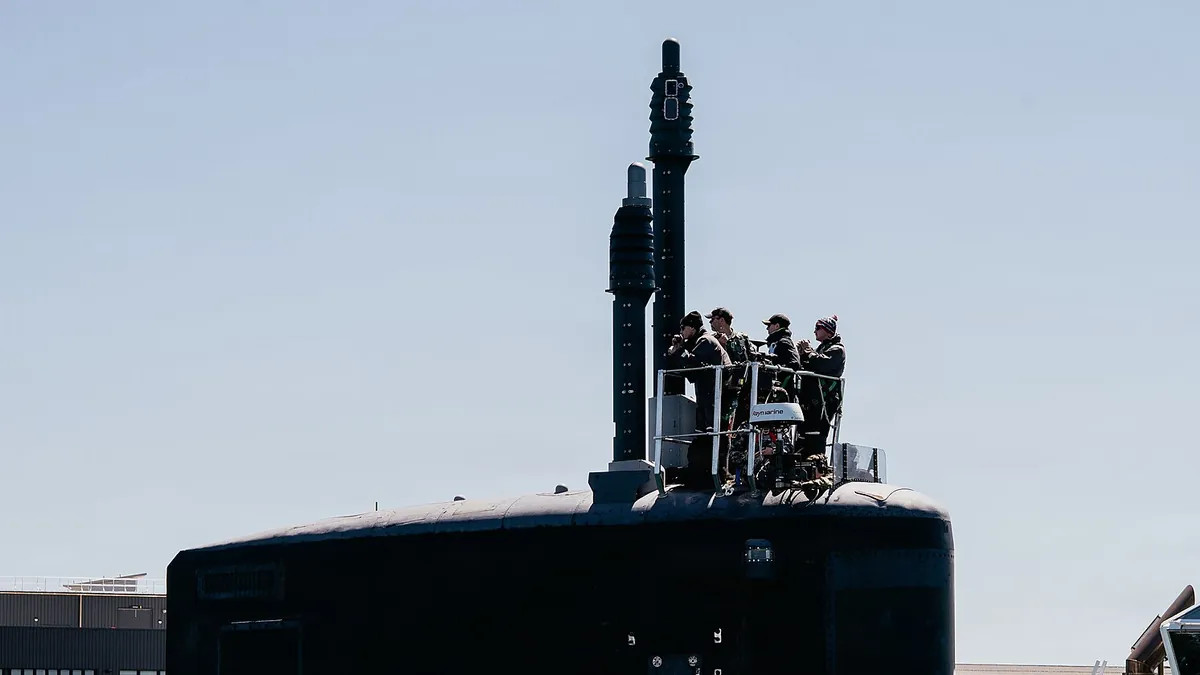
The statement also addressed the planned Submarine Rotational Force-West (SRF-West), which it says will begin from late 2027. UK and US submarine visits to Australia, together with that rotational presence, are described as central to preparing Australia to operate, maintain and steward nuclear-powered submarines. The partners stressed that submarines will rotate through HMAS Stirling in Western Australia and “not be permanently based there”, and that the activities will respect obligations under the NPT and the Treaty of Rarotonga.
Geopolitiki has reported on the build-up to that rotation, including the arrival of USS Colorado to be the first US submarine rotating through Australia under AUKUS, and on UK to lead three AUKUS undersea sensor payloads for uncrewed submarines, due across the three navies from 2027.
The statement does not name the governments that raised objections, referring only to “some” members whose interventions, it said, “distort reality”. It acknowledged that the clarifications had been made before and said the partners would continue to respond at each Board meeting.
Source: UK Right of Reply on behalf of AUKUS partners, IAEA November 2026 (GOV.UK)