Drones
V-BAT: the tail-sitting drone that watches over the Aegean for the Hellenic Army
Shield AI’s V-BAT vertical-takeoff drone passed in the October 28 parade. How it works, why Greece is one of its heaviest users, and what ten more systems mean for Aegean and Evros surveillance.

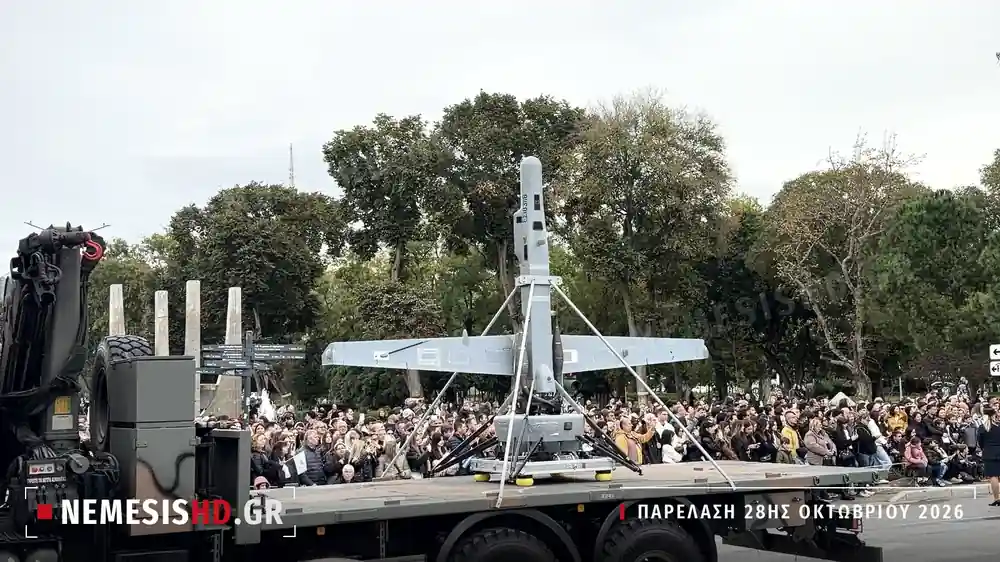
Shield AI’s V-BAT is the Hellenic Army’s “eye” over the sea: an unmanned aircraft that takes off upright, standing on its tail, from a clearing, a harbour or a ship’s deck, and stays over the Aegean for more than twelve hours. The public saw it in the military parade of October 28, 2026 in Thessaloniki, but it is not new to the Greek Armed Forces. The V-BAT first flew in Greece in 2020 and since then has been used for maritime surveillance from Evros to Kastellorizo, on such a scale that the American company itself calls the Greeks “power users” of the system, among its most intensive users worldwide together with Ukraine.
What the V-BAT is and why it “stands” on its tail
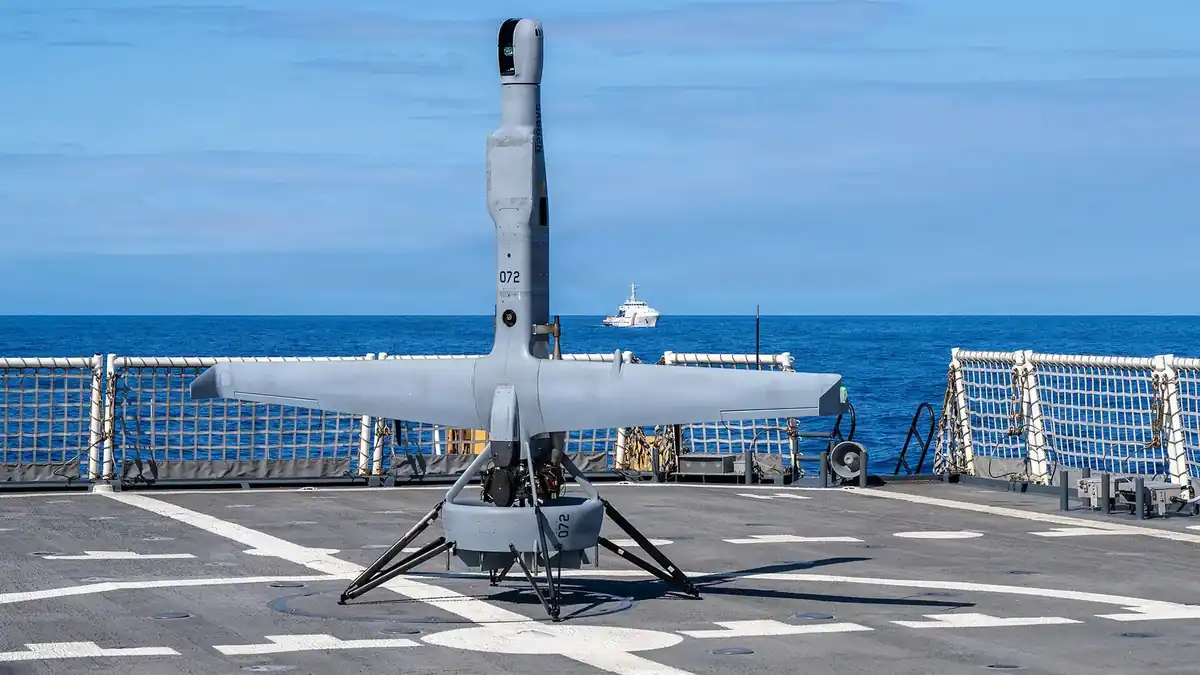
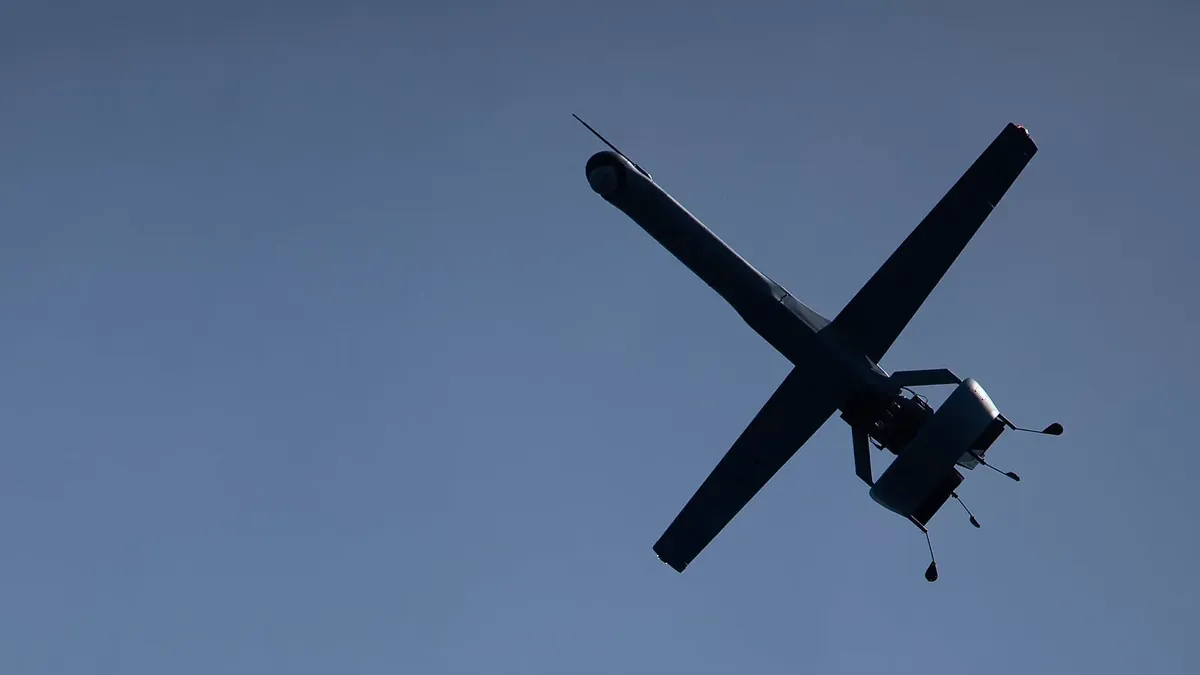
The V-BAT is a vertical take-off and landing (VTOL) unmanned aircraft with a single engine and a ducted fan at the base of the fuselage. It takes off vertically like a rocket, tilts in the air and flies horizontally like an ordinary aeroplane on its wings, and at the end of the mission it “stands up” again and descends upright. This lets it operate without a runway, catapult or recovery net, precisely the elements that limit classic tactical UAVs, and because the propeller is enclosed in the duct, take-off from a narrow deck or a rooftop is safer for personnel. According to the figures given for the parade’s systems, the Greek V-BAT has a wingspan of 3.8 metres, a maximum speed of 139 km/h, an endurance of 12 hours and a range of over 200 kilometres. The engine burns heavy fuel, the same found in every military unit and ship, so no special supply chain is needed.
The second feature that sets the V-BAT apart is software. Shield AI designed it to operate in a strong electronic-warfare environment, and with the Hivemind autonomy software the aircraft can continue its mission even when it loses GPS or the link to the operator, something the company says has been tested in real combat conditions in Ukraine. For the Aegean, where GPS jamming is now an everyday occurrence, that is not a luxury. The V-BAT is also gaining an offensive role: in January 2026 Shield AI agreed with South Korea’s LIG Nex1 to integrate the L-MDM laser-guided light munition on the V-BAT, so that the aircraft can not only detect but also strike targets.
The V-BAT in the Hellenic Army: from 2020 to ten new systems
On June 2, 2026, Shield AI announced that the Hellenic Army had signed an agreement to expand its V-BAT fleet, with the mission of maritime domain awareness across the Aegean. The company announced at the same time that it is opening an office in Athens and will invest in the Greek defence ecosystem, also bringing Hivemind to the development of national autonomous systems. A few weeks later, on July 23, 2026, the Government Council for Foreign Affairs and Defence (KYSEA) approved ten additional V-BATs for network-centric coverage of the Aegean and Evros, together with one more Heron system and a SAR microsatellite constellation. That the Army, and not the Navy, is the main user of a maritime surveillance asset is not a paradox: its units on the Aegean islands and at Evros need their own picture beyond the coastline, without waiting for a ship or an Air Force aircraft.
The relationship with Shield AI now goes beyond the V-BAT itself. In February 2026 Army General Staff officers attended a presentation by DESTINUS, which has agreed with Shield AI to put Hivemind on its own drones, so that European munitions and V-BATs can share target data, and in October Shield AI signed an industrial cooperation agreement with GEK TERNA, looking ahead to the autonomous X-BAT fighter, as covered in Shield AI and GEK TERNA eye the X-BAT. For the V-BAT itself, the logical next step is for support and maintenance to be done in Greece, so that a growing fleet does not depend on spare parts travelling from the US.
What changes in the Aegean with more V-BATs
The V-BAT’s value for Greece lies not in any single performance figure but in the combination of long endurance, independence from runways and low operating cost. Large UAVs such as the Heron and the Patroller need an airfield and expensive infrastructure, whereas a V-BAT can take off from an outpost on Samothrace, from a port on Rhodes or from the deck of a Navy ship and give real-time pictures where the local commander needs them. With ten more systems the Army can have a permanent presence in the air at more points at the same time and spot in good time landing craft, boats or drones approaching the islands. If weapons integration goes ahead, the same aircraft will also be able to close the loop from detection to attack, and that explains why a relatively small drone has gained such a large place in Greek planning.