Cyprus
Cyprus problem: Fidan heads to the occupied territories ahead of Monday’s talks, as Ankara insists on a “two-state solution”
Turkish Foreign Minister Hakan Fidan visits the occupied part of Cyprus on Friday, three days before the November 9 talks, while Ankara repeats that the “most realistic solution” is two states.

Turkish Foreign Minister Hakan Fidan is travelling on Friday, November 6 to the occupied part of Cyprus, three days before the crucial talks between Greek Cypriots and Turkish Cypriots scheduled for Monday, November 9.
The visit was announced on Thursday, November 5 by the Turkish Foreign Ministry, which spoke of a “working visit” to the so-called “Turkish Republic of Northern Cyprus”, an entity recognised by no country other than Turkey. Turkish diplomatic sources said Fidan will be received by Turkish Cypriot leader Tufan Erhürman and the “prime minister” Ünal Üstel, and will also meet the “foreign minister” Tahsin Ertuğruloğlu. At the centre, the same sources said, will be bilateral relations and recent developments on the Cyprus problem.
The UN envoy’s contacts
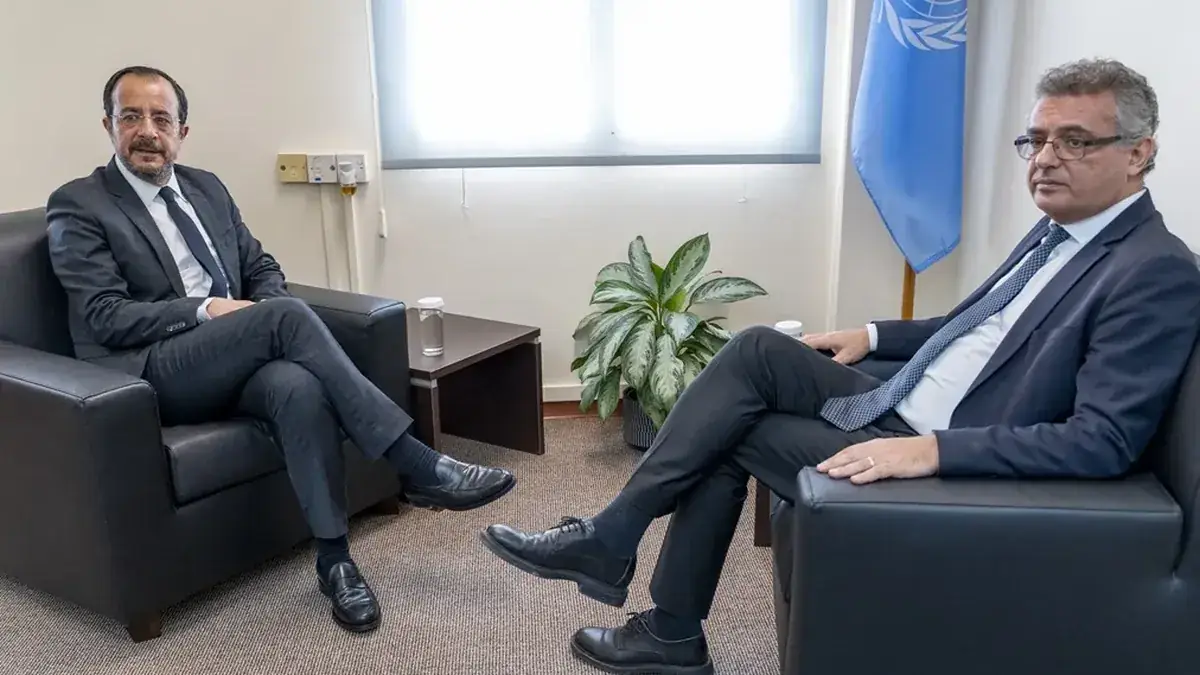
María Ángela Holguín, whom UN Secretary-General António Guterres has named his personal envoy for Cyprus, is on the island from October 29 to November 10 and is holding a series of contacts with the two sides. On Wednesday, November 4 she met Erhürman and then told reporters that the Turkish deputy foreign minister had passed her a message through Turkey’s “ambassador” in the occupied territories.
The activity is part of the process Guterres opened in 2025, aiming to identify areas of cooperation between the two communities. At the first informal meeting in an enlarged format, held in March 2025 in Switzerland with the participation of the foreign ministers of Greece and Turkey, six such areas were agreed, while at the second, four months later at UN headquarters, progress was reviewed. On the critical issues, such as new crossing points, no step forward has been made. After his first visit to the island, at the end of last July, the Secretary-General asked for efforts to be stepped up and announced a meeting in a 5+1 format, making clear however that he does not want a meeting without result. On the Greek Cypriot side, President Nikos Christodoulides has pressed for confidence-building measures such as the fenced-off area of Famagusta.
Ankara does not move
Ankara, however, shows no willingness to move from its positions. The Turkish diplomatic sources repeated that the “most realistic solution” on Cyprus is for two states to coexist and that the international community must recognise the “sovereign equality” and “equal international status” of the Turkish Cypriots. This runs against the framework of the relevant UN Security Council resolutions, which provide for a bizonal, bicommunal federation, and against the reality of the island, a third of which has been under Turkish occupation since the 1974 invasion; see our explainer on the Cyprus problem. Since 2022, Erdoğan has called in every General Assembly speech for the international community to recognise the self-declared “TRNC” without delay.
Üstel took the same line on Wednesday, after his meeting with Holguín, saying the search for a solution on the basis of federation “ended at Crans-Montana” and that reviving a model that has failed, “under other names or methods”, will not help.