Technology
NASA’s Psyche spacecraft puts its foot down on the way to the metal asteroid, with thrusters on nearly 90% of the time
NASA said on October 22 that Psyche has been thrusting almost continuously since September 28 and will fire its Hall thrusters about 90% of the time until arrival at the metal asteroid in summer 2029.

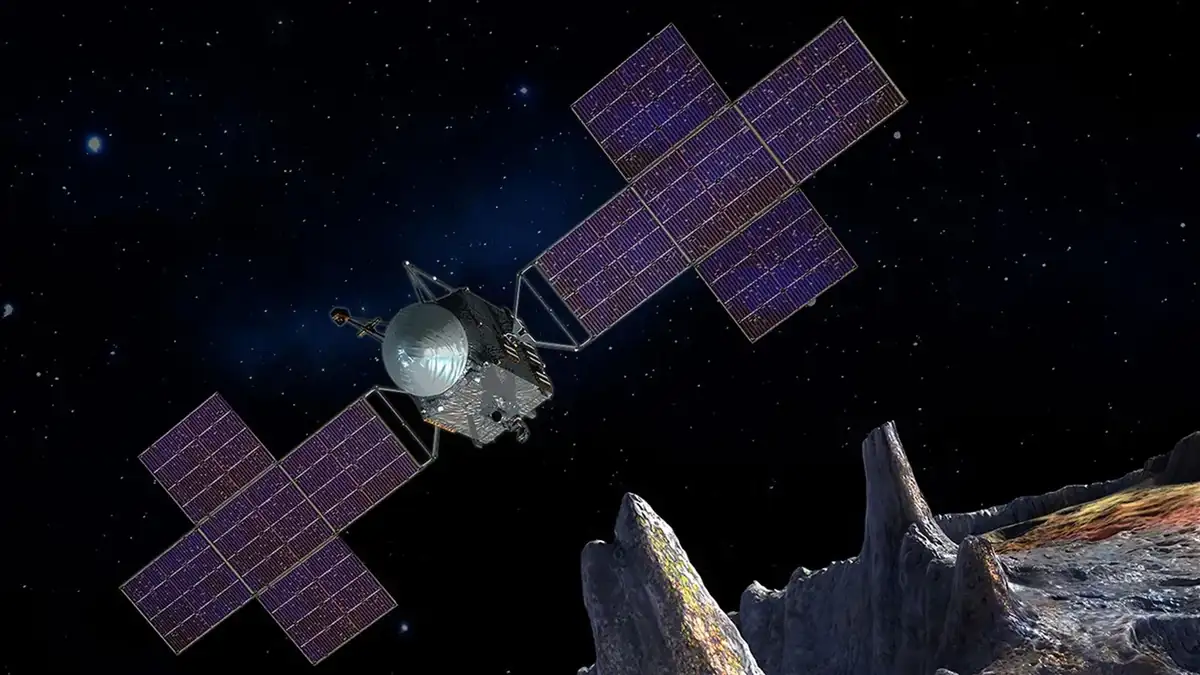
NASA’s Psyche spacecraft has entered a phase of near-continuous propulsion toward the metal asteroid of the same name. As the agency announced in a NASA Science update on Thursday, October 22, since September 28 the spacecraft’s electric thrusters have been running almost without a break, stopping only once a week when the spacecraft talks to controllers on Earth. Arrival at the main asteroid belt, between Mars and Jupiter, remains planned for summer 2029.
“It’s now ‘pedal to the metal’ toward the asteroid Psyche,” said Don Han, the mission’s navigation lead at NASA’s Jet Propulsion Laboratory (JPL). “The thrusters will be running nearly 90% of the time from now until we reach the asteroid.”
Psyche launched on October 13, 2023, and until Mars it used its propulsion intermittently, to be in the right position for a gravity assist: a close planetary flyby that gives a boost and changes course without spending the spacecraft’s propellant. On May 15 the spacecraft passed 4,609 km (2,864 miles) from the surface of Mars and gained speed of about 1,000 miles per hour (about 1,600 km/h).
The target
The asteroid is about 280 km (173 miles) across at its widest point and is thought to be part of the core of a planetesimal, a building block of an early planet. If it proves to be the metal core of an ancient planetesimal, it could offer a unique view into the interior of rocky planets like Earth. On arrival the spacecraft will enter orbit around it and map the asteroid in a series of orbits that descend and ascend in altitude, in a two-year primary science mission. “We are now confidently moving deeper into the solar system, powered by sunlight, ready to explore a mysterious new world in the asteroid belt,” said principal investigator Lindy Elkins-Tanton of the University of California, Berkeley.
How the engine works
Psyche’s engine is unlike the usual ones. Instead of large amounts of fuel giving strong pushes for a short time, the solar-powered system uses electromagnetic fields and gives steady thrust of up to 250 millinewtons, about the weight of an AA battery in the hand. It relies on the Hall effect: ions (charged atoms) of the inert gas xenon are expelled, creating the thrust and an intense blue glow. Four thrusters work one at a time and, although the thrust is small, it accumulates over the whole journey: at the peak of the cruise the spacecraft will be moving at more than 100,000 miles per hour (160,900 km/h) relative to an observer on Earth.
The electricity, which also powers the propulsion, comes from two cross-shaped solar arrays with five panels each and a total light-collecting area of 75 square metres (800 square feet). Psyche launched with nearly 1,090 kg (2,400 pounds) of xenon in seven tanks and in the three years since launch has used about a third, leaving enough to reach the target and accompany it in orbit. “For the next three months we will be thrusting at full power, and then gradually reduce to about half as the spacecraft moves away and the solar arrays receive less light and produce less power,” explained Steve Snyder, lead propulsion operations engineer at JPL.
Hall thrusters need constant management. The ions swirl in the magnetic field and cause a tiny twisting torque which, left uncontrolled, would affect the spacecraft’s orientation. It is absorbed by reaction wheels, spinning wheels that change speed and take up the excess angular momentum. After several hours engineers shut the thruster off, turn the spacecraft and fire another for a few minutes at low power and in a different direction, to unload the momentum accumulated in the wheels. “For a propulsion engineer it’s interesting that you can only measure this torque in space and not on Earth, because it is so small,” said Snyder, adding that it is the first time the effect has been measured on a Hall thruster as a function of power level and operating time, for so long in space.
Psyche is the 14th mission selected in NASA’s Discovery Program. Arizona State University leads the mission, while JPL manages it for NASA.