Europe
Plasma Observatory: ESA picks its next medium-class science mission to study how plasma moves energy
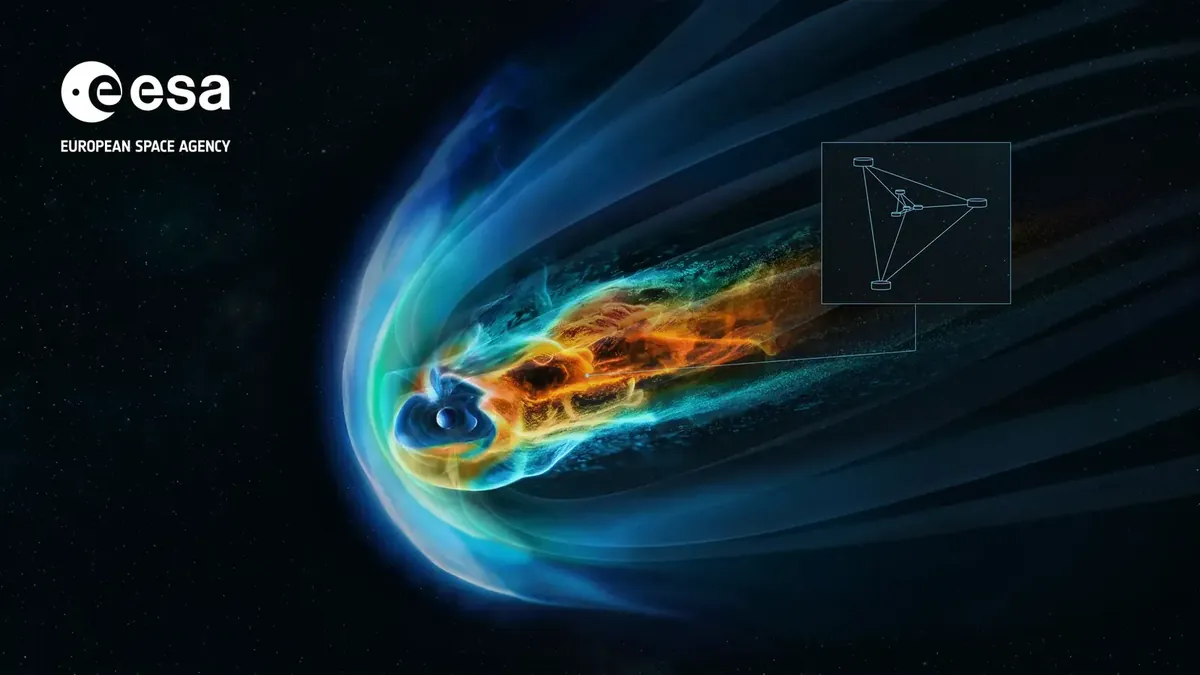
ESA member states have selected Plasma Observatory, a mission of seven coordinated spacecraft that will study how energy from the Sun moves through Earth's magnetic shield.

Plasma Observatory is the European Space Agency’s (ESA) next medium-class science mission. Its member states selected it on Thursday, November 19, 2026, and the agency announced that seven coordinated spacecraft will observe for the first time how energy from the Sun is transferred through the “shield” of Earth’s magnetic field, across different scales of distance and time.
Why plasma matters
Plasma is a gas of charged particles and the fourth state of matter, after solid, liquid and gas. It makes up more than 99% of the visible matter in the Universe, from the Sun and the stars to the solar wind, the continuous flow of plasma emitted by the Sun. The transfer of energy within it shapes almost everything in the Universe and triggers solar storms, shock waves, auroras and magnetic explosions.
When the solar wind reaches Earth, it meets the planet’s magnetic field, which protects us from much of its effects. The most powerful interactions produce auroras and, in extreme cases, power disruptions to satellites and critical electricity-grid infrastructure. For scientists, the magnetosphere, Earth’s magnetic “bubble”, is a natural laboratory. “It is the closest and easiest thing we can study to understand the multiple scales at which plasma acts,” explained Matt Taylor, the mission’s Study Scientist at ESA.
Seven spacecraft, simultaneous measurements
The innovation lies in the simultaneous measurements. Earlier missions, such as ESA’s four Cluster spacecraft, showed that the solar wind interacts with Earth’s magnetic environment on scales from a few to tens of thousands of kilometres and from milliseconds to minutes, but Cluster could examine only one scale of space and time at once. Plasma Observatory will measure magnetic and electric fields and particles at seven points at the same time, showing how small, fast events connect to large changes in key regions of the magnetosphere. ESA’s Director of Science, Professor Carole Mundell, said the mission, built on the results of Cluster, will lead European leadership in heliophysics in the coming decade and beyond.
How the mission was chosen
The process began in December 2021 with a call for the M7 slot in ESA’s Science Programme. Of 27 proposals, five remained in November 2022 and three after the 2023 Phase 0 studies, followed by a competitive industrial Phase A study of about 2.5 years. In June 2026 the agency proposed Plasma Observatory to the Science Programme Committee, in which all 23 member states are represented, and the committee decided on Thursday.
The mission now heads for formal “adoption”, the decision that moves a project from study to full implementation, and then for construction. Launch is provisionally planned for the late 2030s. M7 is the first mission of the Voyage 2050 program. Two medium-class missions are operating today, Solar Orbiter (M1) and the Euclid space telescope (M2), while Plato (M3), Ariel (M4) and Envision (M5) are in preparation.
The next candidates
On the same day ESA narrowed the options for its next missions. Four candidates remain for the medium-class M8 slot: CALICO+ (the dwarf planet Ceres and its possible habitability), FOSSIL (precise measurements of spectral distortions of the cosmic microwave background), PRIAMOS (sample return from a primitive D-type near-Earth asteroid) and SPARK (magnetic reconnection and particle acceleration in solar flares). Three remain for the F3 Fast-class slot: GRINTA (gamma rays), MUSTI (far ultraviolet, massive stars) and SIRIUS (extreme ultraviolet, nearby stars). All seven will go through initial studies in 2027. The Fast mission will be selected in about a year and the medium-class one in 2030.
ESA’s announcement can be read on the ESA website.