Technology
SpaceX’s Starship: Flight 15 ends with the first landing of the spacecraft in the tower’s arms at Starbase, Texas
Starship returned from orbit on November 14 and was caught by the launch tower's arms at Starbase, about 22.5 hours after liftoff. It deployed 26 Starlink V3 satellites; the Super Heavy booster did not return after a shortened boostback burn.

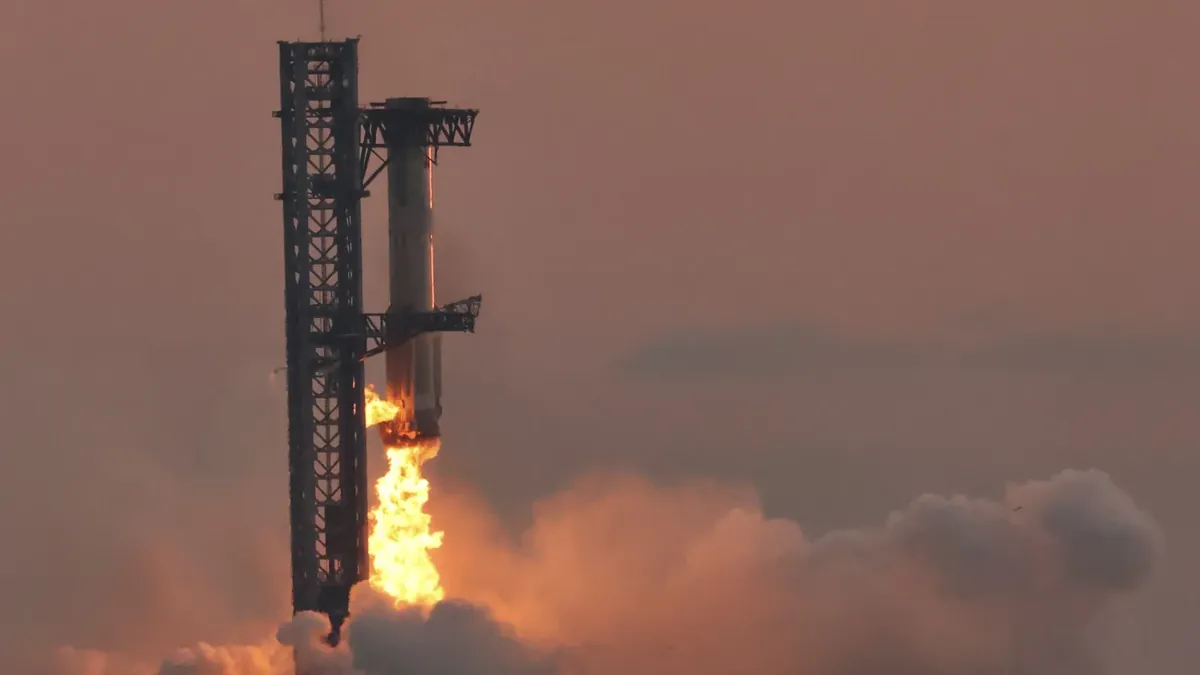
SpaceX’s Starship spacecraft completed its 15th test flight (Flight 15) on Saturday, November 14 with something that had never been done before: it returned from orbit around the Earth and was caught by the mechanical arms of the launch tower at Starbase, Texas. As the company announced on the flight page, the vehicle returned to the launch site from which it had lifted off 22.5 hours earlier.
The launch took place on Friday, November 13 from Starbase’s Pad 2, with the Super Heavy booster and its 33 Raptor engines. After hot-staging, that is, igniting the engines of the upper stage before the lower one separates, Starship continued with six Raptors and entered orbit with the ignition of a single engine. In orbit it released 26 Starlink V3 satellites. SpaceX said that contact was established with all of them and that they are already raising their orbits to join the Starlink constellation.
More than 20 hours of orbiting followed, with continuous systems checks and predetermined alternate splashdown areas in the Pacific, around Hawaii and off Chile. When flight control prepared the return, one Raptor engine fired for the deorbit burn and the vehicle entered the atmosphere.
The route was designed so that Starship would pass over sparsely populated areas of northern Mexico and southern Texas, avoiding the large cities of the Rio Grande valley. It made a final manoeuvre over the Gulf of Mexico and, after passing through the clouds, three Raptor engines fired to flip it to a vertical position. The vehicle descended slowly between the arms of the tower, known as “Mechzilla”, which closed and caught it. On SpaceX’s timeline the catch is placed about 22 hours and 32 minutes after launch.
The Super Heavy booster did not have the same success and did not return to Starbase. In the boostback burn 32 of the 33 planned engines ignited and the burn stopped early because of low propellant mass, with the cause under investigation. The guidance, navigation and control system automatically aborted the return and directed the booster to an alternate landing point at sea. There it successfully performed the landing burn and its engines shut down while it hovered above the Gulf of Mexico. At shutdown, Super Heavy’s flight termination system was activated.
SpaceX presents the catch of Starship as a key step toward full recovery and rapid reuse of the rocket system, a goal it calls the “Holy Grail of rocketry”: a vehicle that flies again quickly, like an aeroplane. On earlier flights the vehicle ended in a splashdown in the ocean. It now also flies over inhabited areas, as the Space Shuttle and the Dragon, Soyuz and Shenzhou capsules did.
NASA’s interest is direct, because the lunar-landing version of Starship, the Starship Human Landing System (HLS), is one of the two landers of the Artemis programme. On October 23 the agency announced that the Artemis III mission will test in 2027, in low Earth orbit, the rendezvous and docking of the Orion spacecraft with test versions of the two companies’ landers. As NASA Administrator Jared Isaacman said, NASA is carrying out President Trump’s National Space Policy for returning American astronauts to the Moon in 2028. How the Blue Moon and Starship landers will be tested is explained in our report on how Artemis III will test the landers.
In NASA’s plan, refuelling Starship tankers transfer propellant in low Earth orbit to a Starship depot, which refuels the lander. The lander waits for Orion in orbit around the Earth, docks with it and pushes it toward the Moon. Both SpaceX and Blue Origin aim to support a crewed lunar landing in 2028.