Analysis
One China policy explained: what the US, Beijing and Taipei each mean
The U.S. “one China” policy is not Beijing’s “one China principle”. Here is what the communiqués, the Taiwan Relations Act and UN Resolution 2758 actually say.

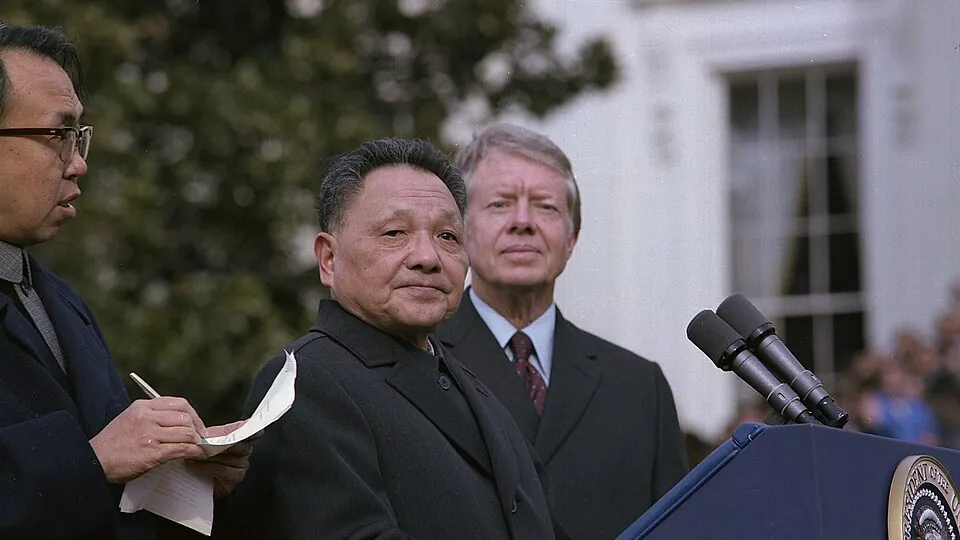
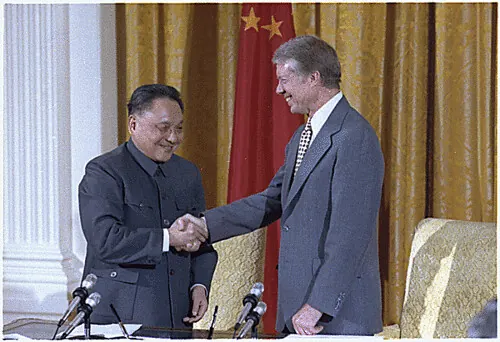
Archive photo: White House Staff Photographers, National Archives and Records Administration (Jimmy Carter Library). Deng Xiaoping and Jimmy Carter, Washington, 29 January 1979. Public domain.
The “one China” policy is the United States’ own carefully worded stance on Taiwan: Washington recognises the government in Beijing as the sole legal government of China, “acknowledges” the Chinese position that Taiwan is part of China, does not endorse that claim, and insists that Taiwan’s future be settled peacefully. It is not the same as Beijing’s “one China principle”, and Taipei rejects both the claim of subordination and the idea that the matter is settled.
The difference matters again this week. After Saturday’s local elections in Taiwan, Beijing’s Taiwan Affairs Office said that no change in the island’s political landscape can stop “the historical trend that the motherland must and will inevitably be reunified”, while Taipei’s Mainland Affairs Council said China must talk with the elected government “without preconditions and with equal dignity”, as we reported in Beijing after Taiwan’s elections: reunification ‘cannot be stopped’; Taipei says China must respect Taiwan’s choices.
Key points
- The U.S. “one China” policy rests on three joint communiqués with Beijing (1972, 1979, 1982), the Taiwan Relations Act of 1979 and the “Six Assurances” given to Taipei in 1982.
- Washington “acknowledges” Beijing’s position that Taiwan is part of China; it does not state that it agrees, and the Taiwan Relations Act says the future of Taiwan is to be determined by peaceful means.
- UN General Assembly Resolution 2758 (1971) seated the People’s Republic of China as the only lawful representative of China at the UN; its text does not mention Taiwan.
- Beijing’s principle says Taiwan is a province of China. Taiwan’s president said in October that Taiwan is “open to exchanges, but will not accept subordination”.
What does “one China” mean for the United States?
The policy was built in stages. In the Shanghai Communiqué of 27 February 1972, the Chinese side stated that “the Government of the People’s Republic of China is the sole legal government of China” and that Taiwan is a province of China. The U.S. side declared: “The United States acknowledges that all Chinese on either side of the Taiwan Strait maintain there is but one China and that Taiwan is a part of China. The United States Government does not challenge that position.” It added that it “reaffirms its interest in a peaceful settlement of the Taiwan question by the Chinese themselves.” The text is published in the State Department’s Foreign Relations of the United States series.
The step to formal relations came on 1 January 1979. In the joint communiqué on the establishment of diplomatic relations, the United States “recognizes the Government of the People’s Republic of China as the sole legal Government of China” and, within that context, said its people would keep “cultural, commercial, and other unofficial relations with the people of Taiwan”. The Office of the Historian records that the U.S. “acknowledged” the Chinese position that there is but one China and Taiwan is part of China, and that Washington declared its intention to abrogate the 1954 Mutual Defense Treaty with the Republic of China.
The word “acknowledges” is the hinge. A Congressional Research Service report on the policy, updated through January 2015, noted that the United States “did not explicitly state Taiwan’s status” in the 1972, 1979 and 1982 communiqués and that, not recognising either the PRC’s claim over Taiwan or Taiwan as a sovereign state, “U.S. policy has considered Taiwan’s status as unsettled”. In the report’s words, U.S. policy focuses “on the process of resolution of the Taiwan question, not any set outcome”.
What does the Taiwan Relations Act say?
Congress wrote the legal framework for the relationship with Taiwan after the switch of recognition. The Taiwan Relations Act, which took effect as of 1 January 1979, states that the U.S. decision to establish diplomatic relations with the PRC “rests upon the expectation that the future of Taiwan will be determined by peaceful means”. It makes it U.S. policy to consider “any effort to determine the future of Taiwan by other than peaceful means, including by boycotts or embargoes, a threat to the peace and security of the Western Pacific area and of grave concern to the United States”, to provide Taiwan with “arms of a defensive character”, and to maintain the capacity of the United States “to resist any resort to force or other forms of coercion” that would jeopardise the security or the social or economic system of the people on Taiwan (22 U.S. Code § 3301).
As quoted above, the act speaks of maintaining the capacity to resist coercion and of providing defensive arms. The CRS report adds that President Reagan also gave Taipei “Six Assurances” in 1982, including that Washington would not mediate between Taipei and Beijing and would not pressure Taipei to negotiate with Beijing.
Taiwan’s own military is watched daily. Its defence ministry recorded 30 Chinese aircraft on one recent day, as we reported in Taiwan: 30 Chinese aircraft detected, 26 crossing the median line, as warships join a “joint combat readiness patrol”.
How is Beijing’s “one China principle” different?
Beijing’s formula goes further than Washington’s. In the Shanghai Communiqué the Chinese side set out its position that Taiwan is a province of China and that its “liberation” is China’s internal affair, and that it firmly opposes “two Chinas”, “one China, one Taiwan” and “independent Taiwan”. After the election, the State Council’s Taiwan Affairs Office repeated that Beijing will keep dealing “resolutely” with “Taiwan independence” forces and advance “the great cause of national reunification”.
The difference can be summarised in one table.
| Party | Position on Taiwan, from the documents |
|---|---|
| United States | Recognises the PRC government as the sole legal government of China; “acknowledges” the Chinese position that Taiwan is part of China; does not challenge it; requires a peaceful outcome; sells defensive arms under the Taiwan Relations Act. |
| People’s Republic of China | Taiwan is a province of China; the PRC government is the sole legal government; “reunification” is inevitable; it opposes “Taiwan independence” and “two Chinas”. |
| Taiwan (Republic of China) | Does not accept subordination; says China must respect Taiwan’s democratic system and talk with the elected government without preconditions. |
Taipei’s position is stated in the Presidential Office’s text of President Lai Ching-te’s 2026 National Day address, in which he said that Taiwan “cherishes peace, but we will not give up our freedom” and is “open to exchanges, but will not accept subordination”. He also accused China of using military and “gray-zone” activity “in an attempt to alter the status quo across the Taiwan Strait”.
For the election background and the full exchange between Beijing and Taipei, see Taiwan local elections: KMT holds Taipei against a candidate wanted by China, DPP gains elsewhere.
What did the United Nations decide in 1971?
The question of who speaks for China at the UN is often confused with the status of Taiwan. General Assembly Resolution 2758 (XXVI), adopted on 25 October 1971, decided “to restore all its rights to the People’s Republic of China and to recognize the representatives of its Government as the only legitimate representatives of China to the United Nations”, and to expel “the representatives of Chiang Kai-shek” from the UN and its related organisations. It deals with representation. Its text does not mention Taiwan and does not say anything about Taiwan’s sovereignty.
The following explainer from CNN 10 gives a short visual summary of how the policy works.
Why is the policy described as ambiguous?
The CRS report describes the U.S. policy as “somewhat ambiguous and subject to different interpretations”. Washington leaves the outcome open, while Beijing treats the matter as settled and Taipei treats the island as already governing itself. The same CRS survey of key statements records the November 1992 exchange in which Taipei’s SEF notified Beijing’s ARATS that each side would make its own verbal statements on “one China”, and ARATS said it respected and accepted that; the report files the episode under the heading “One China, Different Interpretations” (the “1992 Consensus”).
That ambiguity is why each election, military exercise or arms sale is read against the same few sentences from 1972, 1979 and 1982.
Sources
Shanghai Communiqué text, U.S. Department of State, Office of the Historian; Taiwan Relations Act, 22 U.S. Code § 3301; Office of the Historian, China policy under Carter; Congressional Research Service, RL30341; Office of the President of Taiwan, National Day address 2026; UN General Assembly Resolution 2758 (XXVI), 25 October 1971.