Analysis
Dark Eagle hypersonic missile explained: range, how it works, status
Dark Eagle is the U.S. Army's Long-Range Hypersonic Weapon, a ground-launched missile with a glide body that flies at Mach 5 or faster. What it is, how a battery works and why fielding has slipped.

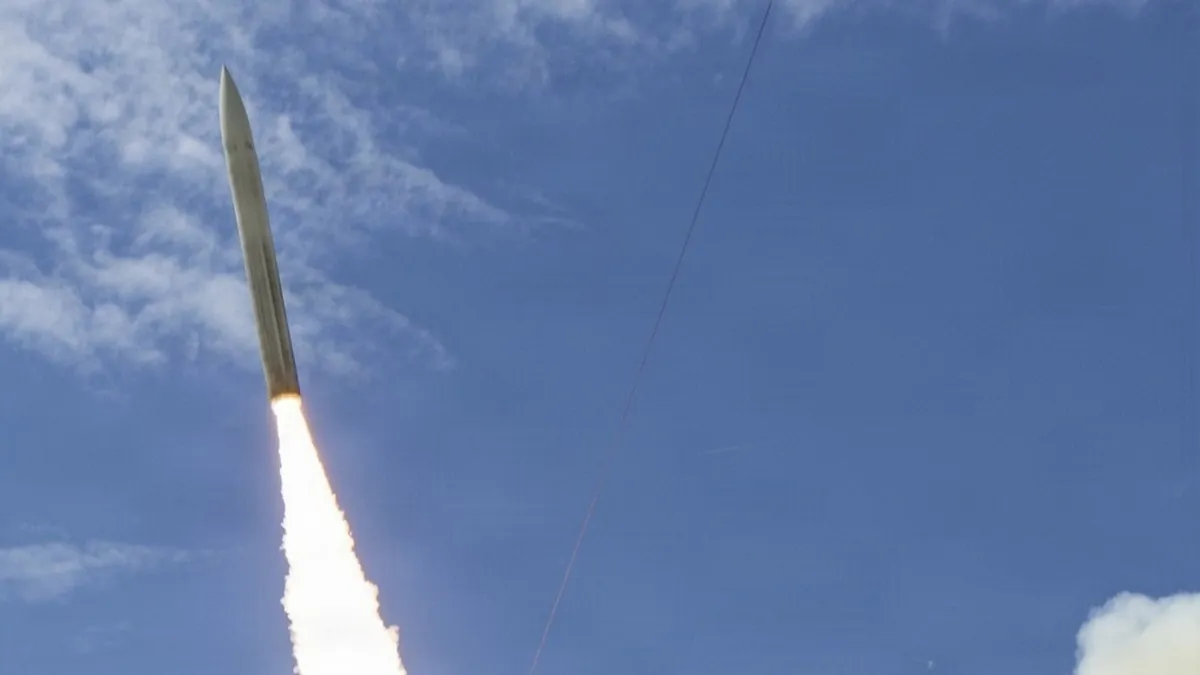
A Dark Eagle missile launch. Photo: U.S. Army Contracting Command/Sarah Nelson, via DVIDS (public domain), file photo dated 20 April 2026
Dark Eagle is the U.S. Army’s Long-Range Hypersonic Weapon (LRHW): a ground-launched missile that carries a hypersonic glide body, built to hit time-sensitive, heavily defended targets from long range. The Congressional Research Service gives its reported range as 1,725 miles, and the Army formally named it Dark Eagle on 24 April 2025.
Fielding has been slow, expensive and repeatedly delayed, which is why the weapon keeps returning to the news. This explainer sets out what Dark Eagle is, how it works, who operates it and where the programme stands, using official U.S. documents.
Key points
- Dark Eagle pairs a two-stage booster with a Common Hypersonic Glide Body (C-HGB) that flies at Mach 5 or faster on its own.
- A battery has one battery operations center, four transporter erector launchers, a support vehicle and up to eight missiles.
- The booster is shared with the U.S. Navy’s Conventional Prompt Strike programme.
- The Army missed its original fielding goal of fiscal 2023; a second battery has slipped to the second quarter of fiscal 2027, according to GAO findings summarised by CRS.
- It is designed for conventional precision strikes, according to CRS.
What is Dark Eagle?
According to the Congressional Research Service (CRS), the LRHW is a ground-launched missile with a hypersonic glide body, plus the transport, support and fire-control equipment that go with it. It is intended for long-range conventional precision strikes against time-sensitive and heavily defended targets in contested environments.
The Pentagon’s own testing office describes how it would be used: Army commanders would employ it against adversary high-payoff and time-sensitive targets, with U.S. Strategic Command as the employment authority under National Command Authority direction, as summarised by CRS.
How does a hypersonic glide weapon work?
The missile is launched like a ballistic missile. A rocket booster accelerates the glide body to well above hypersonic speed, and the expended booster is then jettisoned. The glide body continues on its own. CRS says it travels at Mach 5 or higher without further propulsion and is planned to be manoeuvrable. The Army describes hypersonic systems as flying above Mach 5 and offering speed, range, manoeuvrability and altitude that make them highly survivable and able to defeat time-critical targets quickly (U.S. Army).
Two parts matter most:
- The missile. Developed by Lockheed Martin and Northrop Grumman. With the glide body fitted it is the Navy-Army All Up Round plus Canister (AUR+C), a two-stage booster used by both services.
- The Common Hypersonic Glide Body. Based on the Alternate Re-Entry System developed by the Army and Sandia National Laboratories. Dynetics, a Leidos subsidiary, is producing prototypes for the Army and Navy.
What is in a Dark Eagle battery?
| Element | What it is |
|---|---|
| Battery operations center | One per battery, the command and fire-control node |
| Transporter erector launchers | Four per battery |
| Support vehicle | One battery operations center support vehicle |
| Missiles | Up to eight AUR+C rounds per battery |
| First battery | Assigned to the 5th Battalion, 3rd Field Artillery Regiment, 1st Multi-Domain Task Force, at Joint Base Lewis-McChord, Washington |
| Other batteries | Planned for the remaining Multi-Domain Task Forces as they are activated |
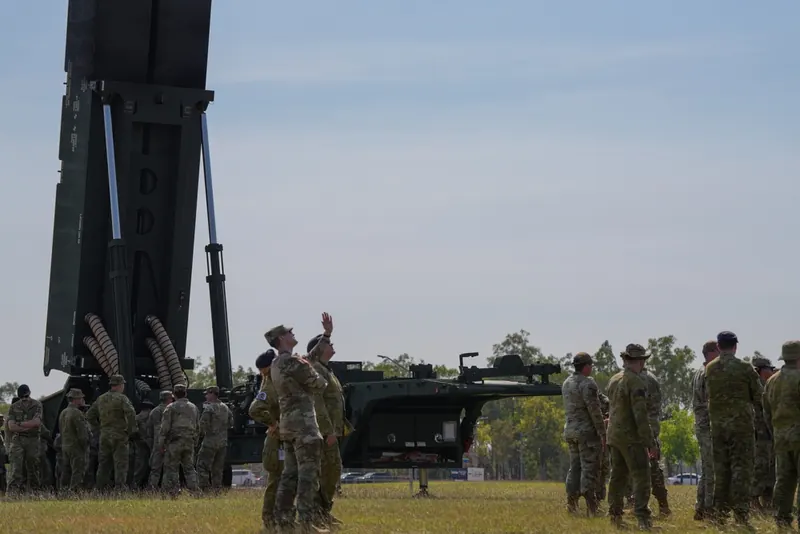
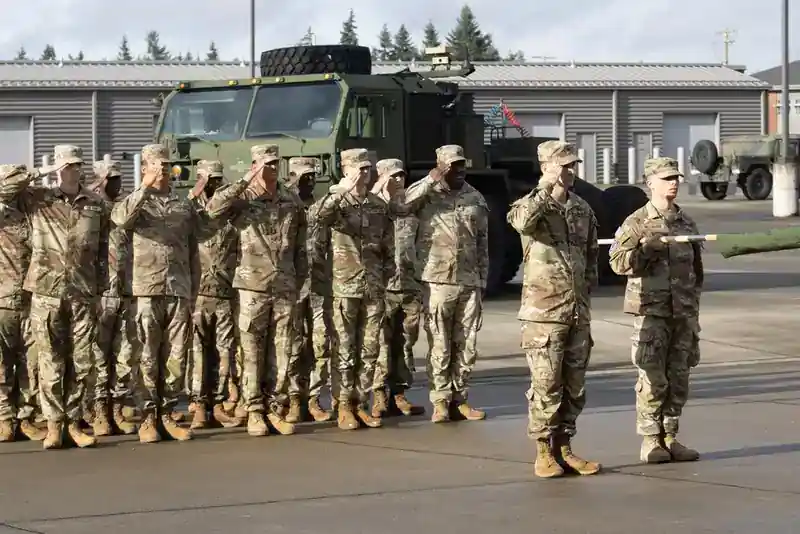
The U.S. Army activated Bravo Battery, 1st Battalion, 17th Field Artillery Regiment, 3d Multi-Domain Task Force, at Joint Base Lewis-McChord on 12 December 2025 as the unit designated to operate Dark Eagle for commanders in the Indo-Pacific (U.S. Army).
How did the programme get here?
The test record explains the delays. Following CRS, the key dates are:
- 21 October 2021: the booster carrying the glide body reportedly failed in a flight test that officials called a “no test”.
- June 2022: a full-missile test reportedly failed.
- 14 September 2023: the Army acknowledged it would not meet its goal of fielding the weapon by the end of fiscal 2023.
- 28 June 2024: the Department of Defense announced a successful end-to-end test from Kauai, Hawaii, over more than 2,000 miles to the Marshall Islands.
- 12 December 2024: a successful end-to-end test from Cape Canaveral, the first live fire using a battery operations center and launcher.
- 26 March 2026: a successful launch from Cape Canaveral Space Force Station, announced on 2 April 2026.
In July 2025 the 3d Multi-Domain Task Force took a Dark Eagle system outside the continental United States for the first time, to the Northern Territory of Australia for Exercise Talisman Sabre 25. Adm. Samuel Paparo, commander of U.S. Indo-Pacific Command, said the deployment “validates the Army’s ability to deploy, position, and exercise command and control” of the system in a forward environment (DVIDS).
Why was Dark Eagle delayed, and what does it cost?
CRS, drawing on Government Accountability Office assessments, reports that first-battery fielding, including missiles, would not occur until at least the second quarter of fiscal 2026, more than two years after the initial goal. Fielding of the second battery slipped to the second quarter of fiscal 2027 because of missile delivery delays of at least six months. Flight-test problems also created a production bottleneck, and the Army and Navy paused production until a successful test. The contractor has also had facility issues.
Money has followed. The FY2027 request in the CRS summary is $446.6 million for research and development and $301.8 million for procurement. A January 2023 Congressional Budget Office study estimated $41 million per missile for a similar class of weapon, and the Army told CRS the fly-away cost of the eight missiles in its FY2025 request would exceed that estimate, though costs could fall with larger orders. On 31 March 2026 Army Contracting Command at Redstone Arsenal awarded a $2.7 billion contract supporting Dark Eagle, the first production contract for the glide body programme (DVIDS).
How does Dark Eagle relate to the Navy?
The booster is common to both services. The Navy’s Conventional Prompt Strike, which is designed to be fired from surface ships and submarines, uses the same two-stage booster and the same glide body, according to CRS.
What questions remain?
CRS lists the issues it expects Congress to watch: missile cost, further operational testing, stockpile requirements, the causes of fielding delays, the adequacy of the contractor’s production facilities, and the readiness effect of any further slips. Congress may also ask for more frequent updates as procurement, fielding and stockpile building proceed.
US Army takes full delivery of first Dark Eagle hypersonic battery, three years late follows the latest delivery news. For other hypersonic programmes, see Lockheed Martin expands its Troy, Alabama plant for the ARRW hypersonic missile of the B-52 after a $694 million Air Force contract, HACM: first flight test of the US Air Force’s hypersonic cruise missile, held over Australia and South Korea: first successful test of a homegrown hypersonic glide vehicle, a “key strategic asset” for the battlefield.
Sources: Congressional Research Service, The U.S. Army’s Long-Range Hypersonic Weapon (LRHW): Dark Eagle (IF11991, July 2026 update); U.S. Army, Long-Range Hypersonic Weapon System Battery activates on Joint Base Lewis-McChord; DVIDS, Behind Dark Eagle contracting; DVIDS, U.S. Army showcases Long-Range Hypersonic Weapon during TS25 in Australia.