Analysis Air Force
Missiles for the F-35 and F-16 Viper: the Hellenic Air Force’s menu if the US does not answer – Meteor, Rampage, ICE BREAKER
The Hellenic Air Force has the money for the munitions of its new fighters but still lacks US approvals. If Washington does not answer in 2027, the air staff is likely to turn to Meteor, IRIS-T, Rampage, SPICE and ICE BREAKER.

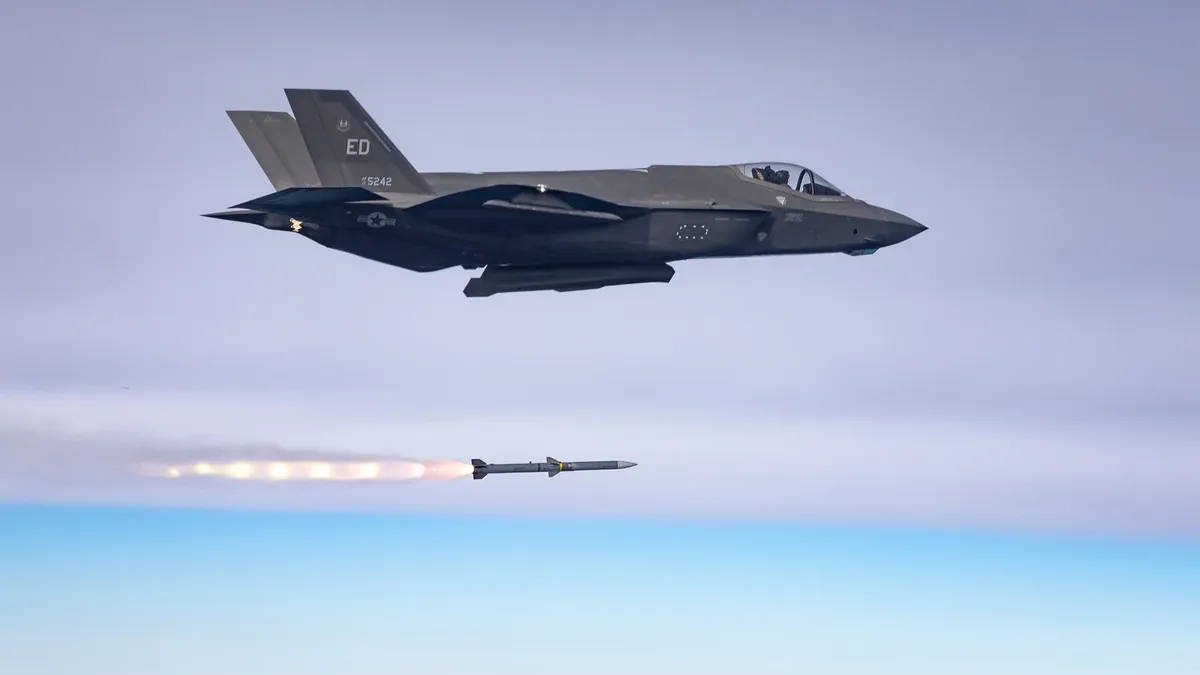
An F-35A of the 461st Flight Test Squadron fires an AIM-120 in a test with TR-3 software. Photo: U.S. Air Force
The Hellenic Air Force has secured the money for the munitions of its new fighters. What it lacks is US approvals. The requests for AIM-120D and AIM-9X air-to-air missiles, the JASSM-ER cruise missile and the Harpoon anti-ship missiles for the F-16 Viper and the F-35 are still waiting for an answer from Washington. If none comes in 2027, the air staff is likely to turn to purchases from other countries. At the centre of that plan is Europe’s Meteor, which the air force already uses on its Rafale and which can become a common stock for Rafale and F-35 once it is certified on the US fifth-generation fighter. The “menu” is wider, though, and includes strike weapons from Israel’s Rampage, SPICE and ICE BREAKER to France’s SCALP.
The US side has not said “no”, but it has not said “yes” either. Asked in Athens in October about the weapons of Greece’s F-35s, US Secretary of State Marco Rubio answered that “there is no official answer” and that the matter “is being examined very seriously”, with the final decision belonging to the president after an interagency process. The same day, October 7, 2026, the joint statement of the 6th Greece-US Strategic Dialogue announced FMS military sales worth $4 billion. For the advanced missiles, however, no Letter of Offer and Acceptance (LoA), the binding US government document, has been issued, nor has a related DSCA notification to Congress been published. The air force’s munitions gap remains open.
The problem is not fiscal. The defence ministry’s 2027 budget provides €4 billion for armament payments, against €3.2 billion in 2026, and the roughly €25 billion 12-year armaments programme the prime minister presented to parliament in April 2025 gives the air staff a planning horizon. What the air force lacks is time, because a fighter delivered without modern weapons is in effect an excellent sensor that cannot complete the strike chain on its own.
Why 2027 is the limit for F-35 and F-16 Viper weapons
The F-35 timeline is known. Production of the first Greek F-35As begins in early 2027, deliveries to the US are due in the second half of 2028 and, according to the government, the first aircraft reaches Greece in November 2029, at the 117 Combat Wing in Andravida. Modern missiles are not delivered the day after signature, however. The AMRAAM production lines are loaded with US and allied orders, and the US agreed with Japan on a final assembly line on Japanese soil, while rising demand for JASSM-ER is stretching delivery times. If the LoA is signed after 2027, the first missiles will probably arrive after the F-35s reach Andravida.
On the F-16s the problem is already here. The Viper-programme F-16s have the APG-83 SABR AESA radar, which replaced the older APG-68, but fly with previous-generation missiles: AIM-120B and C for beyond-visual-range (BVR) combat, AIM-9 and IRIS-T for close combat and AGM-65 Maverick against ships. With the air force also waiting for the LoA to upgrade 37 F-16 Block 50s to Viper, Athens cannot leave the munitions decision hanging indefinitely on US planning. That is why 2027 works as an informal deadline: either the approvals come, or Greece contracts with other suppliers.
Meteor as a common stock for F-35 and Rafale
MBDA’s Meteor is a BVR air-to-air missile with a ramjet motor, an air-breathing engine that regulates its thrust and keeps it for most of the flight, not just the first seconds like a conventional rocket motor. That is why MBDA presents it as the missile with the largest “no-escape zone”, the range within which the target cannot evade by manoeuvring. The air force already has it for its 24 Rafale, and the €400 million weapons package of the first contract for 18 Rafale covered new Meteors along with upgrades of the MICA, SCALP and Exocet missiles it already had.
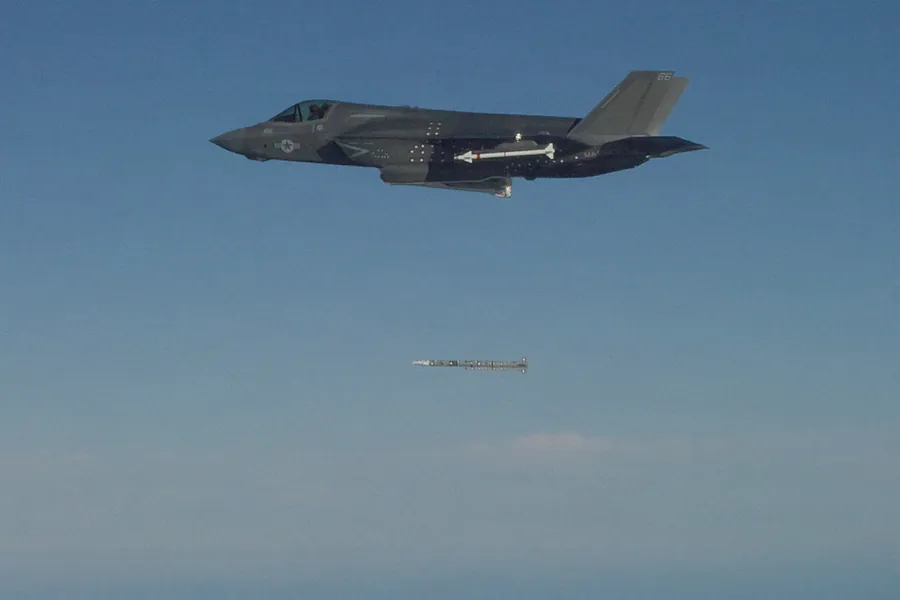
Integration on the F-35 is moving on two parallel tracks: the United Kingdom leads the F-35B integration and Italy funds the F-35A one. After the first Meteor flights on an F-35B in 2025, Lockheed Martin announced in December 2025 that vibration and fit tests of the missile in the F-35A’s internal weapons bay had been completed at Edwards Air Force Base, with one more ground test remaining before flights. On October 7, 2026 a Meteor was released from an F-35B internal weapons bay for the first time, over Naval Air Station Patuxent River, and according to Lockheed Martin drops with different profiles and then live firings will follow.
The critical element for Greece is the timeline. The UK Ministry of Defence, in a written answer to the House of Commons in June 2025, said Meteor’s operational capability on the F-35B is expected in the early 2030s and that the earlier 2027 target has been abandoned. No separate date has been announced for the F-35A that Greece is buying, but on this timeline the first Greek F-35s will probably reach Andravida before Meteor is certified, and the first years will need AMRAAMs. Even a European missile on the F-35 depends on the aircraft’s software, which is managed by the US F-35 Joint Program Office (JPO). Buying the Meteors themselves is a contract with a European supplier, outside FMS, but using them on the F-35 will again require Washington’s consent.
A common stock has clear advantages all the same: one supply chain, common training for technical personnel and, above all, flexibility in a crisis, as the same missiles can go to whichever aircraft type needs them at that moment. If it meets the criteria, the contract could also fit under the EU’s SAFE loan programme, which finances procurement with at least 65% European content. Meteor does not solve the F-16 Viper problem, however, because it has not been integrated on the F-16 and no programme has been announced.
AMRAAM, AIM-9X, MICA NG and IRIS-T: the alternatives
On the F-35A, the air-to-air missiles currently certified are the AIM-120 AMRAAM for medium and long range and the AIM-9X for close combat, while according to the UK Ministry of Defence British F-35Bs also use ASRAAM. The AIM-260 JATM, the new long-range US missile designed for internal weapons bays and in which the air force has shown interest, has not been announced for export to any country, and the newer AIM-424 is still in development. The realistic goal is the AIM-120D, and there is a precedent: the State Department approved on April 29, 2025 the possible sale of 400 AIM-120D-3 to Poland, worth an estimated $1.33 billion, and a similar approval has been given to the Netherlands. If Washington does not approve the D, the air force has already been fully briefed on the AIM-120C-8, which is the likeliest interim solution.
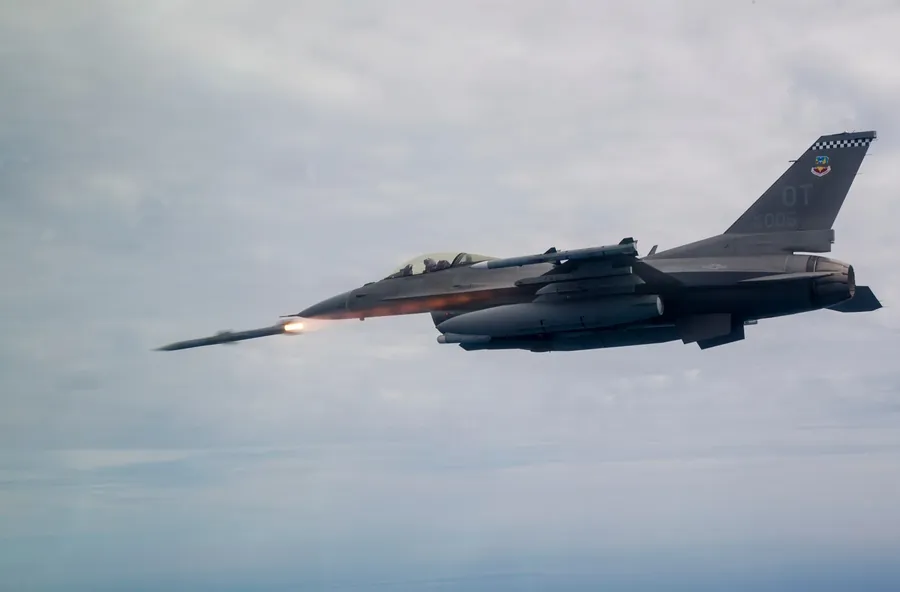
On the F-16 Viper the picture is simpler but harder. No European BVR missile is integrated on the F-16, so for long range the mature solution is AMRAAM, in C-8 or D version, and US approval is unavoidable there. In close combat things are different. Greece was one of the partner countries in the IRIS-T programme of Germany’s Diehl, and Greek F-16s already carry the missile, so the stock can be renewed directly with Diehl without waiting for an answer on the AIM-9X Block II. Israel’s Rafael offers the Python and Derby families, but every new weapon on the Viper requires integration into the aircraft’s mission software through Lockheed Martin. Rampage and SPICE show that it can be done, but it takes time and money.
On the Rafale the air force already has a European solution for both ranges: Meteor for long range and MICA, in radar (EM) and infrared (IR) versions, for medium and close range. MICA’s successor, MICA NG, is in testing with France’s Directorate General of Armaments (DGA): the first firing with guidance from a Rafale took place on June 19, 2025 and the first firing in supersonic flight on June 1, 2026. MICA NG has the same external dimensions as MICA but new imaging-infrared or AESA radar seekers and a dual-pulse motor that increases range. There are initial thoughts in the air staff about MICA NG, but fitting it on the Greek Rafale will require a corresponding software upgrade.
Strike weapons: Rampage, SPICE, ICE BREAKER and SCALP versus JASSM-ER, Harpoon and AARGM
The US list for strike is just as long: the low-observable JASSM-ER cruise missile, for which Greece has already received price and availability data, the AGM-84L Harpoon Block II anti-ship missile, the AARGM anti-radar missile for suppression of enemy air defences (SEAD) and the GBU-53/B StormBreaker small-diameter bombs. Here, though, the air force is not starting from zero, because it has already made its first choices outside the US.
The most characteristic case is the Rampage from IAI and Elbit, a supersonic air-to-ground missile with a range of 150 to 250 kilometres depending on the release profile, chosen for Greek F-16s and shown at the October 28, 2026 parade. Beside it are Rafael’s SPICE 1000 and 2000 guidance kits, which turn 1,000 and 2,000-pound bombs into precision weapons with electro-optical terminal guidance independent of GPS. The €130 million intergovernmental contract 009Γ/23 with Israel has had an inspection and acceptance committee since September 17, 2026, and according to Rafael the SPICE 1000 reaches 125 kilometres.
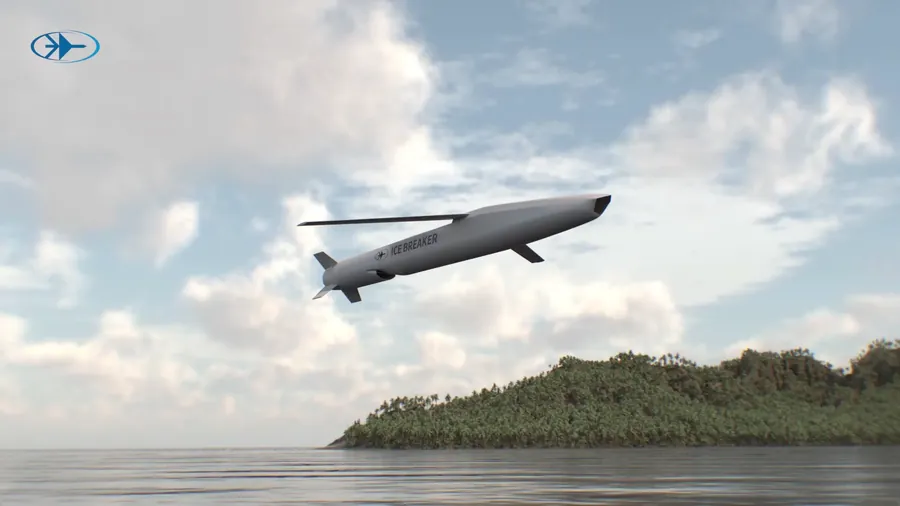
One of the biggest gaps is the F-16s’ anti-ship strike, which today relies on Mavericks. If the Harpoon Block II is not approved, the alternative already proposed is Rafael’s ICE BREAKER, an air-launched version of the family that also includes the SEA BREAKER, a cruise missile with autonomous navigation, low-altitude flight and image-matching terminal guidance, for which the company states a range of about 300 kilometres. Its integration on the Viper would have to be done from scratch. On November 11, 2026 Rafael also unveiled the SUPER ICE, with a 1,000-pound warhead and, according to the company, a longer range, sharing the same launchers and mission planning as the rest of the family.
On the Rafale the air force already has the SCALP-EG cruise missile for deep strikes and the Exocet AM39 for anti-ship strikes, and is also looking at the French HAMMER kits. For the F-35, the European option for striking land and sea targets is Kongsberg’s Norwegian JSM, designed to be carried in the F-35A’s internal weapons bay, while for the British SPEAR 3 the UK Ministry of Defence also gives a horizon of the early next decade. The hardest gap to fill outside the US remains suppression of air defences, because there is no ready equivalent of AARGM integrated on the Viper.
What is decided for the air force in 2027
The air staff’s options come down to two scenarios. If the approvals come, the air force will acquire AMRAAM, AIM-9X, JASSM-ER and Harpoon for the Viper and F-35, and Meteor will enter as a second long-range stock once it is certified on the F-35. If they do not, the scales tip decisively toward Europe and Israel: Meteor in large numbers for Rafale and F-35, IRIS-T for the F-16s’ close combat, Rampage, SPICE and ICE BREAKER for strike, and AMRAAM C-8 only where there is no other solution, namely the Viper’s long range.
The cost of the second option is not only financial. More missile types mean more supply chains, more training and more dependence on integration into aircraft software controlled by others. The benefit is just as concrete: a stock that does not depend on a single supplier, at a time when the war in Ukraine has shown that even the US needs years to replace what it has spent. And every contract that goes elsewhere is a contract the US industry loses, an argument Athens has every reason to put to Washington.
Turkey, which has also been waiting years for Washington over F-16 Block 70s and F-35s, answered with domestic missiles and a turn to the Eurofighter. Greece has a different advantage: it already has the fighters, it has the will and it has tested alternative suppliers. What it does not have is time to wait without end, and that is why 2027 will be the year that decides where Greek F-35s and F-16 Vipers will be armed from over the next decade.
Frequently asked questions
Can the F-35 carry the Meteor missile today? Not yet. Integration is under way, with the UK leading on the F-35B and Italy funding the F-35A. The first Meteor drop from an F-35B internal weapons bay took place on October 7, 2026, and the UK Ministry of Defence expects operational capability on the F-35B in the early 2030s.
Which air-to-air missiles is Greece asking the US for? The Greek interest covers the AIM-120D AMRAAM and the AIM-9X Block II for the F-16 Vipers and the F-35s, and the air force is also following the AIM-260 JATM. If the AIM-120D is not approved, the alternative is the AIM-120C-8. So far no LoA has been issued for any of them.
Can Greek F-16 Vipers carry the Meteor? No. Meteor has not been integrated on the F-16 and no integration programme has been announced. In the Hellenic Air Force it is carried by the Rafale, and in future the F-35 will be able to carry it once certification is complete.
Which strike weapons has the air force already chosen outside the US? For the F-16s it has chosen the supersonic Rampage missile from IAI and Elbit and Rafael’s SPICE 1000 and 2000 guidance kits, for which the €130 million intergovernmental contract 009Γ/23 has been signed. The Rafale carry the SCALP-EG cruise missile and the Exocet AM39 anti-ship missile.