Analysis
NATO 5% defence target explained: where Greece stands
NATO's 5% pledge from The Hague splits into 3.5% for core defence and 1.5% for wider security by 2035. Here is what it means and where Greece stands in NATO's own 2026 tables.

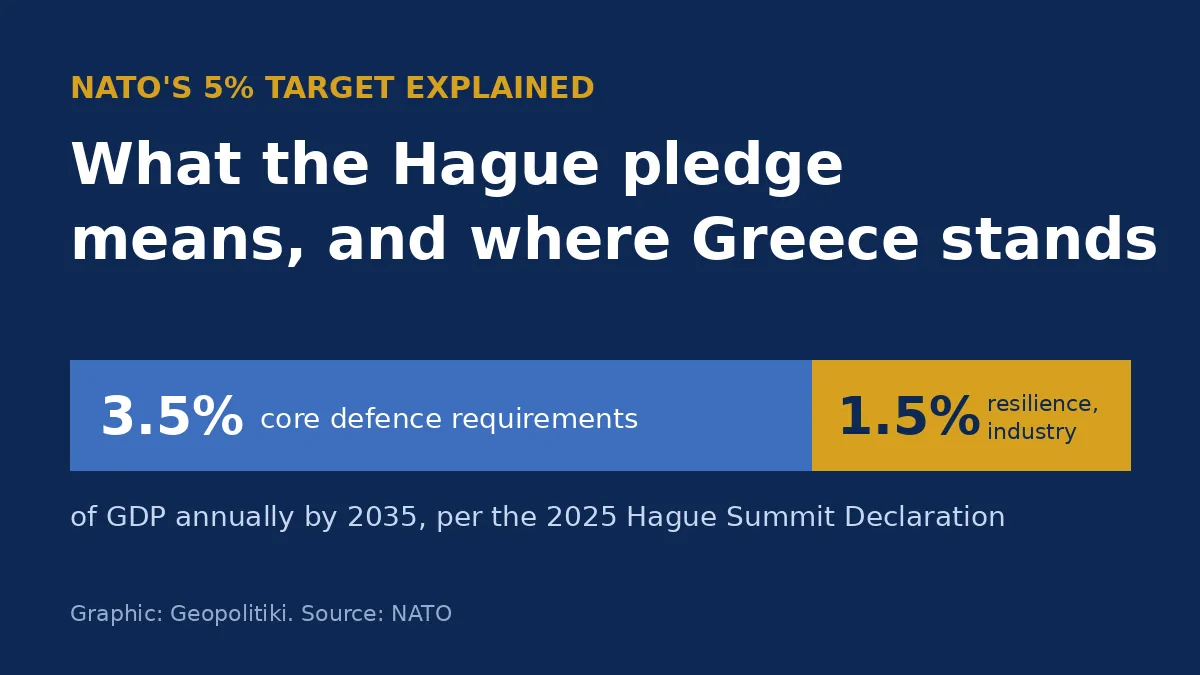
NATO’s 5% target is the pledge, made by all Allies at the 2025 Hague Summit, to invest 5% of GDP a year in defence and defence-related spending by 2035. At least 3.5% must go to core defence requirements and up to 1.5% to wider security investments. In NATO’s own 2026 tables, Greece is among the Allies already above the 3.5% line for core defence, on an estimate for 2026.
Key points
- The pledge comes from the Hague Summit Declaration of 25 June 2025: 5% of GDP a year by 2035, split into at least 3.5% for core defence and up to 1.5% for resilience, infrastructure and industry.
- Allies must submit annual plans showing a credible, incremental path, and the trajectory will be reviewed in 2029.
- In NATO’s July 2026 report, Greece’s core defence spending is estimated at 2.79% of GDP for 2025 and 3.65% for 2026, up from 2.24% in 2014.
- The same table puts Turkey at 1.44% in 2014, 2.33% for 2025 and 2.85% for 2026 (estimates for the last two).
- NATO warns that its figures may diverge from national budgets, because they follow a common NATO definition.
What did NATO leaders agree at The Hague?
The Hague Summit Declaration says Allies “commit to invest 5% of GDP annually on core defence requirements as well as defence-and security-related spending by 2035”. The text ties the commitment to Article 3 of the Washington Treaty, which obliges the Allies to maintain and develop “their individual and collective capacity to resist armed attack” through “continuous and effective self-help and mutual aid”.
The 5% has two parts. Allies will allocate at least 3.5% of GDP annually to core defence requirements and to meeting the NATO Capability Targets, using the agreed NATO definition of defence expenditure. They will also account for up to 1.5% of GDP annually for protecting critical infrastructure, defending networks, civil preparedness and resilience, innovation and the defence industrial base.
The declaration adds that Allies will submit annual plans showing a credible, incremental path to the 3.5% goal, and that the trajectory and balance of spending will be reviewed in 2029. It also states that direct contributions towards Ukraine’s defence and its defence industry will count when Allies calculate their defence spending.
How did NATO’s spending yardstick change over time?
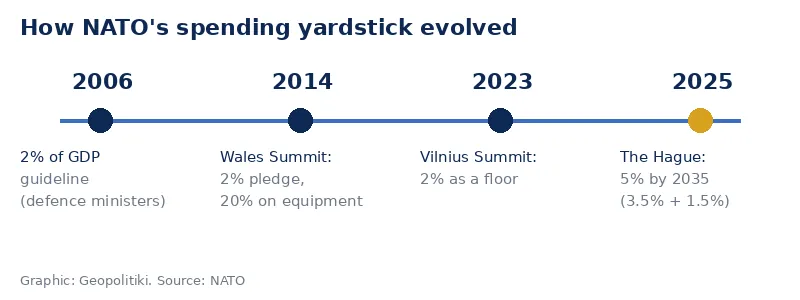
According to NATO’s explainer on defence investment, the 2% of GDP guideline was first agreed by defence ministers in 2006. At the 2014 Wales Summit, in response to Russia’s annexation of Crimea, leaders committed to the 2% figure and agreed that at least 20% of defence expenditure should go to major equipment, including related research and development. At the 2023 Vilnius Summit they agreed an enduring commitment to invest “at least 2%” of GDP, with at least 20% on major equipment, and noted that spending beyond 2% would often be needed.
What counts as NATO defence spending?
NATO defines defence expenditure as payments by a national government, excluding regional and local authorities, to meet the needs of its own armed forces, those of other Allies or those of the Alliance as a whole. Military pensions, stockpiles of war reserves, research and development, operations appropriated under the defence budget and the military component of mixed civilian-military activities are included. War damage payments and civil defence spending are excluded.
Coast guards and similar forces count only in proportion to the part that is trained and equipped as a military force and can realistically deploy outside national territory. NATO uses US dollars as the common currency, with each Ally converted at the average annual IMF rate.
This is why NATO cautions that the figures in its reports “may considerably diverge” from those quoted by national authorities or given in national budgets.
For a general introduction to the Alliance that sets the pledge in context, NATO’s own channel offers an explainer.
How far have Allies got?
NATO’s 2026 defence investment report, with a cut-off date of 3 July 2026, treats figures for 2025 and 2026 as estimates. Its executive summary says European Allies and Canada raised core defence expenditure by more than 19% in 2025 compared with 2024, over USD 90 billion in constant 2021 prices. For 2026, it says 5 Allies are already expected to meet the 3.5% guideline for core defence requirements, 17 are predicted to meet the 1.5% guideline for wider investments, and 5 are projected to meet the overall 5% guideline.
The report’s Table 3 shows the aggregate share of GDP for NATO Europe and Canada rising from 1.40% in 2014 to 2.31% in 2025 and 2.53% in 2026 (estimates for the last two). The United States stood at 3.71% in 2014 and is shown at 3.17% for both 2025 and 2026.
Where does Greece stand?
Greece appears in the same table as one of the few Allies that were already above the 2% line a decade ago. In 2014, only the United States (3.71%), Greece (2.24%) and the United Kingdom (2.13%) were above it. Greece’s share stayed above 2% in every year from 2014 to the 2026 estimate, and the table shows 2.79% for 2025 and 3.65% for 2026.
Read against the Hague formula, the 2026 estimate of 3.65% is above the 3.5% line for core defence. The figure is an estimate and the 5% pledge also counts up to 1.5% of wider security spending, which the core table does not capture. For the equipment side of Greece’s spending, see our explainer on Greece’s F-35s: what has been signed, when they arrive, what is missing on weapons and what changes for the Hellenic Air Force.
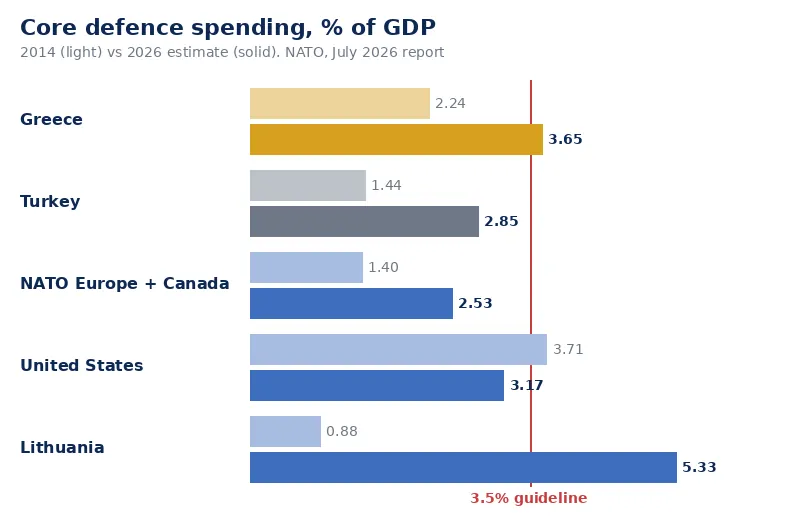
The same table puts Turkey, which like Greece joined the Alliance in 1952 according to NATO’s list of member countries, at 1.44% in 2014, 2.33% in 2025 and 2.85% in 2026. In each of those three years Greece’s estimated share is higher. Lithuania, at 5.33% for 2026, is the highest of the Allies shown in this comparison.
What happens next?
According to the Hague text, Allies must keep submitting annual plans, and the balance between the 3.5% and 1.5% parts will be reviewed in 2029 in light of the strategic environment and updated Capability Targets. For context on how NATO’s collective-defence guarantee works, see NATO Article 5 explained: what it covers and why Greece joined, and for the latest statements on spending see NATO’s Rutte in Estonia: defence spending above 5% of GDP and a new €10 million for PURL.
Sources: NATO, Hague Summit Declaration, 25 June 2025; NATO, Defence investment and NATO’s 5% commitment; NATO, Defence Investment of NATO Countries (2014-2026); NATO’s published text of the North Atlantic Treaty and list of member countries.