Greece
New Turkish provocation: DEHUKAM director questions sovereignty over “about 500” Aegean islands
Mustafa Baskara, director of Ankara University's DEHUKAM, claims Greece has not been explicitly granted sovereignty over “about 500” Aegean islands and may “lose” it over the demilitarised ones. Athens rejects such claims as legally baseless.

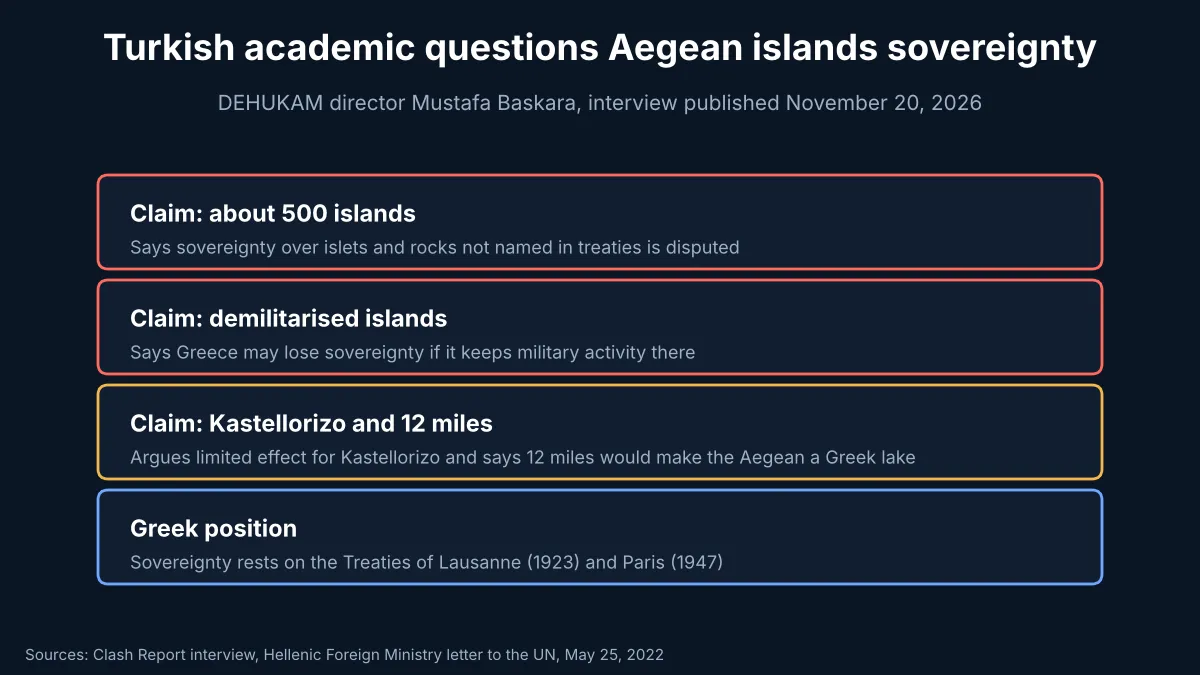
Mustafa Başkara, director of the National Center for Sea Law Research (DEHUKAM) of Ankara University, spoke of “about 500” Aegean islands, islets and rocks whose sovereignty, he argues, has not been explicitly granted to Greece. In an interview with Clash Report, published on Friday, November 20, Başkara repeated Turkey’s long-standing claims on the militarised islands, Kastellorizo and the 12 nautical miles, and asserted that Greece may “lose sovereignty” over Aegean islands.
DEHUKAM is not an ordinary university centre. On May 12, 2026 it hosted the press conference at which the Turkish bill on maritime jurisdiction zones was presented, attended by Çağrı Erhan, deputy chairman of the Security and Foreign Policy Council of the Turkish Presidency. At the same event Başkara presented Turkey’s maritime spatial planning map, which sets out the claims of the “Blue Homeland” (Mavi Vatan) doctrine.
“May lose sovereignty”
His main argument concerns demilitarisation. He claimed that if Greece continues military activity on islands with a demilitarised status, it may lose sovereignty over them for breaching the treaties. In the clip posted by Clash Report he also claimed that only Greece applies 10 nautical miles of airspace while its territorial waters are 6 nautical miles. In the section of the interview titled “500 disputed islands and 10-mile airspace”, he raised a sovereignty question over islands, islets and rocks that, he says, are not named in international treaties, and predicted that new issues will arise in the Aegean.
On Kastellorizo, which he calls by its Turkish name Meis, Başkara argued that Greece claims full effect for its EEZ and continental shelf, but accepted limited effect in its 2020 agreement with Egypt. In his view this shows Athens abandoning a “maximalist” approach when it negotiates with other states. He added that no country can claim a sea area 4,000 times larger than an island’s actual size, and claimed that extending territorial waters to 12 nautical miles would turn the Aegean into a “Greek lake”.
In the interview the Turkish academic also called the Republic of Cyprus’s delimitation agreements with Israel of 2010 and 2021 “invalid”, arguing that Turkish Cypriots must take part in every international agreement of Nicosia. He called Israel’s involvement “unacceptable”.
The Greek position
Greece’s sovereignty over the Aegean islands derives from the 1923 Treaty of Lausanne and the 1947 Paris Peace Treaty. In a letter of May 25, 2022 to the UN Secretary-General, Athens rejected Turkish arguments about the demilitarisation of the Aegean islands as “legally, historically and factually baseless”. Foreign Minister George Gerapetritis has described the Turkish notion of “grey zones” as “completely groundless”.