Greece
Retired Turkish admiral asks for a Turkish role in the Athens FIR as Turkish media seize on Gerapetritis’ 12-mile remarks
Retired Turkish rear admiral Yanki Bagcioglu wants the Athens FIR limits reviewed at ICAO and Turkey to take over responsibility in some areas, while Turkish media highlight Greek Foreign Minister Gerapetritis' remarks on extending territorial waters to 12 nautical miles.

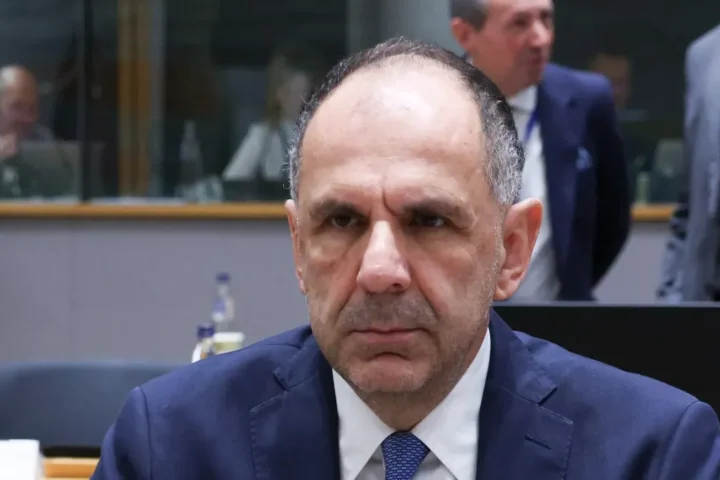
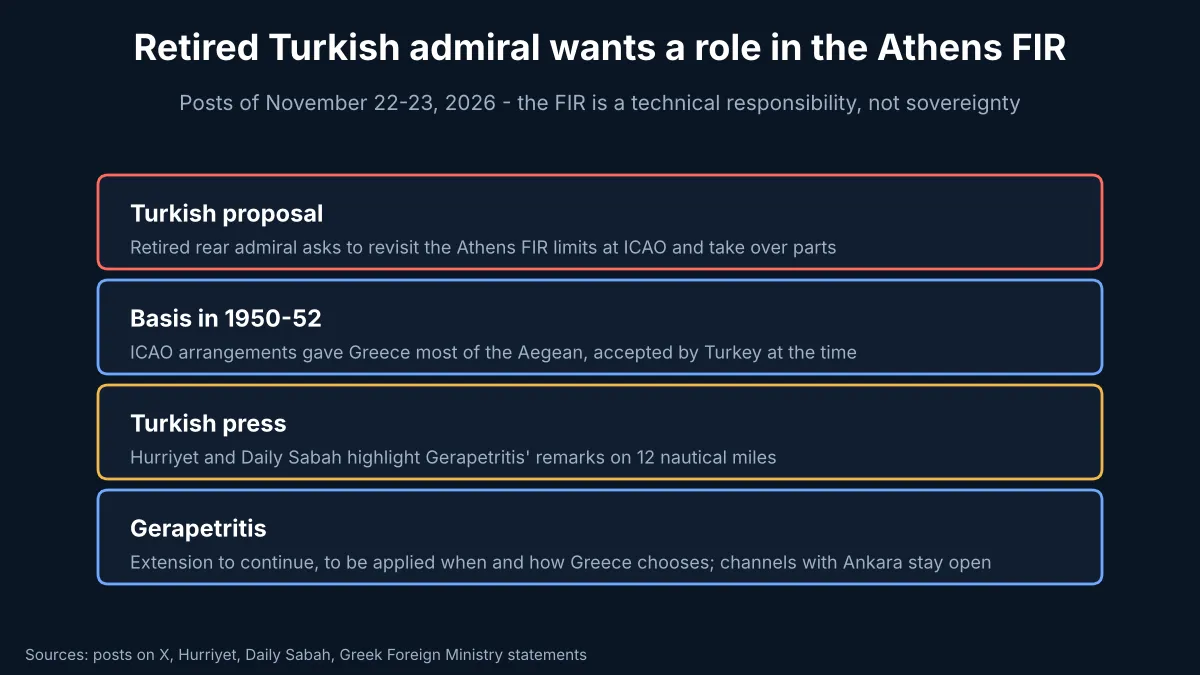
Retired Turkish Navy rear admiral Yankı Bağcıoğlu, a member of the party council of the opposition YENİ Parti, is asking for the limits of the Athens FIR in the Aegean to be re-examined at the International Civil Aviation Organization (ICAO), and for Turkey to take over responsibility in some areas. He made the proposal in a post on X on the morning of Sunday, November 22, and repeated it on Monday, November 23, adding search and rescue. At the same time, Turkish media highlighted Foreign Minister George Gerapetritis’ statement on extending territorial waters to 12 nautical miles.
Bağcıoğlu lists technical problems in the Greek air traffic control system: systems from the 1990s, delays in renewing 15 radars and shortcomings in aircraft identification infrastructure. He claims the European Commission decided on November 19 to refer Greece to the EU Court of Justice over aircraft identification technology, and recalls the communications outage in the Athens FIR on January 4, 2026, which lasted about eight hours. He also cites a shortage of 23 air traffic controllers in 2025, based on EUROCONTROL data.
The retired Turkish officer acknowledges that responsibility for most of the Aegean was given to Greece by ICAO arrangements of 1950, finalised in 1952, which Turkey also accepted. He argues that the FIR is a technical duty and not sovereignty, and that Turkey’s foreign ministry has said in the past that responsibility could pass to another service if Greece does not meet its obligations. In his new Monday post he asks Ankara to approach the competent international organisations so that it takes over part of the FIR and search-and-rescue (SAR) responsibilities, citing flight safety.
Turkish press and the 12 nautical miles
The Turkish daily Hürriyet reported on Sunday that a “remarkable statement” had come from Athens on extending territorial waters to 12 nautical miles, which Turkey regards as a casus belli, a pretext for war that Ankara has no legal ground to claim. In a recent interview, Mr Gerapetritis said the extension process will continue and will be applied whenever and however the Greek state chooses. He added that channels with Ankara remain open, with no retreat from sovereign rights. He also said a Turkish or Libyan attempt to obstruct the surveys of Chevron and HELLENiQ ENERGY south of Crete cannot be ruled out.
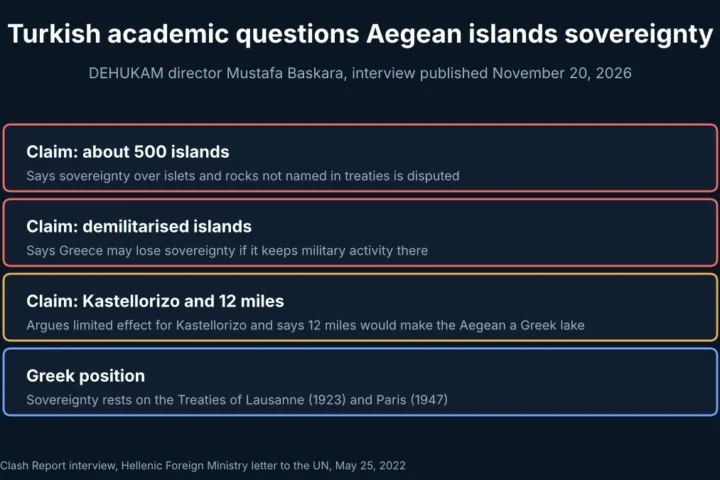
Daily Sabah presented the statement under the headline that Greece “insists on keeping alive” the 12-mile dispute. It also reports that the Greek minister is following Turkish preparations for a “Blue Homeland” (Mavi Vatan) law and has informed the country’s allies. The bill, which aims to give legal form to Turkey’s maritime doctrine in the Black Sea, the Sea of Marmara, the Aegean and the Mediterranean, was presented publicly on May 12 at an event of the National Center for Sea Law Research (DEHUKAM) of Ankara University. There, Çağrı Erhan, a member of the Security and Foreign Policy Council of the Turkish Presidency, said the text “is not directed against any country”.
Daily Sabah repeats the Turkish position that the 12 miles do not apply in the semi-enclosed Aegean. It also refers to the French ship working on the GSI cable, for which Mr Gerapetritis told parliament that the French note verbale has no legal force. The Turkish newspaper claims Ankara “allowed” the work after a short delay.