Greece
On this day, November 25, 1942: the blowing up of the Gorgopotamos bridge, the night ELAS and EDES fought together
About 150 men, ELAS and EDES guerrillas and British SOE saboteurs, destroyed two spans of the railway bridge that carried supplies to Rommel's forces. It was the only time the two resistance groups fought side by side.

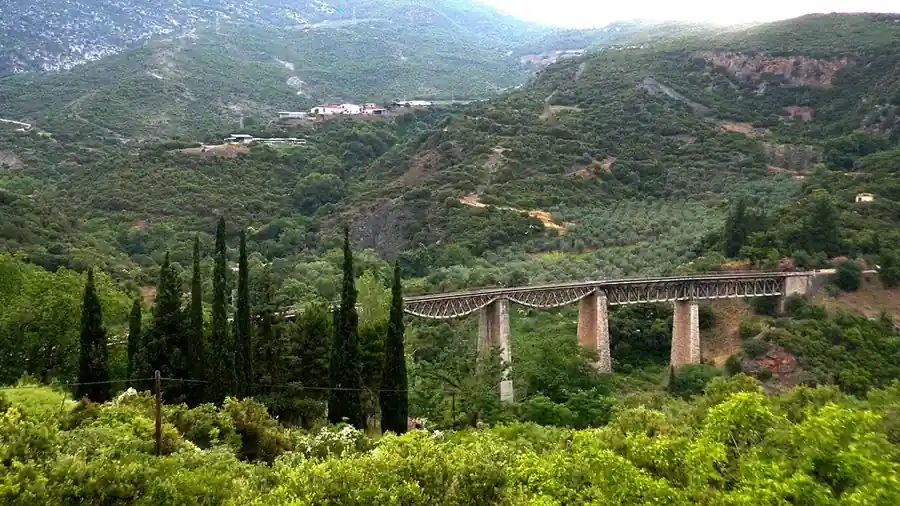
On the night of November 25 to 26, 1942, the railway bridge of Gorgopotamos, southwest of Lamia, was blown up and two of its spans collapsed. The operation was carried out by about 150 men: ELAS guerrillas under Aris Velouchiotis, EDES guerrillas under Napoleon Zervas, and a small team of saboteurs of the British SOE. The bridge linked Central Greece with Thessaly on the Athens–Thessaloniki line, along which Occupation troops and supplies passed. For that reason the Hellenic Army General Staff, in an anniversary post, calls it one of the most emblematic examples of resistance to the Occupation, one that proved the conquerors were not invincible. It was the only time ELAS and EDES fought together on the same battlefield.
The target: the line that fed Rommel
The operation, code-named Harling, was planned at the end of the summer of 1942 by Middle East Headquarters to limit the flow of supplies through Greece to the German forces of Field Marshal Erwin Rommel in North Africa. Three bridges were considered, at Gorgopotamos, Asopos and Papadia in the Bralos area. Destroying the Asopos bridge was preferable, because its repair would take longer, but the final choice was left to the mission’s commander.
The commander was Lieutenant Colonel of the Engineers Eddie Myers, with Major Chris Woodhouse as his deputy. The team, twelve men of the British and Commonwealth forces, among them two New Zealanders, together with the Greek Second Lieutenant Themis Marinos, was split into three groups, each with a leader, an interpreter, a saboteur and a radio operator. On September 30, 1942 the first two groups parachuted near Giona, while the third, which did not spot the signal fires, jumped near Karpenisi, where there was a strong Italian garrison. One of the men landed inside the town and was hidden by residents, and the group escaped to the mountains, where it met Velouchiotis’s guerrillas.
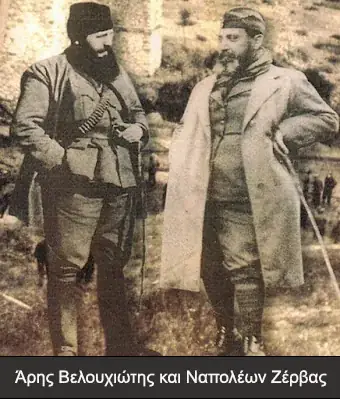
With the help of a local guide, Myers surveyed the three targets and chose Gorgopotamos. Its garrison, about 80 to 100 Italians according to various accounts, could be neutralized, and the terrain offered access, cover and an escape route. On November 2 Woodhouse set out for the mountains of Valtos and on November 14 returned with Zervas and 45 of his men. Zervas backed the operation from the start, while Velouchiotis was initially reluctant, as the EAM leadership in Athens still gave priority to the struggle in the cities. In the end he decided on his own initiative to take part.
The night of the attack
The Hellenic Army General Staff gives the force’s composition as 95 men of EDES, 50 of ELAS and 9 of the British mission, while the more widespread version speaks of 86 from ELAS, 52 from EDES and the twelve-man SOE team. In any case the total was about 150 men. The plan called for an attack at 23:00 on November 25. Two groups of eight guerrillas would cut the railway and telephone lines in both directions and cover the approaches, the main force of about 100 guerrillas would neutralize the garrison at the two ends of the bridge, and the saboteurs, divided into three groups, would wait in the riverbed.
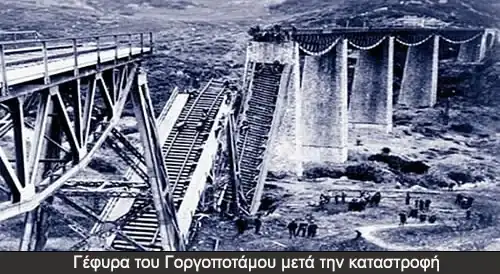
The fight with the garrison lasted much longer than estimated, and Myers decided to send the saboteurs to the bridge while the battle continued. There a new problem arose, because the girders had a different shape from what they expected, and the saboteurs had to cut up the plastic explosive charges and reshape them on the spot. The first explosion came at 01:30 on November 26, caused serious damage to the central pier and brought down two spans of the bridge. The saboteurs placed a new charge on the second pier and on the remaining span. The second charge exploded at 02:21. Meanwhile the covering parties stopped a train with Italian reinforcements heading for the bridge, and by 04:30 the whole force had withdrawn to the assembly point with only four wounded.
What Gorgopotamos achieved
Militarily, the operation came too late for its original purpose. The Battle of El Alamein had already decided the fate of Rommel’s forces and cutting their supplies through Greece no longer had the same value, while the bridge was repaired in 19 days by a railway engineer battalion of the Italian army. But Gorgopotamos was SOE’s largest sabotage operation up to that point and one of the first big ones in occupied Europe. It showed the Allies what an organized guerrilla force could offer in the Greek mountains and lifted morale in occupied Greece.
Contrary to the original plan, Myers’s mission was not withdrawn. It stayed in Greece and became the core of the British Military Mission, which from then on coordinated cooperation with the Resistance. On June 21, 1943 the Asopos bridge was also blown up, this time by a small team of SOE saboteurs, British and New Zealanders, without the participation of guerrillas. Shortly after Gorgopotamos the first clashes between ELAS and EDES took place, a prelude to the open conflict of 1943 and the Civil War that followed.
In 1982, under Law 1285, the anniversary of Gorgopotamos was established as a day of nationwide celebration of the National Resistance.
Frequently asked questions
When was the Gorgopotamos bridge blown up? On the night of November 25 to 26, 1942. The attack on the garrison began at 23:00 on November 25 and the two explosions took place at 01:30 and 02:21 on November 26.
Who took part in the blowing up of the Gorgopotamos bridge? ELAS guerrillas under Aris Velouchiotis, EDES guerrillas under Napoleon Zervas and the British SOE mission Harling under Eddie Myers and Chris Woodhouse, about 150 men in all.
Why was the Gorgopotamos bridge blown up? To cut the Athens–Thessaloniki railway line, along which Occupation troops and supplies passed, including supplies to Rommel’s forces in North Africa.
When was the celebration of the National Resistance at Gorgopotamos established? In 1982, under Law 1285, the anniversary of the bridge’s destruction was established as a day of nationwide celebration of the National Resistance.